Showing posts with label Pays Nantais. Show all posts
Thursday, 12 September 2019
2019 Loire vintage – picking underway in Muscadet
Picker @ the Lieubeau vineyards
source of their Confluence cuvée
Melon de Bourgogne 2019
The official Ban des Vendanges for Muscadet was on Thursday 5th September. There were a few that started the day before but more general picking appears to have started during this week. Otherwise picking has been gradually getting underway with favourable weather conditions, even a little rain during Monday 8 to 12 mm. This case the rain should have been helpful as it has been very during here, although not as dry I think as in the Cher Valley.
As last year the grapes are very healthy. The crop, however, is substantially down on a normal year with an estimate of 250,000 hls, around half of normal. This is due primarily to the April frosts but the drought has further lowered the crop – small berries with not much juice inside.
It is likely that the pace of picking will pick up as producers will want to avoid acidity levels dropping. At the moment the little 2019 juice that I have tasted appears well balanced.
More reports to follow.
Monday, 17 September 2018
20 ans de Gorges
20th anniversary of the foundation of the Association des Vignerons du Cru Gorgeois
Six celebrating Gorges producers in a vineyard
The production criteria for Cru Gorges
2013 Gorges La Vigneaux, Fred Laffer with a lump of gabbro
- Sèvre Nantaise in the background
After much work the INAO recognised in 2011 Gorges as one of the first three Muscadet Cru Communaux, along with Clisson and Le Pallet. The criteria for Cru Gorges include: vines planted on the type of soil called gabbro, green harvest to aim for a yield of 40 hl/ha, the wine to spend 24 months on its lees and once in bottle a jury of experts have to agree that the wine is up to scratch.
Interestingly compulsory hand picking is not in the criteria. Perhaps this will be the next step as an insistence on hand picking would really mark out this top tier of Muscadet as something qualitatively different from the rest. Furthermore given the tiny quantities of Cru Communaux currently being produced obligatory hand picking ought to be easy enough to arrange.
We tasted some 15-20 different Cru Gorges from a number of different vintages. Overall they underlined that these Cru Communaux are indeed a step up and that, although slightly more expensive they still offer great value for money – these are very fine wines.

2000 Gorges, Christophe and Brigitte Boucher
served in magnum for lunchtime apéro
when it was magnificent.
Unfortunately they tried pairing it with
the dessert which in my view didn't work at all.
served in magnum for lunchtime apéro
when it was magnificent.
Unfortunately they tried pairing it with
the dessert which in my view didn't work at all.
Our fine lunch was @ The Restaurant L'Atlantide

Our day started with a visit to the recently restored
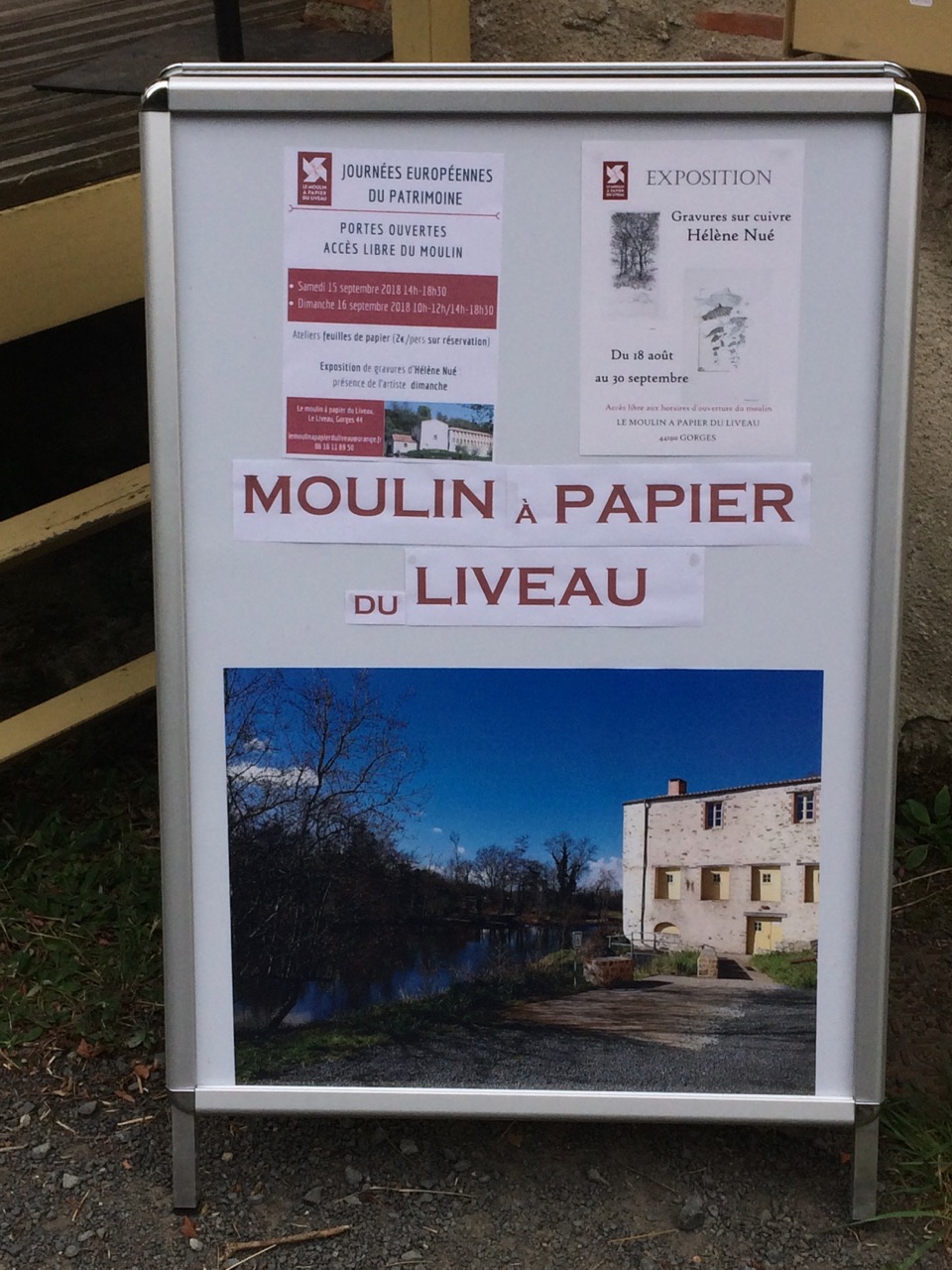
Moulin à Papier at Liveau, a hamlet of Gorges.

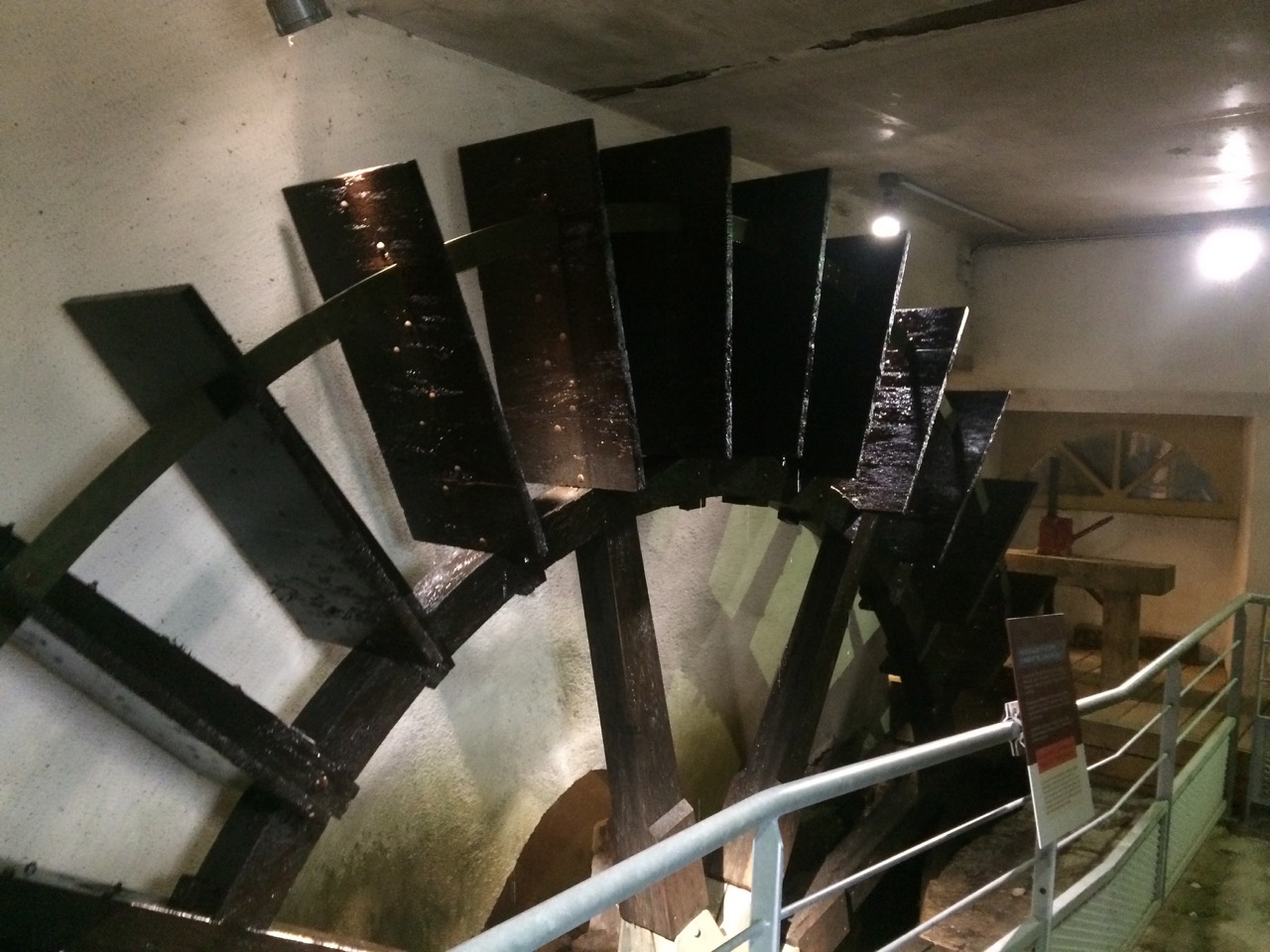
Part of the water wheel in the Moulin

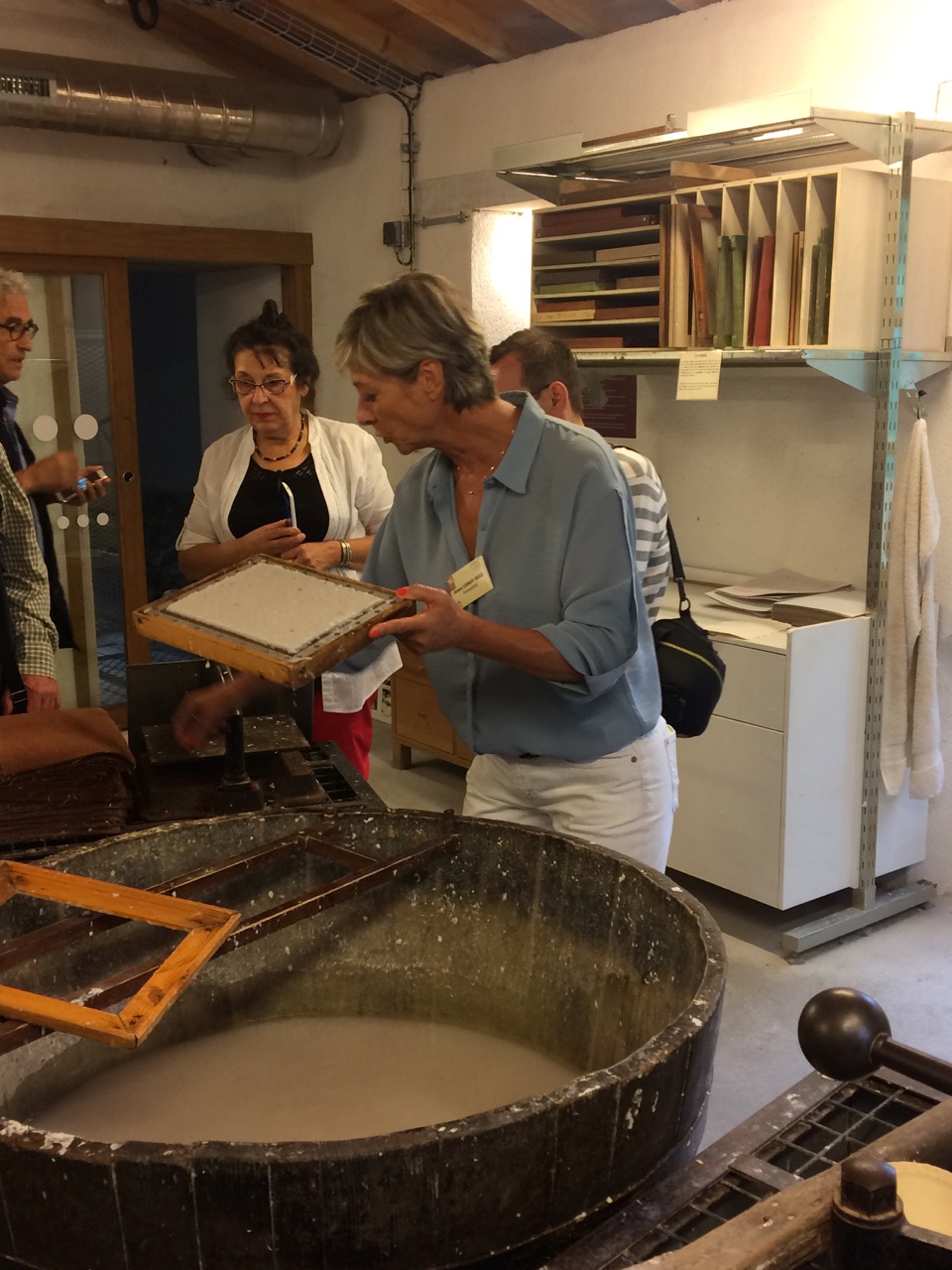
The process of making paper
••••
Tuesday, 1 May 2018
Tuesday and Wednesday nights – squeaky bum time in Eastern Touraine
Météo France forecast for Cheverny, whose low lying
vineyards are frost prone
Cheverny - 40% possibility of frost
Tuesday/Wednesday night
Vignerons in parts of eastern Touraine look to be facing a sleepless couple of nights on Tuesday/Wednesday and Wednesday/Thursday as temperatures drop to close on freezing or just below.
Elsewhere in Loire the forecast is for a little above freezing – fine as long as the forecast is accurate. Tonight's forecast for Vallet shows a low of 2˚C and 0% chance of frost. 2˚C is getting a bit close for comfort – so fingers crossed!
Labels:
Cheverny,
Frost,
gel,
Météo France,
Pays Nantais,
Vallet
Saturday, 16 September 2017
2017 Muscadet – report on the vintage
Picking @Domaines Joseph Landron
We spent Monday and Tuesday of this week in the Pays Nantais looking at the 2017 vintage. It is well known that the Pays Nantais was badly frosted in late April. The effects of the frost are, however, very variable. Some lucky producers like Jéremie Huchet in Château-Thebaud only lost some 10%-15% of his crop. He did, however, lose 40% from frost last year. At the other end Fred Niger has lost 98% of his 2017 crop – making only three hl/ha.
Much of the crop has now been picked – Jéremie Huchet finished on Friday 8th September having started on 28th August. Jo Landon was finishing either on Tuesday or Wednesday. By Monday (11th) Lieubeau were three quarters through their harvest – down 40% due to frost – having started on 31st August.
There should be some very good Muscadet made this year, especially from vineyards not seriously frosted and from fruit picked early on as there was heavy rain on Sunday 3rd September. Following that downpour there is some rot appearing.
In vineyards heavily frosted the quality is more difficult as there is considerable variation in ripeness between the first generation grapes that resisted the frost and the second generation that came through after the frost.
Thursday, 31 August 2017
Loire 2017 – some past harvest photos in anticipation
Man in sombrero – picking in the Pays Nantais
Picking Melon de Bourgogne – 2010
Dealing with Sauvignon Blanc @Vincent Grall's
garage winery in Sancerre
Loïc Cailbourdin (Pouilly-Fumé) dealing with the press
Sorting table @ Bernard Baudry, Chinon
Tuesday, 9 May 2017
The Pays Nantais' take on the April 2017 frosts
Following on from my recent posts on the effects of the series of the recent April frosts, here are extensive extracts from today's newsletter from the Vins de Nantes:
'Edito
Dans
notre manifeste, en mars dernier, nous proclamions « Nous encaissons
les tempêtes, nous ne lâchons pas la barre :
les vignerons tiennent à leurs
vins, il se battent jusqu’au bout ». Mais la nature nous met encore une
fois à l’épreuve :
elle peut tout nous donner et
tout nous reprendre. A l’heure actuelle, les dégâts du gel recensés dans
notre vignoble
sont sévères, les secteurs du
cœur Sèvre et Maine ont été particulièrement très impactés.
A titre individuel, on est
parfois tenté de rendre les armes, tellement impuissants face au
phénomène.
Ce gel historique, qui touche
tout le vignoble français, interroge, désempare ou indigne : quels
outils techniques
pour nous protéger ? Quel régime
assurantiel efficace ? Quelle fréquence des aléas climatiques ?
Exceptionnels ou chroniques ?
Avec nos partenaires de la filière et les pouvoirs publics, du local au
national,
nous mettrons tout en œuvre pour
sauver notre vignoble, maintenir l’équilibre du marché, accompagner les
exploitations,
éviter la déprise viticole
massive et imaginer des modèles innovants pour mieux faire face demain à
ces crises climatiques.
Nous sommes conscients de la
gravité de la situation et adressons à tous les vignerons de Nantes un
message de profonde
et sincère solidarité avec une
détermination indéfectible : celle de poursuivre nos réformes pour tenir
le cap !
Christian Gauthier
Olivier Martin
Joël Forgeau
Fédération des Vins de Nantes'
Christian Gauthier
Olivier Martin
Joël Forgeau
Fédération des Vins de Nantes'
De
fortes gelées deux années de suite, le scénario paraissait improbable.
Pourtant une vague de froid s’est bien abattue sur le vignoble de Nantes
à la fin du mois d’avril causant d’importants dégâts.
Au
matin du 26 avril, certains étaient déjà dans les vignes à estimer les
dégâts. D’autres ont préféré attendre, patienter encore quelques jours
pour faire le tour des parcelles. Tous font pourtant le même constat :
les gelées des 26, 27 et 28 avril, cumulées par endroits à celles du 20
avril, ont détruit une partie de la récolte à venir. Pour mesurer
précisément l’ampleur des dommages, la Fédération des Vins de Nantes a
lancé une enquête commune par commune. Les résultats reçus à ce jour
font état de 50 % de pertes et d’une certaine disparité entre les
secteurs. « Le cœur Sèvre et Maine a
été très fortement touché. Clisson, Vallet, Le Landreau, La
Chapelle-Heulin sont très impactées. Certaines parcelles sont détruites à
100 %. D’autres zones ont été un peu plus épargnées comme La
Haye-Fouassière où 20 % des vignes sont touchées. Le Sud du Lac de
Grandlieu et les Coteaux de Loire ont également enregistré un peu moins
dégâts » indique Olivier Martin, président délégué de la Fédération des Vins de Nantes.
A Bouaye, le Domaine du Haut Bourg fait état de 30 % de pertes. « Ce ne sont pas les mêmes parcelles que l’an dernier qui ont gelé. En 2016 nous avions eu beaucoup de dégâts sur des parcelles gélives, cette année c’est un peu différent. Au final on ne s’en sort pas trop mal » témoigne Nicolas Choblet. A Gorges, Damien Rineau estime que « 15 hectares sur 17 sont touchés à 100 %. C’est mort pour l’instant mais je garde espoir. On est vacciné maintenant. Finalement, des gelées deux années de suite ce n’est pas si surprenant. On avait déjà gelé en 90 par exemple. » La gelée de 1991 reste en effet dans toutes les mémoires. Celle de 2017 y ressemble fortement.
Éoliennes, hélicos et système-D
Annoncée et attendue, cette vague de froid a toutefois surpris par sa précocité. « De 3 à 6 heures du matin nous avons eu des gelées noires » explique Nadège Brochard-Mémain, conseillère viticole à la Chambre d’agriculture. « Il y a ensuite eu des gelées blanches. Il y eu aussi un peu de grêle au Landreau le jeudi ce qui a refroidi les sols. » Plus sévère qu’en 2016, ce coup de froid venu de l’Est a touché des secteurs jusque là plutôt épargnés. Les conseillers de la Chambre ont ainsi noté « des impacts entre Corcoué-sur-Logne et Rocheservière, un secteur qui ne prend jamais le gel. »
Pour se prémunir du gel et limiter la casse, plusieurs solutions ont été
déployées par les vignerons. Avec plus ou moins de réussite. Au
Landreau et à Saint-Philbert de Bouaine, des hélicoptères ont survolé
les vignes. Mais le mal était déjà fait, les appareils ne pouvant
décoller que 30 minutes après le lever du soleil. Les éoliennes, les
canons à air pulsé ou encore l’aspersion ont permis de sauver des
bourgeons. Des feux de paille ont également été allumés de manière à
créer un écran de fumée protecteur. Quant aux produits anti-gel, Nadège
Brochard-Mémain estime « ne pas
avoir assez de recul sur leurs résultats. Certains en ont utilisé mais
n’ayant pas installé de témoins, on ne peut pas savoir s’ils ont
fonctionné ou non. » Beaucoup en tout cas s’interrogent sur la
nécessité de s’équiper et avec quels appareils. Reste la question du
coût et des aides possibles. Carmen Suteau, élue à la Chambre
d’agriculture, milite par exemple pour une prise en charge dans le cadre
du PCAE, le plan de compétitivité et d’adaptation des exploitations
agricoles.
Situation exceptionnelle, mesures exceptionnelles ?
Pour accompagner au mieux les vignerons, la filière viticole se mobilise. Le Conseil Stratégique de la Fédération des Vins de Nantes se réunira le 11 mai pour définir une stratégie de crise. « L’ensemble du Val de Loire étant concerné, la CVVL, la Confédération des Vignerons du Val de Loire, va s’emparer du dossier. Elle fera remonter les demandes auprès des autorités » annonce Olivier Martin. Une délégation composée de représentants de la Fédération, de la Chambre, du SVIN et de la FNSEA a également rencontré la Direction Départementale des Territoires le 4 mai. Une réunion sur le terrain pour dresser un état des lieux précis de la situation. Qu’attendre désormais des autorités ? « Le vignoble a besoin de bien plus qu’un report de charges sociales ou d’un allégement de la taxe sur le foncier non bâti » estime Olivier Martin. « A situation exceptionnelle nous devons trouver des aides exceptionnelles. L’ensemble des élus de la Fédération apporte un soutien sans faille à tous les vignerons touchés par le gel. Ils peuvent compter sur notre mobilisation pour porter leurs préoccupations et leurs demandes auprès des pouvoirs publics. »
« Rester prudent »
A l’heure du bilan des dégâts il est aussi légitime de s’interroger sur l’impact de ce gel sur les marchés. Pour Bernard Jacob, directeur d’Ackerman et président de l’Union des Maisons et des Marques des Vins de Loire (UMVL), « il faut rester prudent. Il ne faut pas alarmer les marchés inutilement. On ne sait pas encore ce que l’on va récolter. En 2016, les estimations étaient alarmistes et la récolte a finalement été supérieure. » Quant aux cours, Bernard Jacob estime que « cela va contribuer à un maintien voire à une évolution des prix tout en restant mesurés pour conserver les marchés. »
Friday, 7 April 2017
Off on an adventure: Day 26 – Jérémie Huchet
As I suspect there will be limited time to post on Jim's Loire
while we are away – there are posts prepared in advance that will feature pics of Loire
producers and may be from elsewhere plus some recently enjoyed bottles.
Wednesday, 22 February 2017
Back in London and ready for Muscadet crus....
Back in London late this afternoon having spent a good month or so in France mainly in the Loire. Back for a big tasting of Muscadet Crus at the offices of Decanter all tomorrow and also on Friday morning.
We will be tasting not just the three officially recognised Muscadet Crus – Clisson, Gorges and le Pallet but also the four more: Château-Thebaud Goulaine, Monnières-Saint-Fiacre and Mouzillon-Tillière as well as other Muscadets made in the spirit of the cru communaux – long aging on the lees.
I understand that the producers in the Pays Nantais have sent in a very generous number of samples including some old vintages. Naturally the tasting will be strictly blind and I am looking forward to it with keen anticipation.
Sunday, 22 January 2017
Champtoceaux: towards a new Muscadet Cru
Press release about the proposed new Muscadet cru in the Muscadet Coteaux du Loire appellation – Champtoceaux:
L’AOC Muscadet revendique sa mutation et édi e
sa gamme. « La vision monolithique de l’appellation
a eu pour conséquence d’enfermer nos vins dans des
instants de consommation stéréotypés. L’objectif n’est
pas de renier l’ADN du Muscadet avec sa mention « sur
lie » mais de nous retrouver autour de notre socle, la
singularité de notre cépage, le melon de Bourgogne et
la fraicheur océanique et ligérienne de nos pro ls. »
reconnait Thierry MARTIN, Président des crus du
Muscadet qui poursuit : « Maintenant, nous devons
raconter notre histoire et nos sols et mettre en lumière
notre savoir-faire et c’est ici tout l’enjeu des crus comme
à Champtoceaux. » Autour d’une vision premium
de l’AOC, l’objectif est bien de coiffer la pyramide
en valorisant la mosaïque insoupçonnée des sous-
sols, le potentiel d’évolution du melon B et surtout le
talent des vignerons, artisans de cuvées de style et de
grande classe.
Le cru muscadet Coteaux de la Loire
Champtoceaux s’inscrit dans cette
démarche. Les expériences de leurs
collègues du Sèvre et Maine ont stimulé
une poignée de vignerons, regroupés sur
les magnifiques coteaux de la Loire, de
part et d’autre de la ville d’Ancenis. Ainsi
en 2014, l’association « Roches de Loire »
constituée de neuf exploitations, est
crée afin d’encadrer la reconnaissance
d’une communale Muscadet en Coteaux
de la Loire.
Appuyé par uningénieur de la Fédération des Vins de Nantes et un animateur de la Chambre d’agriculture, le groupe de vignerons dynamiques et décomplexés, sonde ses parcelles, goûte les vins, travaille son positionnement an d’identier l’aire de délimitation, le profil du vin et le lien au terroir.
Quite widely scattered special sites
identified in Muscadet Coteaux du Loire
Appuyé par uningénieur de la Fédération des Vins de Nantes et un animateur de la Chambre d’agriculture, le groupe de vignerons dynamiques et décomplexés, sonde ses parcelles, goûte les vins, travaille son positionnement an d’identier l’aire de délimitation, le profil du vin et le lien au terroir.
À terme, pour la dizaine de domaines engagés dans
la démarche, les volumes pourraient représenter
600 hl (soit autour de 10% du Muscadet Coteaux de la
Loire), commercialisés en vente directe au caveau, en
CHR et chez les cavistes majoritairement.
« Ces démarches de crus donnent du statut et de la légitimité au vignoble ». Philippe Marchais, vigneron à Thouaré-sur-Loire en proximité immédiate de la métropole nantaise décrypte : « Le cru Champtoceaux est l’occasion de capter des nouvelles clientèles hédonistes et plus urbaines qui souhaitent des vins simples mais authentiques avec un supplément d’âme. »
Ces vins trouvent aussi écho dans la restauration nantaise où l’intérêt suscité par les Vins de Nantes semble de toute évidence en pleine croissance avec des références qui colonisent sans complexe les cartes des plus belles tables.
« Ces démarches de crus donnent du statut et de la légitimité au vignoble ». Philippe Marchais, vigneron à Thouaré-sur-Loire en proximité immédiate de la métropole nantaise décrypte : « Le cru Champtoceaux est l’occasion de capter des nouvelles clientèles hédonistes et plus urbaines qui souhaitent des vins simples mais authentiques avec un supplément d’âme. »
Ces vins trouvent aussi écho dans la restauration nantaise où l’intérêt suscité par les Vins de Nantes semble de toute évidence en pleine croissance avec des références qui colonisent sans complexe les cartes des plus belles tables.
Les parcelles situées en aire d’AOC Coteaux de la Loire sont situées de part et d’autre de la
Loire autour d’Ancenis entre le Vignoble de Nantes et l’Anjou. Elles sont le plus souvent proches
de la Loire ou de ses af uents (Divatte, Erdre et Evre) sur des paysages ouverts favorisant la
circulation des masses d’air et optimisant l’ensoleillement.'
Tuesday, 17 January 2017
2009 stunning Muscadet Château-Thébaud from Lieubeau family
2009 Muscadet Sèvre et Maine, Château-Thébaud
Château de l'Aulnaye, Famille Lieubeau
This is another excellent Muscadet from the Lieubeau family. The 2009 is intended as a precursor of the Château-Thebaud which should soon be one of several new crus communaux that await the swish of the French minister's pen.
Ths 2009 spends three years on its lees which gives this Muscadet unusual richness accentuated by 2009 being a hot and rich vintage. The 2009 has lovely opulence and is utterly delicious. Initially we had it as an apéro and then it went beautifully with grilled salmon steaks. Unfortunately the bottle disappeared all too quickly between the two of us!
Tasted blind my guess is that few would pick this opulent and delicious wine as a Muscadet. These longer aged Muscadet's are adding a new expression to the wines of the Pays Nantais. Furthermore they are still a remarkable bargain.
Wednesday, 30 November 2016
Shameless, indulgent nostalgia .........
1986: Wearing a Redmon Cycling Club sweat-shirt
During a slightly overdue tidy-up I came across some photos from the 1980s and 1990s. My apologies for the nostalgic and rather egotistical memories.
1986 Vaucluse: Max Hasender of Schwarzenfeld,
Jim and Paul, Max's eldest son
1986 Cycling in Bavaria
1986 Bavaria: Almost a white shirt – what can he have been thinking of?
1986 Bavaria: Max Hasender, Jim, CRM and Richard Hasender, Max's father
February 1989 Muscadet CRM with a
once serious wine writer visting François Bonnehomme
(above and below)
on first assignment for Decanter
Pays Nantais with Gilbert Bossard
Not sure of the date
Pays Nantais with Jean-Ernest Sauvion
then of Château du Cléray and Maison Sauvion
September 1992: being intronised into
Les Entonneurs Rabelaisiens de Chinon
Glass of Chinoin already empty......
Sunday, 30 October 2016
Harvest Report 2016 – Pays Nantais from Vincent Lieubeau
The 2016 vintage will remain forever in our minds and memories, it is exceptional in more ways than
one.
First, it celebrates the 200th anniversary of Joseph Gregoire Lieubeau's birth. The child, orphaned on 1816, the 10th of May, under the porch of Nantes “Hotel-Dieu”, is the founder of both family and winery.
Distributors, wine shops, sommeliers, partners Chefs... This was our pleasure to welcome you at Stereolux arts hall to celebrate this anniversary at the foot of the “Ile de Nantes Machines” Elephant. Another important event is our sister Marie’s landing as she joined the winery this year in charge of management and direct sales.
The 2016 vintage reminds us how related to nature, in all its complexity, our winemaker’s life is. All at once, an exceptional environment in which we have the chance to live. We are protecting nature, who in return, enables us years after years to express the diversity of terroirs and vintages. Also that is a challenge to adapt and accept the climate up and downs which can seriously complicate the vineyard work. 2016 will likely remain the “superlatives vintage”, scenarized with a devastating spring frost worse than 1991, an historic mildew pressure greater than 1977 and a summer drought dryer than 2003.
Best regards,
First, it celebrates the 200th anniversary of Joseph Gregoire Lieubeau's birth. The child, orphaned on 1816, the 10th of May, under the porch of Nantes “Hotel-Dieu”, is the founder of both family and winery.
Distributors, wine shops, sommeliers, partners Chefs... This was our pleasure to welcome you at Stereolux arts hall to celebrate this anniversary at the foot of the “Ile de Nantes Machines” Elephant. Another important event is our sister Marie’s landing as she joined the winery this year in charge of management and direct sales.
The 2016 vintage reminds us how related to nature, in all its complexity, our winemaker’s life is. All at once, an exceptional environment in which we have the chance to live. We are protecting nature, who in return, enables us years after years to express the diversity of terroirs and vintages. Also that is a challenge to adapt and accept the climate up and downs which can seriously complicate the vineyard work. 2016 will likely remain the “superlatives vintage”, scenarized with a devastating spring frost worse than 1991, an historic mildew pressure greater than 1977 and a summer drought dryer than 2003.
The vineyard year began on a wet and mild winter with no real extended frost episode. Several direct
consequences on spring: a slower than expected budburst, around April 7th, a strong initial mildew
inoculum, preparing an exceptionally high diseases pressure throughout the vintage, and a very rapid
weeds development, requiring enforced soil care (plowing and/or natural grass inter-row cover),
even more speaking about organic farming. In late April, the “Loire winemakers scariest nights”, we
had 4 episodes (April 17, 24, 25 and 28th) of spring white frost with temperatures down to -1/-2 °C.
These destroyed all hope of harvesting on the hillsides banks and significantly affected other plots to
an estimated overall loss of about 20% of the yield.
May and June gave us no rest, with exceptional moisture, punctuated by violent thunderstorms (80mm recorded on May 29th). Despite a fierce fighting, a spectacular mildew development on leaves but also on fruits, causes severe crop losses. This was followed by an unusually dry summer with less than 15mm of cumulative rainfall on July and August (vs. a norm of about 100mm) causing hydric stress and a slight maturation slowdown on the most draining sandy soils. A few showers early September unblocked the situation.
In the end, the moderate temperatures recorded throughout the year led to a slightly late harvest that began on September 19th, a week after 2015. The harvest reached the Fruitière under the sun, with perfect sanitary state and signed again the historic identity of this vintage 2016. The strong September variations in temperature, the summer drought and the very limited yields have achieved alcoholic degrees and aromatic concentration that are historic in Muscadet area: 12.2% on average and over 13% on some very old plots. Paradoxically, dehydration of the berries related to drought and cool night temperatures have also helped maintain concentration by rather high acidity levels (average 4.4 g/l), announcing full bodied but balanced wines with the greatest aging potential. Finally, yields are exceptionally low due to the disastrous spring weather conditions, around 25 hl/hectare on average at the winery.
2016 also achieved our second year of organic farming conversion (under Ecocert certification), an additional challenge on this vintage. On plot selections, the team skill and experience improvement, generalized soil plowing, sexual confusion, regular cares based on natural or mineral preparations (copper, sulfur, orange essential oil), manual harvesting, helped us keep the sanitary state and achieved an historic maturity. At the winery, our Crus are vinified without sulfites before fermentation, with natural yeast to respect the most natural terroir expression. With a little hindsight, and our natural optimism, this vintage 2016 will remain an excellent opportunity to enhance our learnings and improve our vineyard methods in hard climate conditions. From the quality of the grapes and first juice, the outcome is on the rightest track: a maturity and balance that are, like the 2016 weather conditions, exceptional and historic.
We look forward to present you this vintage 2016. Please do not hesitate to come back to us for any kind of further info,
May and June gave us no rest, with exceptional moisture, punctuated by violent thunderstorms (80mm recorded on May 29th). Despite a fierce fighting, a spectacular mildew development on leaves but also on fruits, causes severe crop losses. This was followed by an unusually dry summer with less than 15mm of cumulative rainfall on July and August (vs. a norm of about 100mm) causing hydric stress and a slight maturation slowdown on the most draining sandy soils. A few showers early September unblocked the situation.
In the end, the moderate temperatures recorded throughout the year led to a slightly late harvest that began on September 19th, a week after 2015. The harvest reached the Fruitière under the sun, with perfect sanitary state and signed again the historic identity of this vintage 2016. The strong September variations in temperature, the summer drought and the very limited yields have achieved alcoholic degrees and aromatic concentration that are historic in Muscadet area: 12.2% on average and over 13% on some very old plots. Paradoxically, dehydration of the berries related to drought and cool night temperatures have also helped maintain concentration by rather high acidity levels (average 4.4 g/l), announcing full bodied but balanced wines with the greatest aging potential. Finally, yields are exceptionally low due to the disastrous spring weather conditions, around 25 hl/hectare on average at the winery.
2016 also achieved our second year of organic farming conversion (under Ecocert certification), an additional challenge on this vintage. On plot selections, the team skill and experience improvement, generalized soil plowing, sexual confusion, regular cares based on natural or mineral preparations (copper, sulfur, orange essential oil), manual harvesting, helped us keep the sanitary state and achieved an historic maturity. At the winery, our Crus are vinified without sulfites before fermentation, with natural yeast to respect the most natural terroir expression. With a little hindsight, and our natural optimism, this vintage 2016 will remain an excellent opportunity to enhance our learnings and improve our vineyard methods in hard climate conditions. From the quality of the grapes and first juice, the outcome is on the rightest track: a maturity and balance that are, like the 2016 weather conditions, exceptional and historic.
We look forward to present you this vintage 2016. Please do not hesitate to come back to us for any kind of further info,
Best regards,
Vincent Lieubeau
Tuesday, 23 August 2016
Remembering the 2009 Loire vintage – Le Pays Nantais
Chereau-Carré (Muscadet Sèvre-et-Maine) – offices
Chereau-Carré (Muscadet Sèvre-et-Maine)
Melon de Bourgogne grapes from the 100 year old vines
(above and below)
Bernard Chereau
Bernard with the 2009 juice
Picker
Melon de Bourgogne
The pigeonnier
Domaine Pierre Luneau-Papin
Pierre Luneau with a sample of Muscadet
2009 Muscadet, Domaine Pierre Luneau-Papin
Domaine des Herbauges (Muscadet Côtes de Grandlieu)
Jérôme Choblet and his family
Luc Choblet – Jérôme's dad
Subscribe to:
Posts (Atom)