Awards and citations:


1997: Le Prix du Champagne Lanson Noble Cuvée Award for investigations into Champagne for the Millennium investment scams

2001: Le Prix Champagne Lanson Ivory Award for investdrinks.org

2011: Vindic d'Or MMXI – 'Meilleur blog anti-1855'

2011: Robert M. Parker, Jnr: ‘This blogger...’:

2012: Born Digital Wine Awards: No Pay No Jay – best investigative wine story

2012: International Wine Challenge – Personality of the Year Award


Showing posts with label Quarts de Chaume Grand Cru. Show all posts

Wednesday, 17 October 2018

2018 Loire – brief report from Anjou + making a Grand Cru credible

Chenin - 18 
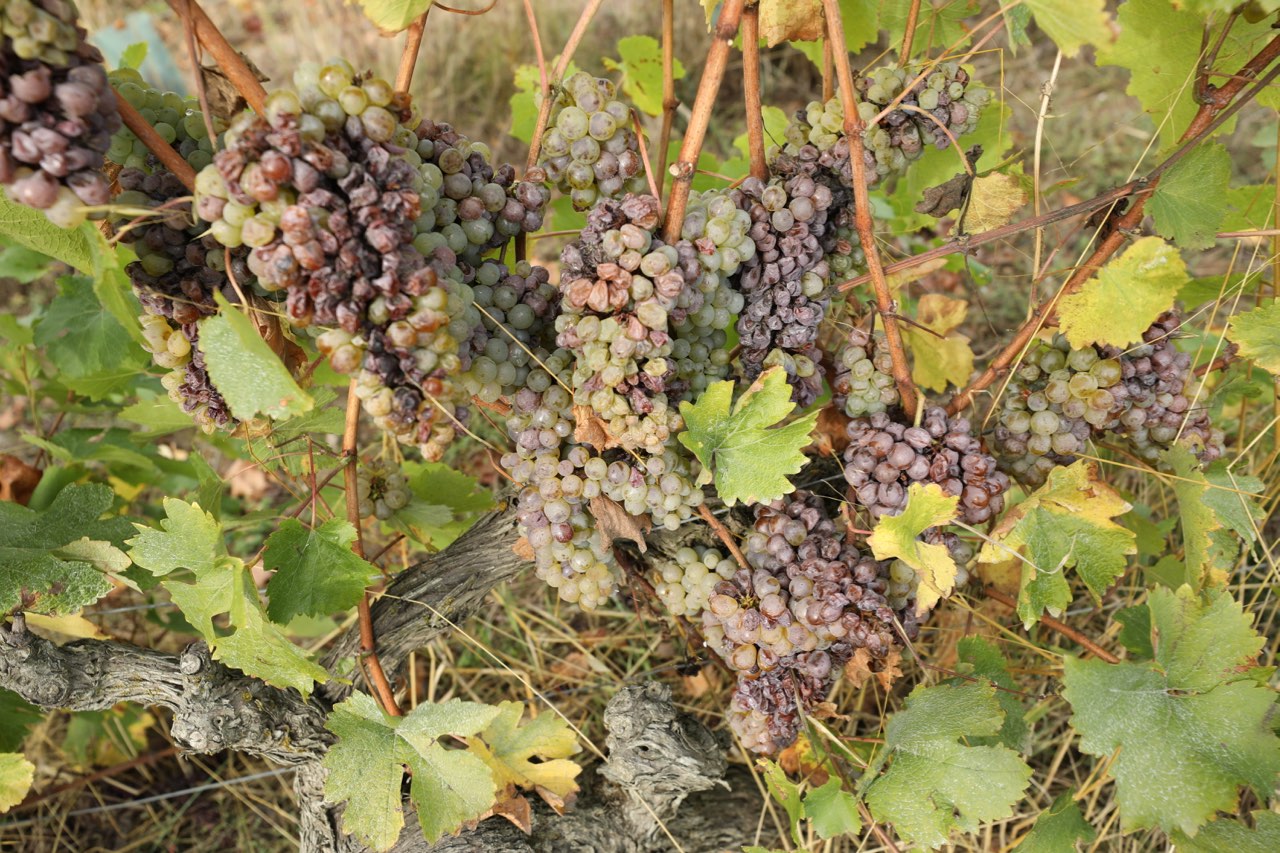
Chenin Blanc destined for a single cuvée of moelleux 
at Domaine de Juchepie
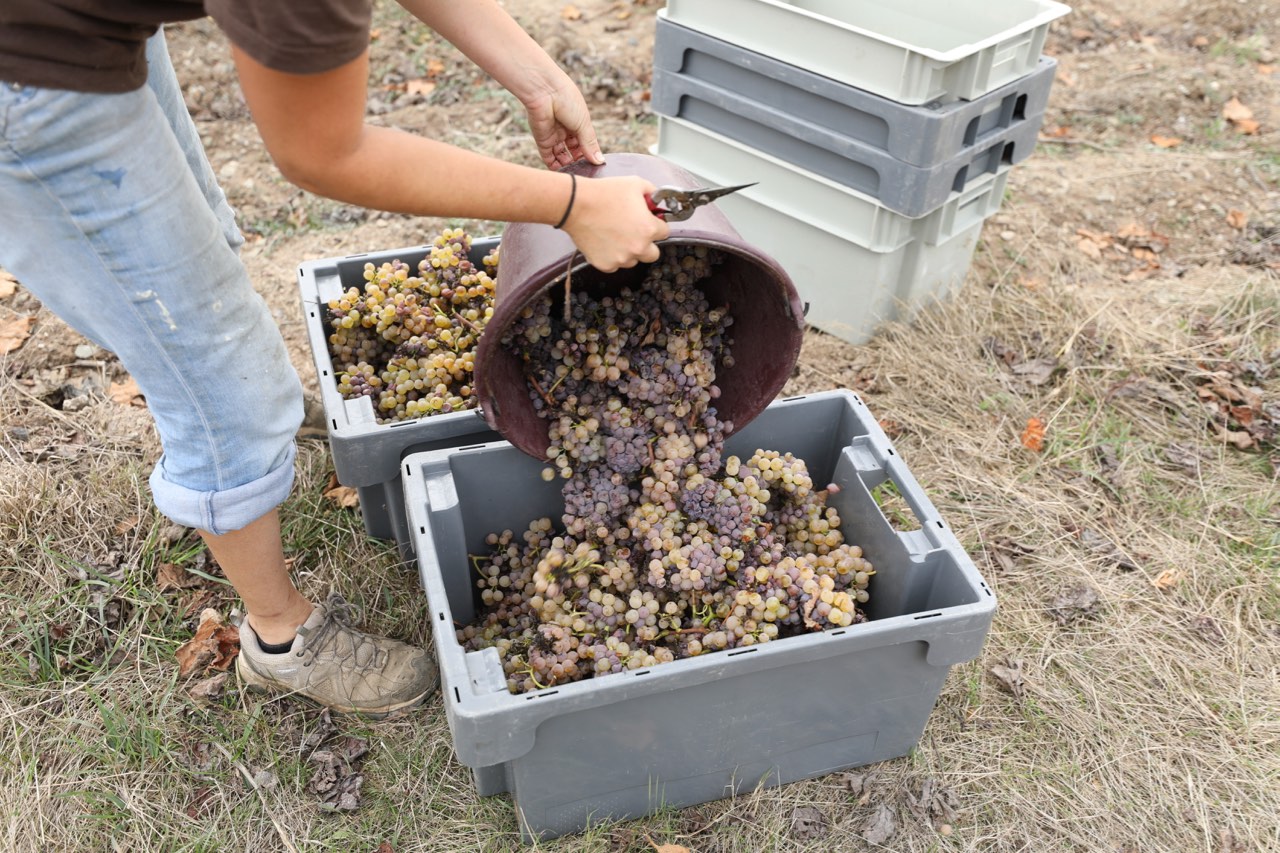
Chenin-picking

Picker's hat 
Picker's hat held in place by a local stone

We spent last Wednesday and Thursday in Anjou on a quick visit to see how the harvest has been going here. Overall the message is much the same as in other parts of the Loire. Several producers commented that they had never seen grapes like these before – giving both quality and quantity.

Of the producers we saw many started in early September – Damien Laureau (4th September and finishing by 10th September), sisters Anne and Marie Guégniard, Domaine de la Bergerie (6th September) and Vincent, Catherine and Emmanuel Ogereau also on 6th.

I tasted juice/fermenting wine at all three domaines and I found them all clean and precise often with potential complexity depending on the particular parcel and age of vine.

Visiting Claude and Réné Papin at late Wednesday afternoon, Claude was critical of producers who he thought had picked to early and suggested that many 2018 wines would be simple, fruit driven without complexity because the grapes had been picked before they were physiologically ripe. The counter argument to this is that picking started in early September to avoid alcohol degrees shooting up to ridiculous heights due to the very warm conditions. Some of Damien Laureau's cuvées are at 14.5% despite starting and finishing early.

It will be exciting to taste these wines when they are finished. Perhaps we will be able to see who got it right....... may be!

Once again the one sour note in 2018 is mildew with some very badly affected. We dropped in to see Eddy et Mylène Oosterlinck-Bracke(Domaine de Juchepie). Sadly they have been badly hit by mildew this year which has affected their morale as they have lost around two thirds of their crop. This means that instead of making a thrilling range of different sweet wines they will probably just make one. From the limited first pressing, however, it is already at 22% potential alcohol.
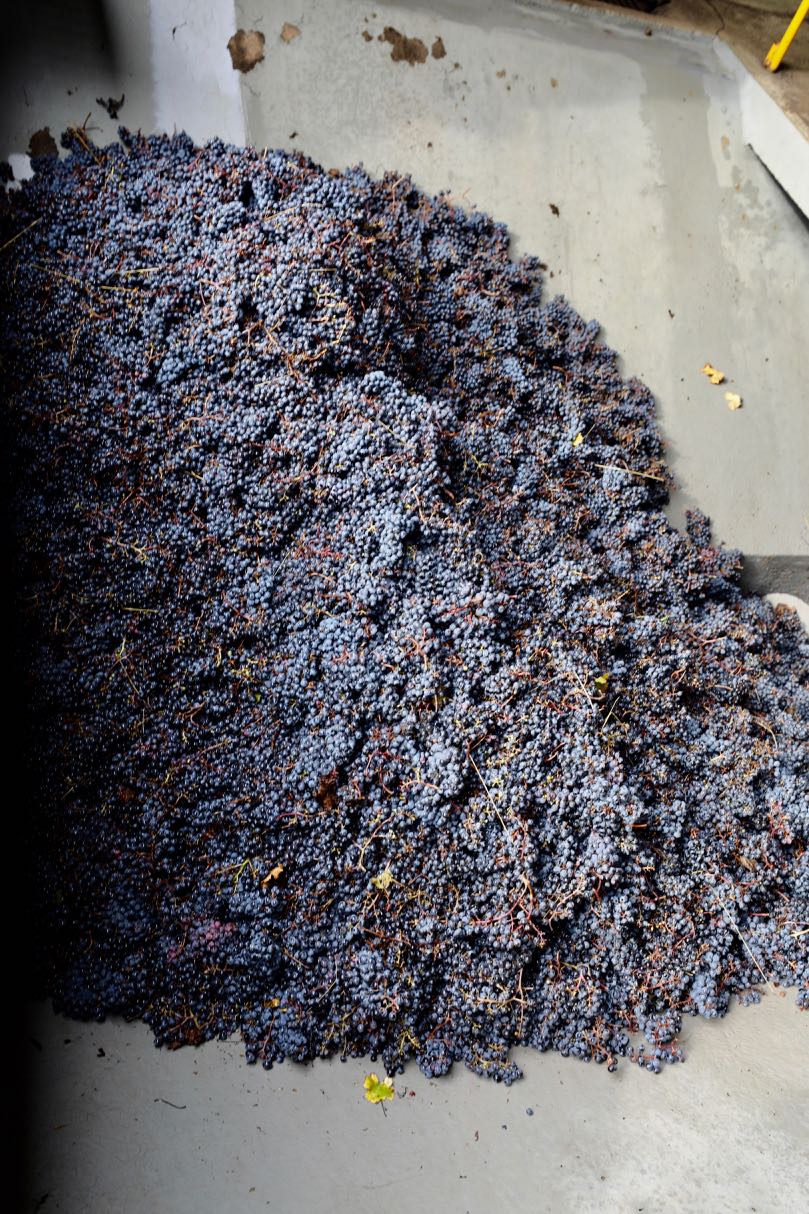
Cab Franc - PA 
Cabernet Franc for Petra Alba, Anjou-Villages Brissac,
Domaine de Bablut

•••

Quarts de Chaume – the Loire's only Grand Cru – must be credible

Très Cru 

InterLoire
Approved in November 2011 the appellation Quarts de Chaume (some 43 hectares) remains the only Grand Cru in the Loire and seems likely to remain the valley's solitary Grand Cru for some time to come. Its rules are strict and precise with clear indications of how these rules should be monitored. This is as it should be as Quarts de Chaume can be one of the world's great sweet wines.

Variable 

Mature bunch 
Very promising bunch – clearly showing
Chenin's typical variable ripening pattern

L'Echarderie 

Excess bunches
At least 12 bunches on this vine
Cahier des Charges
1.7 kilos

Maximum yield per vine fixed at 1.7 kilos or 
2.5 kilos for any vignes larges 
(low density plantatings)

Production rules 

Bénéfice GC 

Excess-a 
12 or 13 bunches on this vine perhaps more
– weighing just 1.7 kilos in total?


On Thursday morning I spent about an hour walking around the eastern part of the Quarts de Chaume appellation – the part to the east of the hamlet of Chaume. The previous afternoon I had spent a little time in the western part – unfortunately during one of the rare times during this harvest when it was raining. Here Baumard's vines had been picked – probably recently, so I cannot comment on their condition except that in his parcel on the plateau the grapes are often amongst the most advanced in terms of ripeness and incidence of botrytis. Whether the fact that these are vignes larges (low density vines) is a factor is an interesting question.

The fruit that I saw on Thursday morning were in variable states of ripeness – a characteristic of Chenin Blanc. On the whole the vines had a limited crop with the notable exception of a parcel of vines immediately east of the Château Echarderie – see photos above. It may be that the owner of this parcel is not intending this year to make Quarts de Chaume Grand Cru from this parcel. If so, this would be the correct decision, as unless these bunches are remarkably light, they appear likely to weigh considerably more than the maximum 1.7 kilos per vine allowed in the legislation of 22nd November 2011.

It would, however, be a little strange if the owner of this parcel is not intending to make 2018 Quarts de Chaume from these vines as the price point for Quarts de Chaume is naturally higher than any other labelling options. In which case, the 'control sur terrain' should have ruled this parcel ineligible for the appellation Quarts de Chaume Grand Cru until the crop had been reduced in line with the regulations. Given that this is a small prestigious appellation it should be easy to carry out the necessary checks and, if some parcels have an excessive crop, the rules (22.11.2011) make it clear that they should not benefit from Quarts de Chaume Grand Cru appellation. The particular over-loaded parcel was right by one of the main unmetalled tracks through the appellation and certainly not tucked away in a hard to find spot.

Quarts de Chaume Grand Cru is proudly promoted by the Loire as an exceptional wine. Claude Papin, president of the Quarts de Chaume producers, is rightly concerned that all bottles of Quarts to Chaume are up to standard. Wine buyers have the right to be assured that all growers in the Quarts de Chaume respect the rules and that the premium these wines can rightly command is justified.

I made some similar points on Jim's Loire around this time last year on vines that had a noticeably low weight of crop.


Monday, 16 October 2017

2017 Loire – Quarts de Chaume: Grand Cru status comes with responsibilities


 Track to Les Martinières


After visiting Domaines de la Bergerie and Ogereau last Tuesday we had a very quick look at what fruit was left to pick in the Quarts de Chaume. We took part of the the track up to Les Martinières. 

With no claims that what I saw was representative of the Grand Cru appellation this year – we only looked at a small part and this is well into the harvest – but the fruit management looked worrying variable. On some vines there were clumps of  bunches with individual vines looking to carry a substantial weight of grapes. Under the 2011 regulations that set up Quarts de Chaume Grand Cru the maximum weight of grapes on each individual vine is set at 1.7 kilos – for the remaining Vignes Larges (more widely spaced vines) 2.5 kilos are allowed. 

I have been a strong supporter of Quarts de Chaume becoming a Grand Cru, which it did in 2011. However, the Grand Cru status surely imposes certain responsibilities and accepting a commitment to very high quality on all of the producers. There are 20 producers with just 29 hectares in the Quarts de Chaume. Given that two producers – Baumard and Suronde – have some 12 of these 29 hectares – that means that the average for the remaining 18 producers is less than a hectare. Allied this with the status of grand cru and price that these wines can command, there should be no excuse for less than impeccable viticulture in the Quarts de Chaume. Otherwise the consumer is being taken for a ride, which is exactly the reason I have been critical of Baumard's methods.

Grand cru viticulture?  
You cannot be serious!    

I should make it clear that none of the vines in the photos below belong to Domaine des Baumard. On this occasion we didn't have time to visit any of their parcels.


Mix of botrytis and golden grapes 
– typical of Chenin's variable ripening 
– on this well spaced out bunch

Similarly above and below


Some spread out bunches but two clumps 
– just 1.7 kilos of grapes on this vine? 

Surely the bunches on these vines should have been thinned 
Is this viticulture of grand cru standard? 
(above and two below) 

Grand Cru viticulture?


Monday, 3 March 2014

Quarts de Chaume: reflecting on the Conseil d'Etat's verdict

Florent Baumard  

The Conseil d'Etat's very welcome decision* and its associated judgment to reject the legal challenge to the revised appellations of Quarts de Chaume and Coteux du Layon 1er Cru Chaume has wider implications than just in this small sector of the Layon. It appears to open the possibility of a few further grand crus and, more likely, premier cru status for especially favoured sites in the Layon and perhaps elsewhere in the Loire.

Although an interesting and perhaps welcome development it may also sow the seeds of further conflict as inevitably classifications create new haves and have nots. There are, for instance, plenty of examples of this in Bordeaux as well as in Coonawarra, Australia with the arguments over the limits of the terra rosa.

Perhaps the most interesting part of the judgment is the forthright rejection of cryoselection – see below. In the section below it is evident that the view of INAO that cryoselection is barely an acceptable process for appellation wines and, surely not all, for by implication one of France’s greatest sweet wines. This is more than supported by the Conseil d’Etat, who characterize cryoselection as a means of significantly increasing yields, allowing the picking of grapes at the beginning of the harvest before they have achieved the required of super-ripeness.

The Conseil d’Etat judgment forcefully stresses that the maximum yield for an appellation is indeed a maximum and not a threshold to be regularly attained. One of the objections to the 2011 décret was that it wasn’t possible to attain the maximum yield permitted without the use of cryoselection.    

‘S'agissant de l'interdiction du recours au procédé de cryosélection:

17. Considérant qu'il ressort des pièces du dossier que le procédé de cryosélection, qui permet de sélectionner les grains de raisin les plus concentrés et sucrés et d'isoler les grains les plus aqueux en portant l'ensemble des grains cueillis à température négative, a été regardé par la commission d'enquête de l'INAO comme relevant des " pratiques peu ou pas recommandables en matière d'AOC " au motif qu'il conduit à un affaiblissement du lien spécifique du produit avec son terroir en incitant à récolter en début de vendange plutôt que d'attendre la surmaturation, soumise aux conditions climatiques d'arrière-saison, du raisin sur pied ; que, si ce procédé permet une amélioration substantielle du rendement de la vigne, il ne ressort pas des pièces du dossier qu'il serait indispensable à la rentabilité de l'exploitation des vins de Quarts deA... ; que, contrairement à ce que soutient la société requérante, le niveau de rendement de la vigne fixé par le cahier des charges n'est pas un seuil à atteindre mais un maximum ne pouvant être dépassé ; qu'il ne ressort pas des pièces du dossier que ce procédé serait indispensable pour atteindre le titre alcoométrique volumique naturel minimum fixé par le cahier des charges ; que doit, dès lors, être écarté le moyen tiré de ce que le pouvoir réglementaire aurait commis une erreur manifeste d'appréciation en homologuant un cahier des charges interdisant le recours au procédé de cryosélection ;’

The Conseil d'Etat's unequivocal rejection of cryoselection should not only discourage any other Quarts de Chaume producers tempted after two difficult harvests - 2012 and 2013 - to use this technique while it remains legal until after the 2019 vintage under the transitional arrangements. What producer would want to use cryoselection for top quality sweet wine when this technique is barely or even not recommended by the INAO and the Conseil d'Etat characterised it as giving higher yields, from grapes picked early before surmaturite and before they have attained the required concentration?

Will the judgment make any difference to producers in other parts of France aiming to make quality sweet wine? The damning judgment would seem to be a clear disincentive despite the advantage of obtaining higher yields. 

The Conseil d'Etat also rejected the complaint over the yield in low density vines being reduced by 10%. The Conseil notes that it is rare in the Quarts de Chaume to reach maximum permitted yield and that with lower spaced vines it is easier to attain the maximum yield. 

Hopefully producers in the Quarts de Chaume and Chaume can now concentrate on making wines that are fully worthy of their grand cru and premier cru status, accepting that, in Quarts de Chaume especially, you cannot expect to make this in all years. There will be vintages when it will be impossible to produce or the resulting wine does not merit the Quarts de Chaume status. Instead it can be sold as Coteaux du Layon. Or there is the possibility of making dry white wine instead - but that is a whole new discussion that is starting to stir! Not one for this post.  

And Domaine des Baumard?
Will Florent Baumard come to accept in time that the court's was the best outcome for him and even, perhaps, come to welcome it? The judgment brings to an end a conflict over the status of the Quarts de Chaume and Chaume that has soured relationships in this small but beautiful part of the Layon for more than a decade.

This is the third time that the Baumard family has challenged an appellation décret in the hamlet of Chaume. On the first two occasions their challenges were successful. The 2003 was annulled in 2005 and the 2007 was annulled in 2009. Details of the judgments are on the Conseil d'Etat website – here. *Type in 'Quarts de Chaume' to start your search. For the latest judgment type in 356103 – the number of the file.

Incidentally the Domaine des Baumard also appealed in 2008 to the Conseil d'Etat over the spacing of some of their vines in both the Quarts de Chaume and Savennières. These vines were too widely spaced to meet the appellation rules. The INAO had informed Domaine des Baumard that for the 2007 vintage that these parcels would be excluded from their respective appellations. The Conseil d'Etat rejected the Baumards' appeal on 17th December 2008. So to date a score draw – played four – won two, lost two.    

Presumably Florent Baumard now has the choice of continuing to use the Quarts de Chaume appellation without the aid of cryoselection after 2019 or to continue to use cryoselection and sell the wines as Vin de France. Of course, a mix of the two would also be possible.

Ironically Jean Baumard can be seen the father of Quarts de Chaume Grand Cru. Back in 1968 he was the president of the Syndicat de Quarts de Chaume when they decided to apply to the INAO to make the Quarts de Chaume. Although Jean Baumard duly wrote a letter to the INAO, the proposal doesn't appear to have gone any further.  


Jean Baumard: Le Quarts de Chaume published April 2007

Thursday, 27 February 2014

Breaking news – Quarts de Chaume: Conseil d'Etat upholds Grand Cru

Quarts de Chaume sign


Breaking news: 
The Conseil d'Etat has rejected the Domaine des Baumard's attempt to have the Conseil d'Etat annul the 2011 décret that established Quarts de Chaume Grand Cru, while tightening the regulations.

Apparently the judgment, which is due to be posted on the Conseil d'Etat's website, runs to 10-pages. According to Claude Papin (Château Pierre-Bise), who is the president of the Quarts de Chaume syndicat, the judgment opens the way to favoured sites in the Layon gaining premier cru status. Sounds similar to Burgundy's premier cru. 

Naturally the INAO is very pleased that the changes and the establishment of the Loire's first Grand Cru that they approved in 2011 and was signed into law in November 2011 has been upheld 

This is very good news and hopefully will finally bring the conflict over the status of Quarts de Chaume and Chaume to an end as there is I understand no appeal on a decision by the Conseil d'Etat – it is France's Supreme Court after all. 

Time for the producers to concentrate on making great sweet wine from a very special site and to accept that there will be vintages when this won't be possible. 

Time also to work for a revival in the appreciation and popularity of these great wines – they are far more versatile than is often imagined!    

More to follow once the judgment has been published.

 2011: The first vintage of the Loire's first Grand Cru – Quarts de Chaume
and the Loire's first 1er Cru: Coteaux du Layon 1er Cru Chaume

Friday, 31 January 2014

Quarts de Chaume: an update on the Baumards' attempt to annul new Grand Cru


Quarts de Chaume: terraces close to the River Layon 
The peaceful battlefield!

Florent Baumard


On Wednesday afternoon (29th January) Jean and Florent Baumard's legal challenge to the Quarts de Chaume Grand Cru was heard before France's Conseil d'Etat (the country's Supreme Court) with the rapporteur giving their conclusions. I understand that the court is due to hand down its decision in two or four weeks time. I assume that the Conseil will also have heard during this hearing the Baumards' challenge to AOC Coteaux du Layon Premier Cru Chaume.

I understand that the commission set up to look into this legal challenge gave their report and conclusions to the judges on the Baumards' challenge. This commission spent several months looking at the issues involved, which included the hierarchisation – Grand Cru Quarts de Chaume and Coteaux du Layon Premier Cru Chaume, the names and the eventual ban on cryoextraction/cryoselection.


Jean and Florent Baumard successfully challenged two previous newly created appellations involving Chaume with the Conseil annulling the previous versions in 2005 and 2009 respectively. See here and here. 

It is ironic that the Baumards' challenge has been heard just before the Salon des Vins de Loire and probably a very good thing that the Conseil's decision will not be handed down until after the Salon keeping all the parties concerned in suspense.

Although the court's decision will directly affect this small part of Anjou – Quarts de Chaume is around 50 hectares, it has wider implications. If the Quarts de Chaume Grand Cru décret is annulled this is likely to put back any proposals from other Loire appellations seeking grand cru status for their best sites. 

There are broader issues than Grand Cru status, assuming the Baumard's challenge to Q de C was based at least in part on the banning of cryoextraction/cryoselection (permitted to 2019 vintage). Allowing cryoextraction, especially for a very special site like the Quarts de Chaume, will signal that France allows its producers to use freezing or other forms of technological intervention to change the hand that nature dealt. It will diminish the risk involved in making very special sweet wines (at their best) like the Quarts de Chaume. It is likely to permit growers to produce larger quantities of these sweet wines. Would the Baumards have challenged the new Grand Cru if it had permitted cryoextraction/cryoselection?

I hope that the Conseil d'Etat rejects the Baumard's challenge and that the Quarts de Chaume Grand Cru décret of November 2011 remains in place as it bought welcome rigour to one of France's greatest sweet wines made in a special, magical site. 

Today I am even more convinced that cryoextraction/cryoselection should have no place in the Quarts de Chaume. If conditions during the harvest are so difficult – over 200mm of rain in October 2012, for example, then there should be no Quarts de Chaume made/declared that year. Instead it can de declared as Coteaux du Layon, assuming that the wine meets this appellation's less rigorous criteria. If you want to use cryoextraction – fine but sell it as Vin de France just as an increasing number of producers do for other wines that do not fit into appellation rules. 

Although there is no definition for 'natural' wine its success as shown by enthusiasm of wine lovers who attend fairs like RAW and the Real Wine Fair is that there is a demand for authenticity, for wines made without large scale technological intervention. These wine lovers would expect Quarts de Chaume to be made as naturally as possible and not to be a product of freezing.   

  
Sign for Quarts de Chaume Grand Cru – to stay or be removed?


Western end of Quarts de Chaume AC with Saint Aubin in the background

Thursday, 21 February 2013

My ‘inquisitorial’ questions to Jean Baumard


Domaine des Baumard Quarts de Chaume: 9.10.12@15.03.39 Terraces 

Domaine des Baumard Quarts de Chaume: 9.10.12@14.57.45 Terraces view across Layon through the foliage

Domaine des Baumard Quarts de Chaume: 9.10.12@15.11.46 Terraces – view over vignes larges to southside of the Layon.

 Domaine des Baumard Quarts de Chaume: 9.10.12@15.13.59 Terraces

Domaine des Baumard Quarts de Chaume: 9.10.12@14.56.08 Terraces

1er tri: 15/16th October 2012
2er et dernier tri: 25th October 2012

Occasionally a kissed frog will turn into a princess but not very often...

I put the following three questions (below) to Jean Baumard on 14th February 2013. They were dismissed as 'inquisitorial'.

'Permit me to ask you a few questions about the 2012 please?

a) At the time of picking what was the average potential alcohol of the grapes from the 1er tri picked 15th or 16th October?

b) At the time of picking what was the average potential alcohol of the grapes from the 2eme tri picked around 25th October?


c) What percentage of your total Quarts de Chaume harvest did the 1er tri represent?

Obviously M Baumard is under no obligation to answer my questions, although I have over the past 24 years asked similar questions about potential alcohols, yields etc. of many hundreds, perhaps thousands, of producers not just of Loire producers but around the globe. All have been happy to answer. 

However, Jean and Florent Baumard surely have a duty to assure their distributors, agents and potential customers that in 2012 they have satisfied the ripeness requirements as laid down in the 2011 Cahier des Charges for the Quarts de Chaume. Was the required minimum of 298 grams of sugar per litre achieved on the vine or was it augmented by cryoselection/cryoextraction?

I have been accused on several occasions of claiming that cryoselection/ cryoextraction/cryoextraction sélective is now banned per se in the Quarts de Chaume. I have been very careful not to say this as the 22nd November 2011 Décret for Quarts de Chaume Grand Cru permits the lowering of the temperature of the grapes to below -5˚C until and including the 2019 harvest. This practice will be banned from 2020, although lowering the temperature of the grapes to just above -5˚C will still be permitted. 

However, the grapes for Quarts de Chaume have to have reached the required ripeness levels on the vine before the use of any process that lowers the temperature is permitted if it is to be declared as Quarts de Chaume. The décret's cahier des charges requires that a record is kept of the maturity of the grapes when picked as well as the number of tris (pickings). This can be subject to an inspection in the vineyard by the INAO.


Previous posts on Domaine des Baumard's 2012 Quarts de Chaume here, here and here. 


Sunday, 10 February 2013

Horsemeat and Baumard's Quarts de Chaume

Horse's head@a winery in the Terras do Sado  
(Photo used for illustrative purposes – no suggestion that the winery owner is in any way involved in the meat scandal)  
 
No, I'm not suggesting that the Baumards have enhanced the flavour of their 'Quarts de Chaume' with horse rather that there are clear parallels with the scandal now engulfing the processed food industry.

The horsemeat as beef scandal is not about taste but mislabelling – misleading consumers to believe that are are buying a product containing beef when it actually contains a proportion of horsemeat. In some instances the only meat in a 'beef' product has been found to be horse. 

As far as I know there have been no complaints about the taste of the contaminated meat products. Instead the scandal is about passing off a cheaper meat as more expensive beef – allowing someone in the processed meat chain to make a greater profit than would normally be possible. 

There have understandably been expressions of outrage. Here are just two examples:

An Aldi spokesman said: "This is completely unacceptable and like other affected companies, we feel angry and let down by our supplier.

"If the label says beef, our customers expect it to be beef. Suppliers are absolutely clear that they are required to meet our stringent specifications and that we do not tolerate any failure to do so.”

UK Health Secretary Jeremy Hunt said: "We don't believe at the moment that there are public safety issues - there may be fraud issues in terms of people eating something that isn't what the label on the tin says it is."
BBC News 10.2.13 

Although very different in scale, the Baumards have attempted to pass off inferior and cheaper grapes – unripe and probably ignobly rotten – as Quarts de Chaume. This is certainly the case in 2012 and may well be partially the case in 2011 and  2010 as the following photos indicate. I would be very surprised if any of Baumard's grapes in 2012 met the appellation's minimum requirements – 18.5% potential for each sweep through the vine. Just as with beef consumers have the right to expect the wine inside the bottle to match the label, particularly as they pay a considerable premium for Quarts de Chaume. They don't expect to pay the premium for grapes possibly suitable for a dry white wine processed into a sweet wine. It is customary for Domaine des Baumards to declare the maximum, or close to the maximum, permitted under the appellation rules. 

There is nothing wrong with horse meat just as there is nothing wrong with artificially created, processed sweet wine providing the label is truthful and the consumer knows that this is what they are buying.           

The Baumards have been using cryoextraction since 1989. It is not known whether this process has been used for every vintage or just some of them. I have photos of the Quarts de Chaume vines of Domaine des Baumard for the last three vintages – 2010-2012.  

In November 2011 the new Quarts de Chaume Grand Cru décret was signed into law. The term Grand Cru can be used from the 2010 vintage onwards providing the criteria of the new décret are met. Prior to this the minimum degree of ripeness on the vine was 17.5% potential. As the new décret did not become law until November 2011 grapes picked in 2011 and 2010 at 17.5% potential but not as high as 18.5% could still qualify as Quarts de Chaume but not Quarts de Chaume Grand Cru. 

The 2011 décret lowered the permitted yield per hectare from 25 to 20 with 1.7 kilos allowed for each normal sized vine and 2.5 kilos for the vignes larges. The changes came fully into force for the 2012 vintage. Florent Baumard has both normal sized and vignes larges – normal on the plateau, so so 1.7 kilos max per vine, with the vignes larges on the terraces – 2.5 kilos per vine. 


1.7 kilos of grapes (in this instance eating not wine grapes) 

 2.5 kilos of grapes

Bunch@848 grams  


2010 vintage: 
Every year since 2008 I have spent at least three weeks in the Loire during the harvest trying the cover what is happening from the Pays Nantais to Pouilly-sur-Loire. Such is the size of the Loire and distances involved it is impossible to see all the appellations every year. 

On 26th September 2010 I made a special point of visiting the Quarts de Chaume as the Quarts de Chaume Syndicat would be voting on elevating the appellation to grand cru the following day.  

As I had always been impressed with Domaine des Baumards Quarts de Chaume I had assume that their vineyards would be similar to those of other high quality estates in Anjou – low yields, small bunches carefully spaced. All the measures that has transformed the best sweet wines of Anjou over the last 25 years or so.      


View through the vignes larges on the terraces of Domaine des Baumard 
across to the south bank of the Layon. 
  
Instead I was utterly staggered to discover vines that were groaning with large bunches of green grapes. It was suddenly clear why the Baumards were so insistent on retaining cryoextraction. Florent Baumard did say that of course these grapes were not used for Quarts de Chaume but it is clear from the last three vintages that their yields are high, as are their declarations de récolte. Nor has Florent said what they were used for.      

Baumard – 2010: vignes larges in the Quarts de Chaume: pm 26th September 2010


The vines of other Q de C producers were markedly different – small yields, widely spaced, small bunches – not yet ready to pick but coming along nicely. The Ban des Vendanges had yet to be declared for 2010.    

Below: Château Belle-Rive 


2011 vintage: 
I was in the Quarts de Chaume  on 28th and 29th September. The 2011 vintage was very early and these last days of September were gloriously warm and sunmny with temperatures above 30˚C. Picking had already begun with potential degrees in the late 20s. 

The Domaine des Baumard vines were less heavily laden than in 2010 and with some bunches on their way to surmaturité. The domaine had, however, failed a control by the INAO in late July – their Quarts de Chaume vines judged to have excessive yields. The excess grapes were picked in early September and are believed to have been used to make Crémant de Loire. A somewhat unique approach making Crémant and Quarts de Chaume from the same vines, although I'm sure it made economic sense!   

   
 Baumard: vignes larges at the top of the terraces

Baumard: vignes larges with a range of ripeness: 28th September 2011 

Baumard: a promising bunch

 Baumard: large bunches a long way off ripe even for a dry white wine

Baumard: if all the bunches were like this there would be no need for cryoextraction!

 
Baumard: probably a case for cryoextraction...

28.9.2011: grapes from another producer close by to Baumard's vines already looking magnificent – passerilage rather than botrytis at this stage:  

Still a big variation in ripeness within the small bunch which is such a feature of Chenin Blanc


2012 vintage: 

Baumard: heavily laden vine on the plateau with around 18 bunches.
Just 1.7 kilos allowed from each vine - this is way over the limit.


Domaine des Baumard has declared nearly 80hls from this very difficult vintage has already been covered here (English) and ici (Français). In the 2010 and 2011 vintages I can only speculate on the role played by cryoextraction. In 2012 we know that Florent and Jean Baumard picked well below the required minimum degree of ripeness. Therefore it cannot legally be sold as Quarts de Chaume. The minimum required degree of ripeness has to be achieved on the vine and not in the freezer.  

It is astonishing and highly regrettable that Domaine des Baumard has attempted to pass off this industrially concentrated sweet wine as Quarts de Chaume, one of France's greatest sweet wine appellations. 


Jean Baumard devoted a book to the Quarts de Chaume – 
ironically he and Florent appear to be determined to undermine its reputation 


2013 vintage:
Very early days of course but I hope that 2013 will be a much easier than 2012 proved to be and that the quality of this year's Quarts de Chaume is similar to that of 2007, 2010 and 2011. Loire vintages ending in '3' have a mixed reputation. 1893, in particular, and 2003 being very good to great vintages, while 1963 being the opposite.

It would be very good news if 2013 proves to be the year that Florent Baumard abandons the high yield practices of the bad days of the 1970s and 1980s and changes his approach to join that of many of his fellow producers in the Coteaux du Layon, who have made such dramatic progress over the past 25 years.

An invitation:
Once again I plan to be in the Loire during the vintage. It would be good to organise a morning or an afternoon in late September or early October for any interested journalists in the area at the time to visit the Quarts de Chaume to see how the grapes are progessing and prospects for the vintage in the presence of as many producers, including I hope Florent Baumard, as possible.