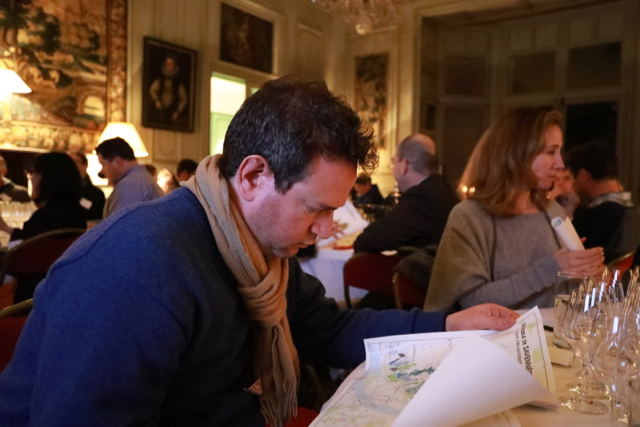
Evelyne de Pontbriand tutoring the vertical tasting

Tasters in the magnificent surroundings of the Château des Vaults
(Domaine du Domaine de Closel)
On the evening of Monday 6th February – the second day of the 2017 Salon des Vins de Loire – we were invited to a vertical tasting of the Domaine du Closel's Clos du Papillon. The vertical ran from 2001 through to 2015 but without 2012 as none was made due to frost. We tasted from oldest to youngest, which made perfect sense as we could see the evolution in the purity and precision in the wines. At the end we were treated to two older bottles – 1992, which was not a very auspicious vintage, and 1989, which was a great vintage.
2001 was the first vintage that Evelyne took over from her mother –Michèle Bazin de Jessey. The Clos du Papillon overlooks the small village of Savennières sited just to the north.
Although the vineyards were grassed over when Evelyne took over over, the vineyards were farmed and the wine made in a traditional manner. The wines tended to have a short fermentation and be given high doses of SO2. The period of fermentation has been extended and the vinification is now down in 400-litre barrels when before it was done in vat. Using cover crops.
Since 2001 Evelyne has taken from being traditional to firstly organic and now to being farmed biodynamically. Conversion to organic viticulture began in 2006 with full certification in 2009, while biodynamic status was achieved in 2015.
Yields have been reduced from 35/40 hl/ha down to 15-20hl/ha today. From 2009 using a software system to analyse the right time to pick the grapes.
The vertical:
2001:
Light golden colour, honey and truffle, some texture but a little short.
Light golden colour, honey and truffle, some texture but a little short.
2002:
Light to mid-gold, clearly taken on a lot of colour, honeyed evolved flavours, rich with fair balance. Loire wines from 2002 tend to be well-balanced. 6.4 gms of residual sugar. Among my favourites.
Light to mid-gold, clearly taken on a lot of colour, honeyed evolved flavours, rich with fair balance. Loire wines from 2002 tend to be well-balanced. 6.4 gms of residual sugar. Among my favourites.
2003:
Honey and quince, rich but less interesting than the 2002 – an effect of this heatwave year?
2004:
Delicate honey aromas, attractively finely textured wine although a little dilute in the finish but considerable charm.
Honey and quince, rich but less interesting than the 2002 – an effect of this heatwave year?
2004:
Delicate honey aromas, attractively finely textured wine although a little dilute in the finish but considerable charm.
2005:
Deep light gold colour, richly textured, botrytis – this is a rich oxidative style.
Hot dry summer and autumn.
2006:
Light gold colour, attractively textured wine with honeyed evolution, good length and nicely balanced. Among my favourites.
Deep light gold colour, richly textured, botrytis – this is a rich oxidative style.
Hot dry summer and autumn.
2006:
Light gold colour, attractively textured wine with honeyed evolution, good length and nicely balanced. Among my favourites.
2007:
Light gold, honey and quince flavour with a touch of caramel, textured wine, the richness hides the acidity but the finish is a little short.
Light gold, honey and quince flavour with a touch of caramel, textured wine, the richness hides the acidity but the finish is a little short.
2008:
Vineyard frosted. Honey and quince on nose and palate,some truffle too, texture, quite austere long finish. Aromas persist in the empty glass.Among my favourites.
Vineyard frosted. Honey and quince on nose and palate,some truffle too, texture, quite austere long finish. Aromas persist in the empty glass.Among my favourites.
2009:
Clean and precise with attractively vibrant texture, some honey character, noticeable acidity in long finish. There is a growing precision in the Papillon wines.
Clean and precise with attractively vibrant texture, some honey character, noticeable acidity in long finish. There is a growing precision in the Papillon wines.
2010:
Richly and seductively textured with honey and quince character, lovely balance and length. Certainly amongst my favourites.
Richly and seductively textured with honey and quince character, lovely balance and length. Certainly amongst my favourites.
2011:
Still youthful wine, attractive texture and complexity, some toasty flavours along with a touch of caramel with good balancing acidity in the finish.
Still youthful wine, attractive texture and complexity, some toasty flavours along with a touch of caramel with good balancing acidity in the finish.
2012:
Not made – severe April frost
2013:
Citric aromas and palate, quite austere finish reflecting this difficult vintage, precise but the wine falls away in the finish.
2014:
Floral and ripe fruit nose and palate, some barley sugar notes, very good length and very clean purity with some delicate wood notes. Still young but with impressive potential. Certainly amongst my favourites and shows the progress that has been made with the Papillon wines.
Not made – severe April frost
2013:
Citric aromas and palate, quite austere finish reflecting this difficult vintage, precise but the wine falls away in the finish.
2014:
Floral and ripe fruit nose and palate, some barley sugar notes, very good length and very clean purity with some delicate wood notes. Still young but with impressive potential. Certainly amongst my favourites and shows the progress that has been made with the Papillon wines.
2015:
Floral and citric – obviously still very youthful.
Floral and citric – obviously still very youthful.
The two additional vintages:
1992
This was a big vintage after the very severe frost of 1991. Wines were often dilute. Light gold, very oxidative style, nutty character but dilute in fish. Certainly reasonable for the vintage.
This was a big vintage after the very severe frost of 1991. Wines were often dilute. Light gold, very oxidative style, nutty character but dilute in fish. Certainly reasonable for the vintage.
1989
Showing the hallmarks of a great vintage. Ironically this wine shows the precision and vibrancy that Evelyne has to working for since she took over Closel. There is a little oxidative character but it is very restrained. Amazinly fresh – stunning wine!
Showing the hallmarks of a great vintage. Ironically this wine shows the precision and vibrancy that Evelyne has to working for since she took over Closel. There is a little oxidative character but it is very restrained. Amazinly fresh – stunning wine!
Many thanks to Evelyne and her team at Closel for a fascinating and most instructive tasting.