Awards and citations:


1997: Le Prix du Champagne Lanson Noble Cuvée Award for investigations into Champagne for the Millennium investment scams

2001: Le Prix Champagne Lanson Ivory Award for investdrinks.org

2011: Vindic d'Or MMXI – 'Meilleur blog anti-1855'

2011: Robert M. Parker, Jnr: ‘This blogger...’:

2012: Born Digital Wine Awards: No Pay No Jay – best investigative wine story

2012: International Wine Challenge – Personality of the Year Award


Showing posts with label Evelyne de Pontbriand. Show all posts

Monday, 27 February 2017

A journey to precision: vertical of Closel's Clos du Papillon

bu0a1126
Evelyne de Pontbriand tutoring the vertical tasting 
bu0a1125
Tasters in the magnificent surroundings of the Château des Vaults
(Domaine du Domaine de Closel)
On the evening of Monday 6th February – the second day of the 2017 Salon des Vins de Loire – we were invited to a vertical tasting of the Domaine du Closel's Clos du Papillon. The vertical ran from 2001 through to 2015 but without 2012 as none was made due to frost. We tasted from oldest to youngest, which made perfect sense as we could see the evolution in the purity and precision in the wines. At the end we were treated to two older bottles – 1992, which was not a very auspicious vintage, and 1989, which was a great vintage.
2001 was the first vintage that Evelyne took over from her mother –Michèle Bazin de Jessey. The Clos du Papillon overlooks the small village of Savennières sited just to the north.
Although the vineyards were grassed over when Evelyne took over  over, the vineyards were farmed and the wine made in a traditional manner. The wines tended to have a short fermentation and be given high doses of SO2. The period of fermentation has been extended and the vinification is now down in 400-litre barrels when before it was done in vat. Using cover crops.
Since 2001 Evelyne has taken from being traditional to firstly organic and now to being farmed biodynamically.  Conversion to organic viticulture began in 2006 with full certification in 2009, while biodynamic status was achieved in 2015. 
Yields have been reduced from 35/40 hl/ha down to 15-20hl/ha today. From 2009 using a software system to analyse the right time to pick the grapes. 
The vertical:
2001:
Light golden colour, honey and truffle, some texture but a little short.
2002:
Light to mid-gold, clearly taken on a lot of colour, honeyed evolved flavours, rich with fair balance. Loire wines from 2002 tend to be well-balanced. 6.4 gms of residual sugar. Among my favourites.
2003:
Honey and quince, rich but less interesting than the 2002 – an effect of this heatwave year?

2004:
Delicate honey aromas, attractively finely textured wine although a little dilute in the finish but considerable charm. 
2005:
Deep light gold colour, richly textured, botrytis – this is a rich oxidative style.
Hot dry summer and autumn.

2006:
Light gold colour, attractively textured wine with honeyed evolution, good length and nicely balanced. Among my favourites.
2007: 
Light gold, honey and quince flavour with a touch of caramel, textured wine, the richness hides the acidity but the finish is a little short. 
2008:
Vineyard frosted. Honey and quince on nose and palate,some truffle too, texture, quite austere long finish. Aromas persist in the empty glass.Among my favourites.
2009:
Clean and precise with attractively vibrant texture, some honey character, noticeable acidity in long finish. There is a growing precision in the Papillon wines.  
2010:
 Richly and seductively textured with honey and quince character, lovely balance and length. Certainly amongst my favourites.
2011:
Still youthful wine, attractive texture and complexity, some toasty flavours along with a touch of caramel with good balancing acidity in the finish.   
2012:
Not made – severe April frost

2013:
Citric aromas and palate, quite austere finish reflecting this difficult vintage, precise but the wine falls away in the finish.

2014:
Floral and ripe fruit nose and palate, some barley sugar notes, very good length and very clean purity with some delicate wood notes. Still young but with impressive potential. Certainly amongst my favourites and shows the progress that has been made with the Papillon wines. 
2015: 
Floral and citric – obviously still very youthful.
The two additional vintages:
1992
This was a big vintage after the very severe frost of 1991. Wines were often dilute. Light gold, very oxidative style, nutty character but dilute in fish. Certainly reasonable for the vintage.
1989
Showing the hallmarks of a great vintage. Ironically this wine shows the precision and vibrancy that Evelyne has to working for since she took over Closel. There is a little oxidative character but it is very restrained. Amazinly fresh – stunning wine! 
Many thanks to Evelyne and her team at Closel for a fascinating and most instructive tasting.

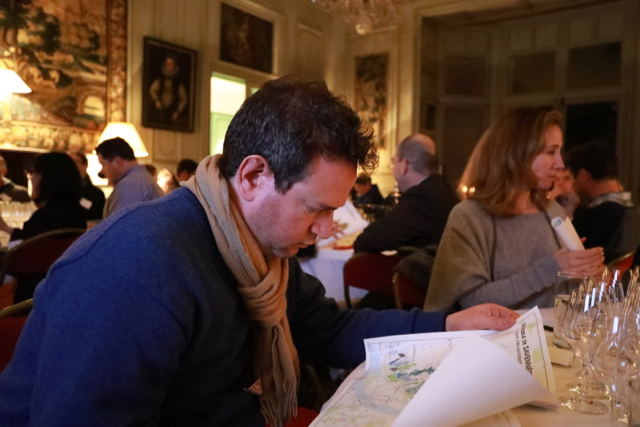
bu0a1132
bu0a1130
Ben Llewelyn of Carte Blanche Wines studying 
a carte of the vineyards of Savennières

Thursday, 1 August 2013

La Paulée de l'Anjou noir: 2nd edition 29th July 2013


Patrick Baudouin

Evelyne de Pontbriand (Domaine de Closel)@RAW Fair, London May 2012

I received several kind invitations to attend the second edition of La Paulée de l'Anjou noir, which was held last Monday. I was invited by Evelyne de Pontbriand and Patrick Baudouin. Sadly I was unable to make it as I'm in Scotland. Hopefully, if I'm invited again, I will be able to make next year's as it sounds like a great occasion as this report (31 juillet 2013) from Philippe Rapiteau's la pipette aux quatre vins makes clear:      


En 2012, nous avions évoqué cette heureuse initiative, partie du côté de chez Jo Pithon, à St Lambert du Lattay, réunissant la cohorte chaque année grandissante des vignerons bio d'Anjou. Une rencontre qui permettait de constater un croisement de générations et plus encore une sorte de fusion avant même d'évoquer une fédération qui ne dirait pas encore tout à fait son nom.


Wednesday, 17 April 2013

Savennières tasting (27.3.13): the wines I picked out


On Wednesday 27th March I tasted 47 Savennières ranging from 2011 to 2007, although the vast majority came from the 2011 and 2010 vintages. I tasted the wines blind at Domaine du Closel where Evelyne de Pontbriand (président of the Syndicat) had kindly organised the tasting for me. Here are the wines that most impressed me, ordered by vintage.  

2011 Vintage
Almost all the 2011s tasted would benefit from more time in bottle. If served now best decanted.

The most impressive wines: 

Le Hu Boyau, Château d'Epiré, Luc Bizard 
Good weight, power and length, citric with a touch of austerity in the finish

Also the Epiré Cuvée Speciale - described by Luc as his ideal notion of a Savennières, although I preferred Le Hu Boyau.

La Croix Picot, Domaine de la Bergerie, Yves Guégniard
Richer and fuller style to Epiré with good length. La Croix Picot is vinified in stainless steel, while the Clos le Grand Beaupréau, which I tasted next, is vinfied in wood. The 2011 Grand Beaupréau showed its potential but it needs time (probably one or two years) for the wood to marry with the fruit and for it to show its best. 

Clos du Papillon, Domaine des Forges, Stéphane Branchereau 
Vibrantly clean, attractive weight, long, well made, a touch tight in the finish – needs more time.

I also noted Domaine des Deux Vallées, Philippe and René Socheleau.

2010 Vintage
Overall impression: considerable variation in styles and quality. many would benefit from further bottle age. If drunk now best put into a carafe before serving.     

The most impressive wines:
Bel Ouvrage, Damien Laureau
Some honey on nose and palate, generous concentration of fruit and good length. 

Clos du Papillon, Domaine du Closel
Light gold, beeswax aromas, quite rich fruit, well balanced with lovely clean acidity. Could be drunk now but tight in the finish and would benefit from further time in bottle. 

L'Enclos, Eric Morgat
Floral and honey aromas, lovely ripe fruit in a good counterpoint with a quite austere finish though the fruit runs on through. Potential to age well.

Le Clos, Château de Plaisance  
Ripe honeyed style, good concentration but still quite tight in the long finish. 

        
I also noted La Croix Picot, Domaine de la Bergerie, Yves Guégniard; Clos des Perrières, Château Soucherie; two cuvées of Loïc Mahé – Equilibre and Les Fougeraies; Schistes, Pithon-Paillé

2009 Vintage
There were four wines from this ripe vintage. The wines, however, showed good balance.   


The most impressive wine:
Patrick Baudouin
Seamlessly balanced wine with floral and honeyed notes. Although Patrick has now planted vines in Savennières with the first vintage due this year, his impressive 2009 is made from bought-in grapes from three different parcels that are cultivated organically.

I also noted:
Clos la Royaute, Vignobles Laffourcade 

2008 vintage
There were two wines from this vintage.

The most impressive wine:
Clos du Papillon, Domaine de Closel 
Honey and beeswax, some rich fruit but not a heavyweight rather delicacy and finesse. 

I also noted:
La Croix Picot, Château de Bellevue  

2007 vintage
There were two wines from this vintage.
The most impressive wine:
Château de Chamboreau, Domaine FL
This was one of my favourite wines in the tasting – harmonious with delicate honeyed flavours and showing some evolution. The wine's initial richness is attractively balanced by a fine, austere finish. Demonstrates the benefit of giving Savennières time in bottle. 


My thanks again to Evelyne de Pontbriand for organising this tasting and to all the producers who kindly submitted samples.


Friday, 29 March 2013

Savennières tasting 27th March: 2011-2007

Two 2010 Savennières showing range of colour
left: 2010 Les Vieux Clos, Nicolas Joly
right: Clos la Royauté, Pascal Laffourcade 
Photo taken when labels were still covered with the Laffourcade 
immediately preceding the Joly. I was struck by the variation in colour 


On Wednesday morning I had the opportunity to taste 47 wines from Savennières mostly from the 2011 and 2010 vintages but with a few from 2009, 2008 and 2007. The tasting was kindly organised for me by Evelyne de Pontbriand (Domaine du Closel) in her capacity as president of the Syndicat des Producteurs de Savennières. My thanks to Evelyne and all of the producers who sent in samples.

It was a fascinating opportunity to try a broad range of Savennières, which I tasted blind. After tasting the 47 samples the most striking overall impression was their diversity – diversity in terms of style – ranging from light, very clean and pale wines to a golden richer style. Some saw wood, some did not. Some had a touch of oxidation, which added to the complexity, except in one case when the oxidation was so marked that it obliterated everything else. There is also not one single form of bottle – some are typically Loire but there are others akin to Burgundy while others nod to Alsace.  

Some overall conclusions: there is a diversity of styles so not really possible to say this or that is a typical Savennières.  At their best there is a thrilling harmony between the texture of the fruit and the acidity in the finish. The wines should not be served too old and they need time in bottle for their elments to marry, especially if they have been fermented in oak, and to show their best.  Although there were only a few wines from 2009, 2008 and 2007, there was a higher proportion here that really showed well compared to 2010 and 2011. This is not to say that these are poor vintages – rather that there are a number of good wines here but ideally they need more time. Alternatively if you are going to serve them now they would benefit from being decanted. 

Attempt (not entirely successful) to show variation in bottle shapes
Tasting was in the library of Domaine du Closel/ Château des Vaults  


In another post I will list my favourite wines.        


Sunday, 20 May 2012

Some #RAW photos from the fair@Trumans, London


The RAW Fair in the Old Truman's Brewery

Despite the best efforts of (No Sunday) Transport for London and the difficulties of actually finding the right entrance the RAW fair attracted a good crowd today, especially by early afternoon. The space is big, good and light with plenty of room to move around.   

 Alexandre Bain: Pouilly-Fumé

 Amy Lillard, La Gramière: vin de table in the Rhône

Damien Laureau: Savennières

 Amy Lillard getting acquainted with top quality Chenin: 2006 Clos du Papillon 
from Domaine du Closel with Closel's owner Evelyne de Pontbriand

Peter Hahn, Le Clos de la Meslerie AC Vouvray
An American in Vouvray

 
Naturally business 

The globe orbiter Luiz Alberto arrives in Brick Lane 

Three friends around a spittoon inc Roger Kolbu and Luiz Alberto 

The middle is the message!

 Stare crazy with Vrazon's Gabriella and Ryan

 A wild ferment in the gents ......


Thursday, 27 January 2011

Loires@Richards Walford 26th January

2009 Les Chênes, Reuilly, Denis Jamain


Brief visit to the annual Richards Walford tasting yesterday to have a look at the short selection of Loires on show. Denis Jamain (Domaine de Reuilly, Reuilly) and Evelyne de Pontbriand (Domaine du Closel) were in attendance.

Here are my three favourites from the tasting. 2009 Les Chênes (£15.99) is a new cuvée from Denis. Made from 100% Pinot Noir from old vines close to his house in Reuilly, this silky red is aged for 12 months in barrels made from oak trees planted by his grandfather. It has good depth, length and more structure than his straight Reuilly Rouge (£12.69) which is rather angular at present. Bottled three months ago this needs more time but in a year or two should be a very attractive wine.

Denis Jamain in his Pinot Noir vineyard
2006 Clos du Papillon, Savennières, Domaine du Closel

This 2006 (£27.99) from Domaine du Closel demonstrates again that Savennières needs some bottle age. This complex 2006 has honeyed weight combined with a long mineral finish. It would I suspect work well with rich fish and shellfish dishes.

2000 Le Mont demi-sec, Vouvray, Domaine Huet

As Richards Walford & Co is Domaine Huet's UK agent, it is no surprise that one of Huet's wines would feature here, even though there was only one wine shown. The 2000 Le Mont demi-sec (£19.49) has complex aromas and flavours – honey, mousseron and a touch of wet limestone. Lovely, long lasting and characterful Vouvray – ready to drink now or will certainly continue to age well.