Showing posts with label Chinon. Show all posts
Sunday, 28 June 2020
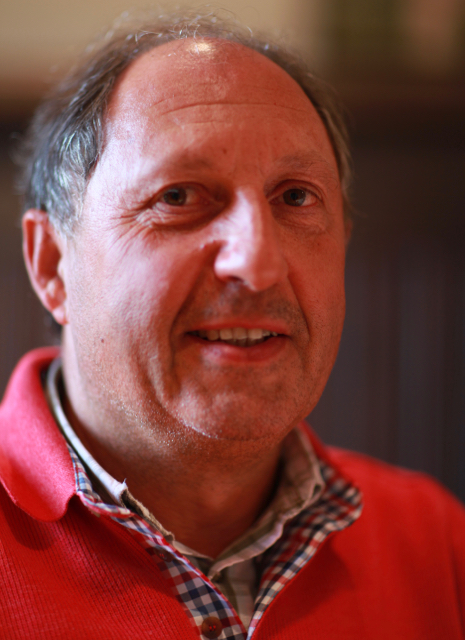
Fabrice Gasnier est le nouveau Président du Syndicat des Vins de Chinon
Press release on the appointment of Fabrice Gasnier as the new president of the Syndicat des Vins de Chinon following the end of Francis Jourdan's three year term.
'Elu par les 27
personnes siégeant au Conseil d'Administration du Syndicat des Vins de Chinon, Fabrice
Gasnier remplace désormais Francis Jourdan qui a dirigé l'AOC de 2017 à juin 2020.
Fabrice Gasnier se met donc au service du collectif pour un mandat de 3 ans. Il
peut s’appuyer sur un bureau renouvelé pour partie, composé de Sébastien du
Petit Thouars (Château du Petit Thouars) et Jean-Martin Dutour (Domaine
Baudry-Dutour) comme vice-présidents, Rodolphe Raffault (Domaine Jean-Maurice
Raffault) trésorier et Béatrice Lambert (Domaine Béatrice et Pascal Lambert) secrétaire,
ainsi que sur les 5 présidents de secteurs de l’appellation.
Vigneron, Fabrice Gasnier -50 ans- pratique la viticulture biodynamique
certifiée depuis 2008, sur les 30 hectares du domaine familial situé sur la
commune de Cravant les Coteaux. Fondateur de la Cuma de Cravant, il a une bonne
expérience du collectif avec la mise en place de systèmes de protection commun des
vignes contre le gel.
Elu pour représenter les 170 vignerons de Chinon, il aura pour mission
la promotion de l’appellation et la garantie de l’authenticité des vins de
Chinon. Les enjeux de demain sont nombreux, particulièrement tournés vers la
transition écologique de la production et les actions à mener dans le cadre du
changement climatique ; le commerce, le développement de l’export et la
gestion des stocks vont aussi être l’objet de son attention. Il défend déjà
avec ardeur « l’esprit de Chinon », c'est-à-dire l’image
culturelle de nos vins, attachée à l’humanisme de Rabelais et au patrimoine qui
font la singularité du positionnement de l’AOC Chinon. Fabrice Gasnier
confie : « La marque « Chinon » nous donne à tous
beaucoup, c’est un juste retour que je lui consacre aussi de mon temps ».
Une mission cependant conséquente lorsqu’on sait que Chinon est la plus
importante appellation de vins rouge de Loire – environ 13 millions de
bouteilles produites chaque année- qui s’étend sur 26 communes.'
Francis Jourdan, the previous president
Saturday, 23 February 2019
Pierre Couly: RIP

Pierre Couly at the Salon des Vins de Loire 2014
Although both Couly-Dutheil and Domaine Pierre et Bertrand Couly made good wine, it was very sad to see such a bitter family fall-out.
Pierre was a gentleman, was always friendly and welcoming. He will be greatly missed through the Loire as the reaction to posts on Facebook have already showm
Our thoughts and condolences are with his family and friends. #Loire.

Pierre Couly flanked by son Bertrand and Bertand's wife
Jim
Wednesday, 28 November 2018
Some more Loire dates: Portes Ouvertes chez Pierre-Henri Gadais, Noblaie + Marché de Noël à Pouilly-sur-Loire
Les Trois Jeunes Vignerons
– Pierre-Henri, Michel et Christophe Gadais
Portes ouvertes at Pierre-Henri Gadais' Domaine de la Combe: Saturday 1st December and Sunday 2nd December.
Details of Domaine de la Combe here and here.
•••
Domaine de la Noblaie, Ligré (Appellation Chinon):
Portes Ouvertes: Saturday 1st and Sunday 2nd December
Details here:
***
Marché de Noël at La Tour de Pouilly – Sunday 9th December
Monday, 5 November 2018
Vignobles et Signatures venture to London (part one)

For the first time since the Vignobles et Signatures group of French producers were founded in 1984, representatives from 15 members of their 17 members came to London to show off their wines. In the case of Roger Groult it was their cider and Calvados and for Famille Lesgourgues an Armagnac.
I don't know whether V&S decided that October 2018 was their last easy chance to display their wares before the utter lunacy of Brexit kicks in at the end of March 2019 leading to who knows what sorts of complications – visas, travel delays etc. – to make the short journey across the Channel/La Manche. Two of the club's members were absent – Domaine Rolet (Jura) and Vignobles Joseph Janoueix (Saint-Emilion, Pomerol). I can only assume that they decided that it made no sense to visit a small island off the coast of mainland Europe in the middle of a full blown nervous breakdown and wilfully committing economic and political suicide. Who, furthermore, from 29th March 2019 will not be able to afford to buy their wines. All in all a rather understandable and hard-headed decision.
Whatever it was a very good tasting with the 15 who ventured into the lunatic asylum as each producer was sensibly limited to showing four wines/cider or spirit.. This meant I was able to taste the majority of the wines although I didn't have time to taste everyone.
All the wines shown were of a high standard – I didn't taste one poor wine.
Vignobles & Signatures have three Loire domaines – Château de Tracy (Pouilly-Fumé), Guilbaud Frères (Muscadet-Sèvre-et-Maine) and Couly-Dutheil (Chinon).

Château de Tracy
I started with Château de Tracy (Pouilly-Fumé). It was good to meet Juliette d'Estutt d'Assay, who took over a couple of years ago from her brother Comte Henry d'Assay, who ran the estate for many years but in 2016 founded his own négociant business – Comte Henry d'Assay – which concentrates on Sauvignon Blancs from the Loire and the Côtes de Gascogne.
Juliette showed three wines – the 2017 domaine, 2015 Haute Densité (a small plot planted with 17,000 vines per hectare) and 101 Rangs also a 2015 from a plot on flint near the château. Of the three I found Haute Densité, which is matured in a 30 hl foudre, the most impressive with its concentration, length and clear potential to age.
Pascal Guilbaud
I first met Pascal Guilbaud (Guilbaud Frères) in February 1989 during my first professional visit to the Pays Nantais and my first trip for a Decanter article. Those were the days when the sales of Muscadet in the UK were buoyant and there was an annual article in Decanter. Pascal wasn't in London instead it was good to meet his daughter Romane and her partner Maxime Fernandez. Romane started working at the family firm in October 2017.
From their four wines I picked out the characterful 2017 Soleil Nantais and the complex 2009 Clos du Pont, which is made in a long ageing (more than two years) Muscadet Cru Communal style. Guilbaud Frères first made this cuvée in 1983. Romane told me that although they are in the commune of Gorges, Pascal isn't part of the Gorges Cru Communal as it was they who started off the movement with this cuvée. As an outsider staying outside the Crus Communaux movement, which is raising Muscadet's profile seems a pity, especially if you were a precursor.
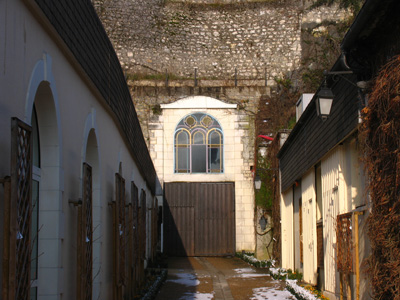
Approach to the Couly Dutheil cellars
in the centre of Chinon
Due to finishing the fine 2018 harvest Arnaud Couly stayed behind in Chinon. They showed two whites from 2017 – Blanc de Franc (Vin de France) from 100% Cabernet Franc and Les Chanteaux (Chinon Blanc) from 100% Chenin Blanc. It is rare for Cabernet Franc to be vinified as a still white, although this is a frequent practice for Loire sparkling wines. It works well with the 2017 Blanc de Franc having good concentration and attractive texture. Of the two reds the Clos de l'Echo naturally stood out with its ripe concentration of black fruits. Although it can be drunk now this really needs more time in bottle to reveal its full potential.
My post next week will cover the producers from outside the Loire.

Tuesday, 12 June 2018
A day of combatting esca

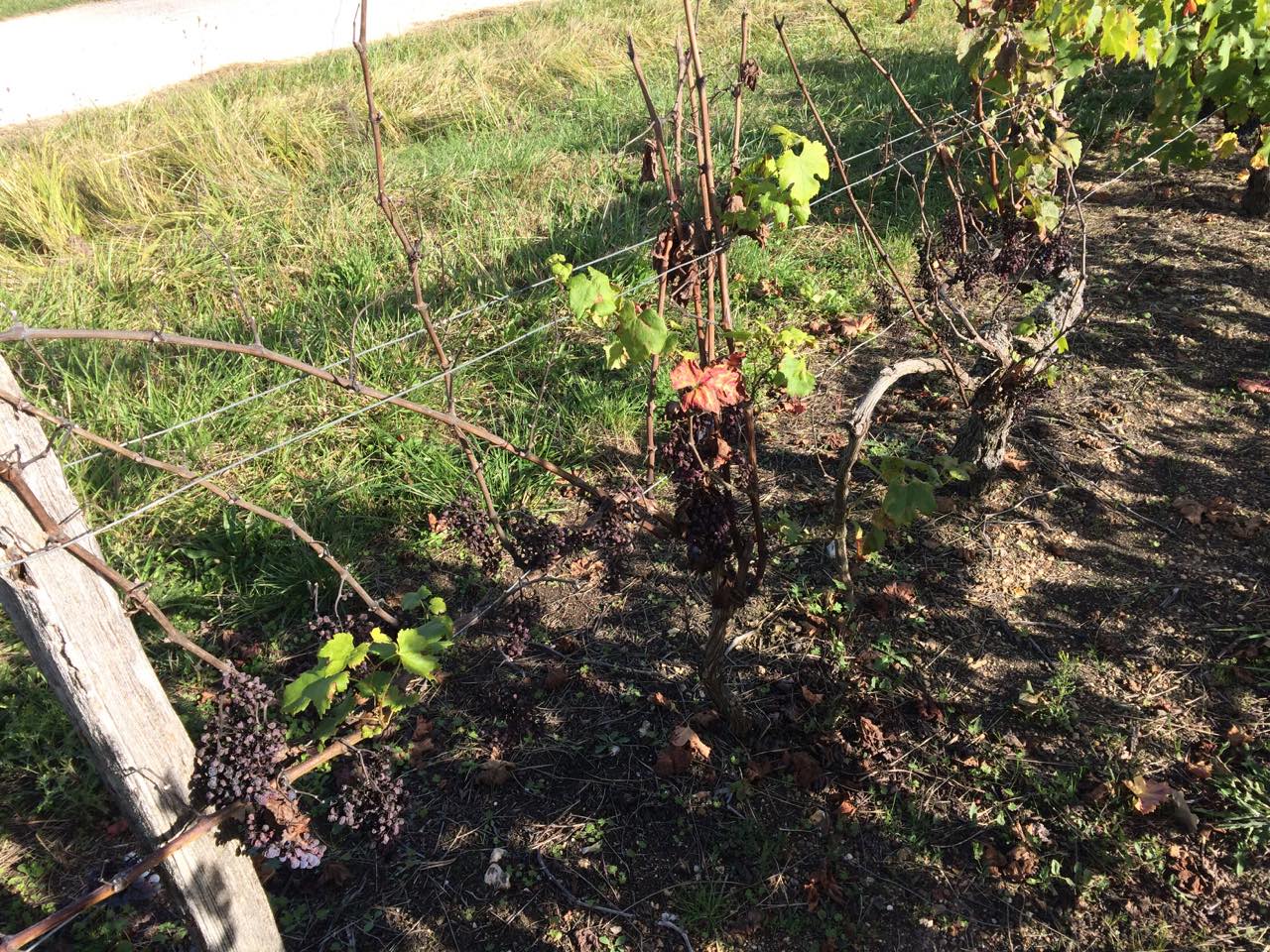
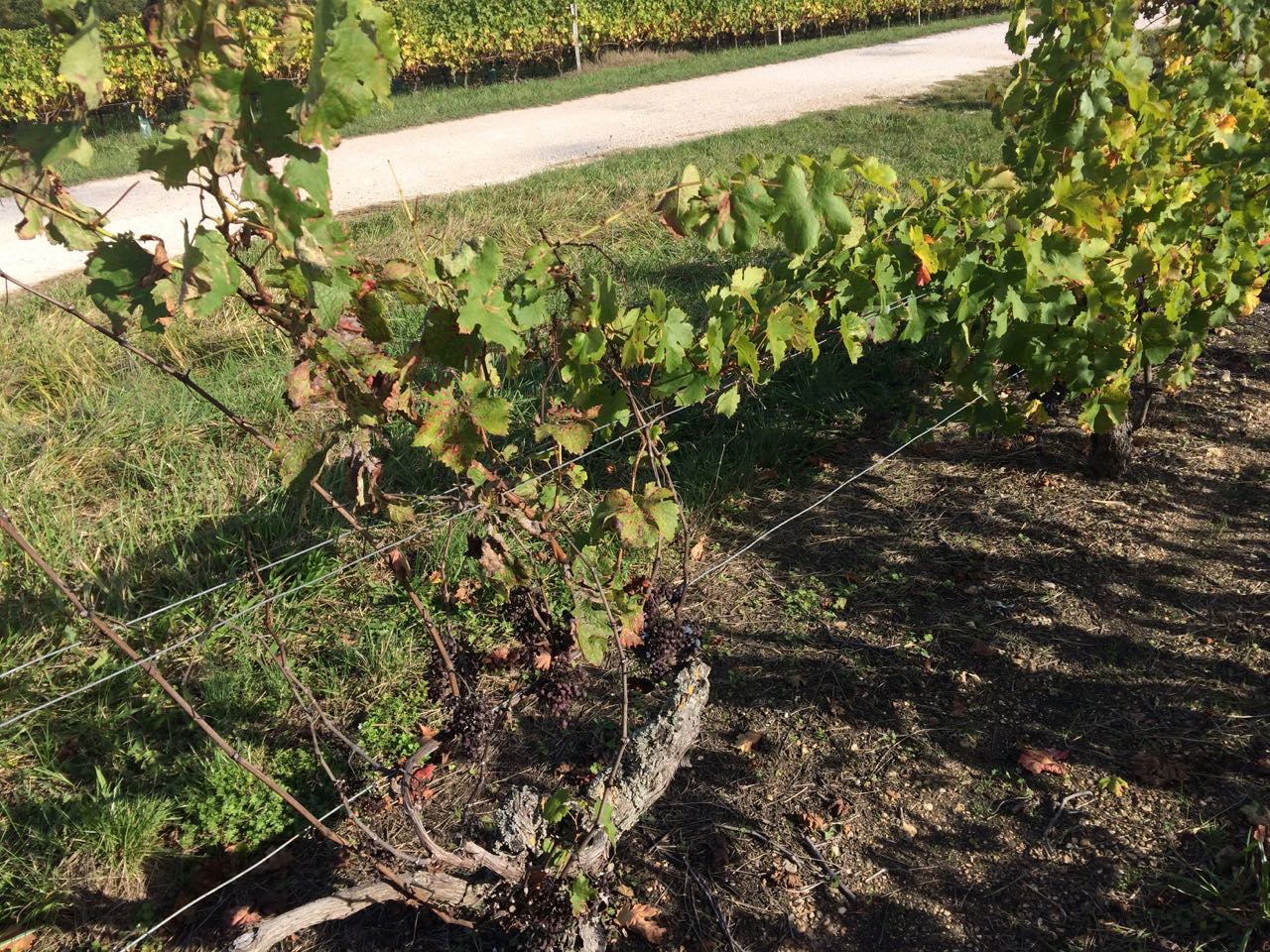
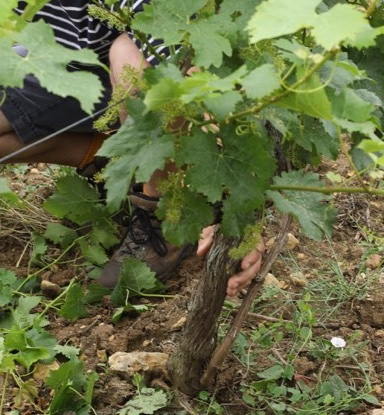
Vines affected by esca – note the loss of leaves and the shrivelled grapes:
September 2017 (above and immediately below)

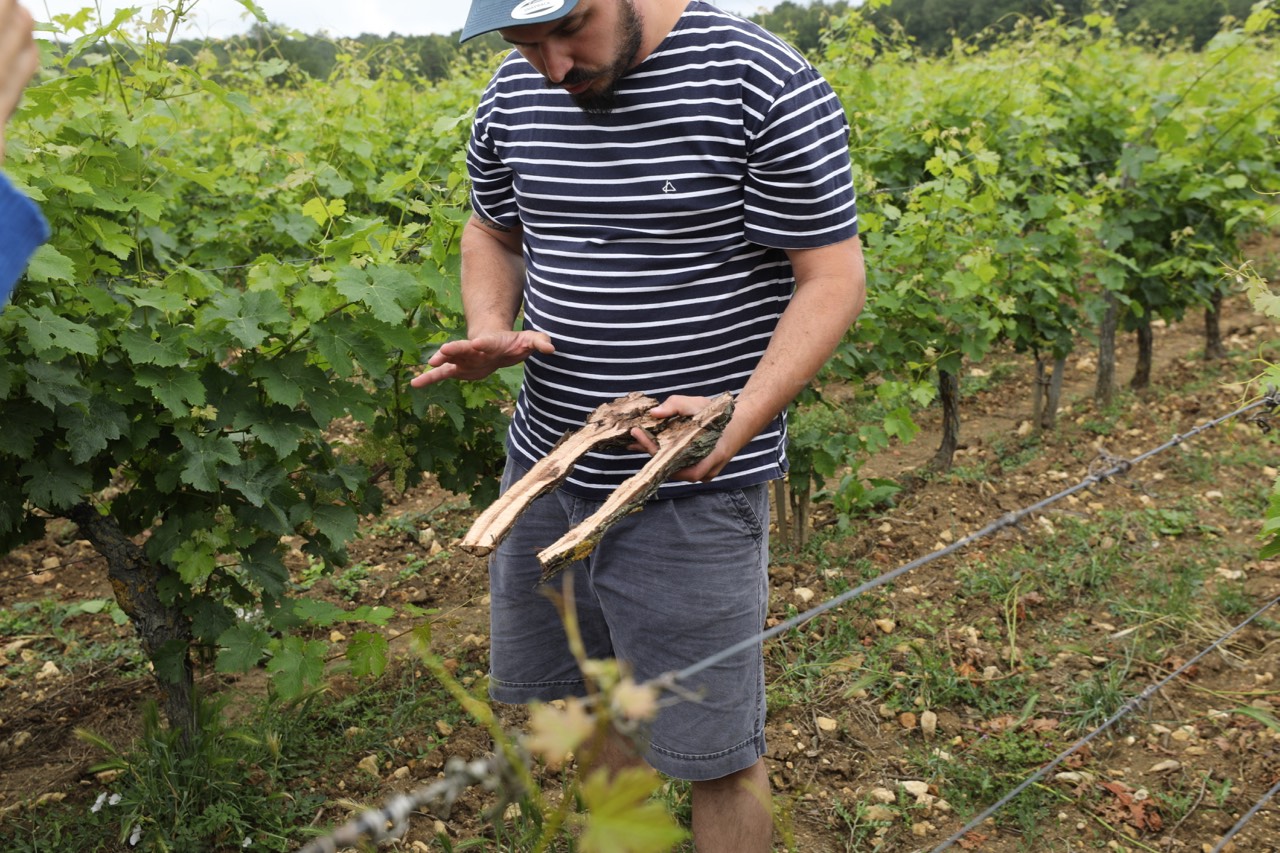
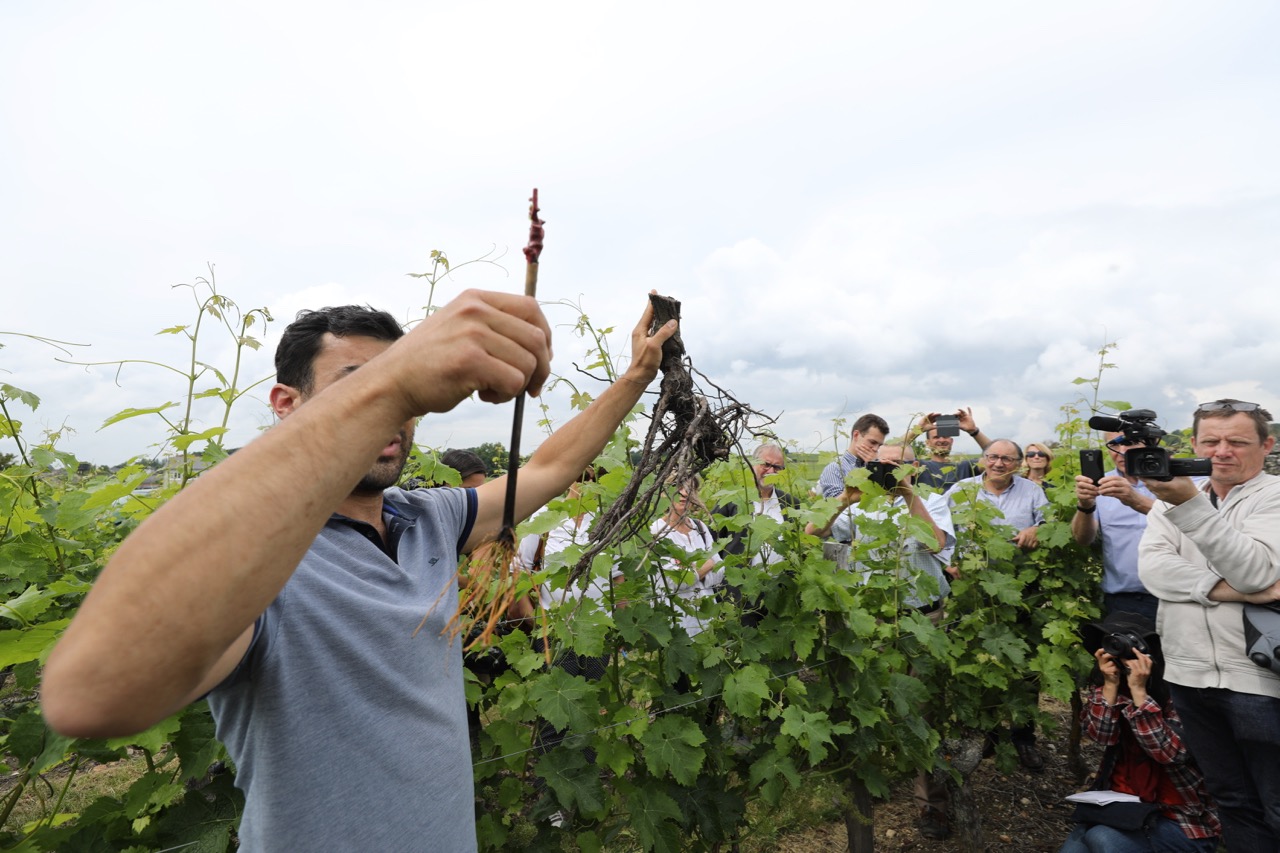
Boris Desbourdes, Domaine de la Marinière, Chinon – shows
the progress of esca through a trunk of a vine
Last Tuesday (5th June 2018) I was invited on a day-long press trip to learn more about the fungal vine disease, esca, and the methods used to combat or alleviate it.
Esca is a major problem causing a significant proportion of vines to die every year. Annual mortality estimates vary from around 2% to 10% or more. This depends upon a number of factors including the year and the stress the vines are under as well as the grape variety. Worryingly for the Loire, especially Touraine and the Central Vineyards, Sauvignon Blanc is particularly susceptible to the disease.
There are numerous initiatives now underway to combat and to eventually find a solution. These initiatives put the vignerons at centre of the research. Unfortunately it is currently not known what has triggered esca – what the causes are. There are a number of theories – nurseries supplying below quality plants, excessive use of chemicals weakening/ killing off the micro-organisms around the roots, errors in pruning etc. There may, of course, not be one factor but a whole number of them.
Until 2001 arsénite de sodium was used to control esca. I understand that it wasn't a cure but helped to keep esca under control. In 2001 it was banned because it caused a number of cancers, especially amongst vineyard workers.
Esca is a fungal disease that apparently works it way down the trunk of a vine until it eventually cuts off the supply of sap which is carried up by two 'arteries'. Once this happens the vine dies very quickly – like a human hit by a stroke.
Methods of combatting/alleviating the disease

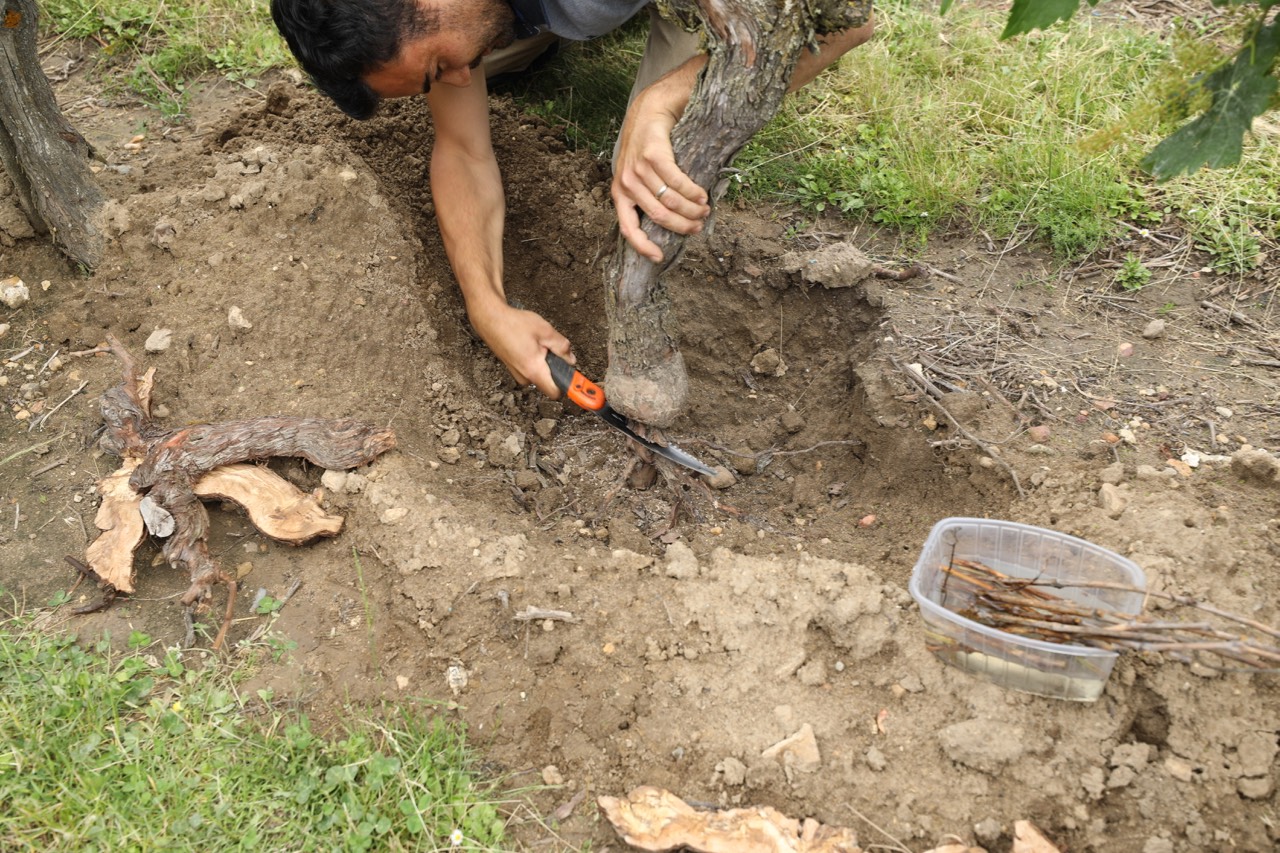
Curetage – the most dramatic method

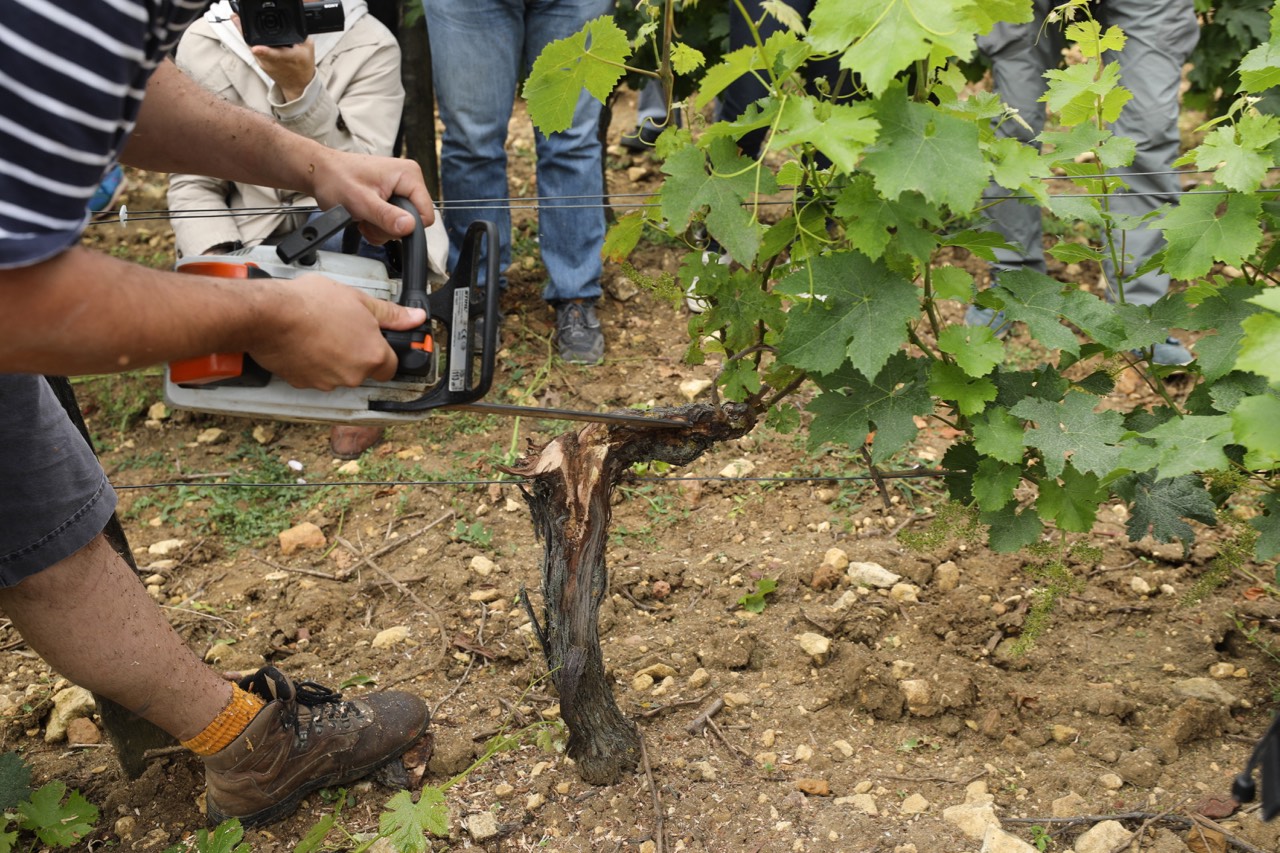
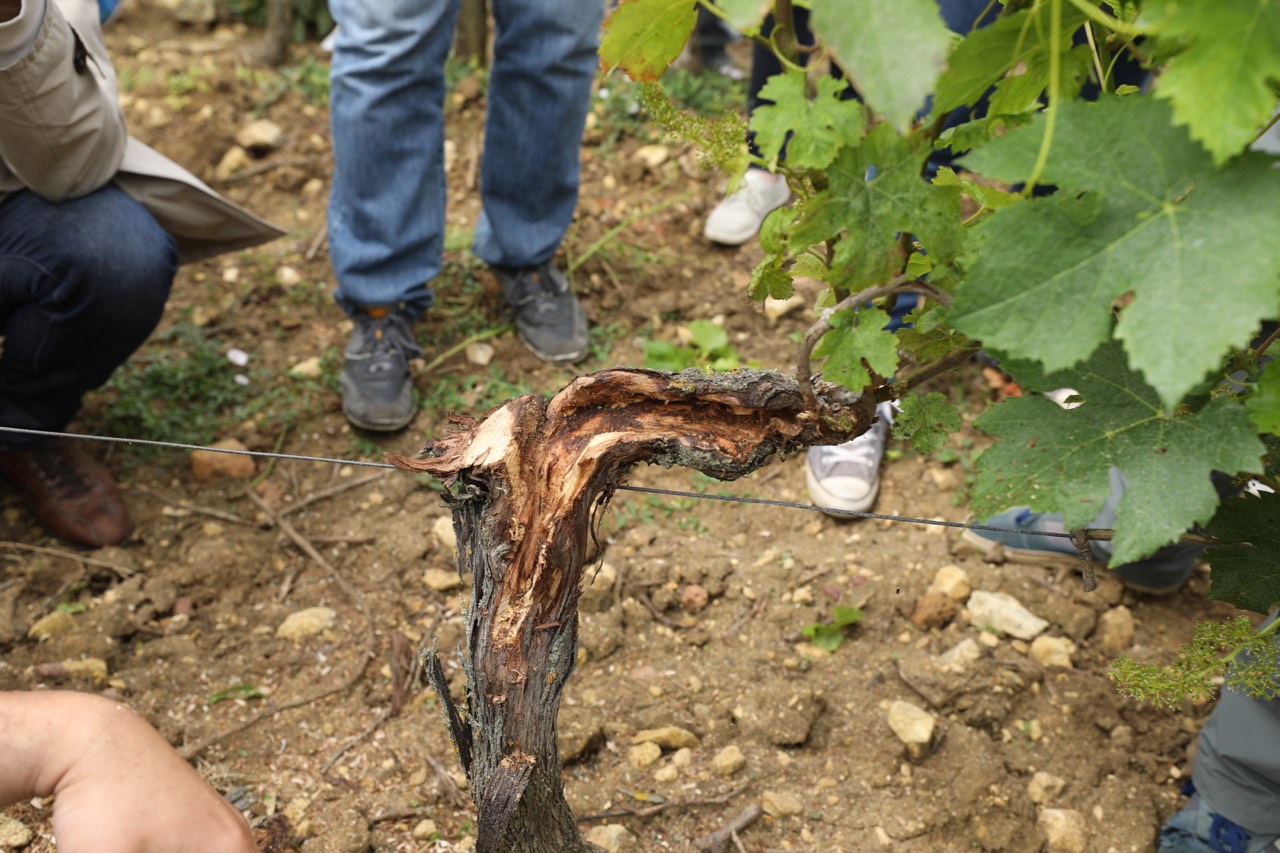
Job done – diseased wood cut out and trunk exposed to
the air
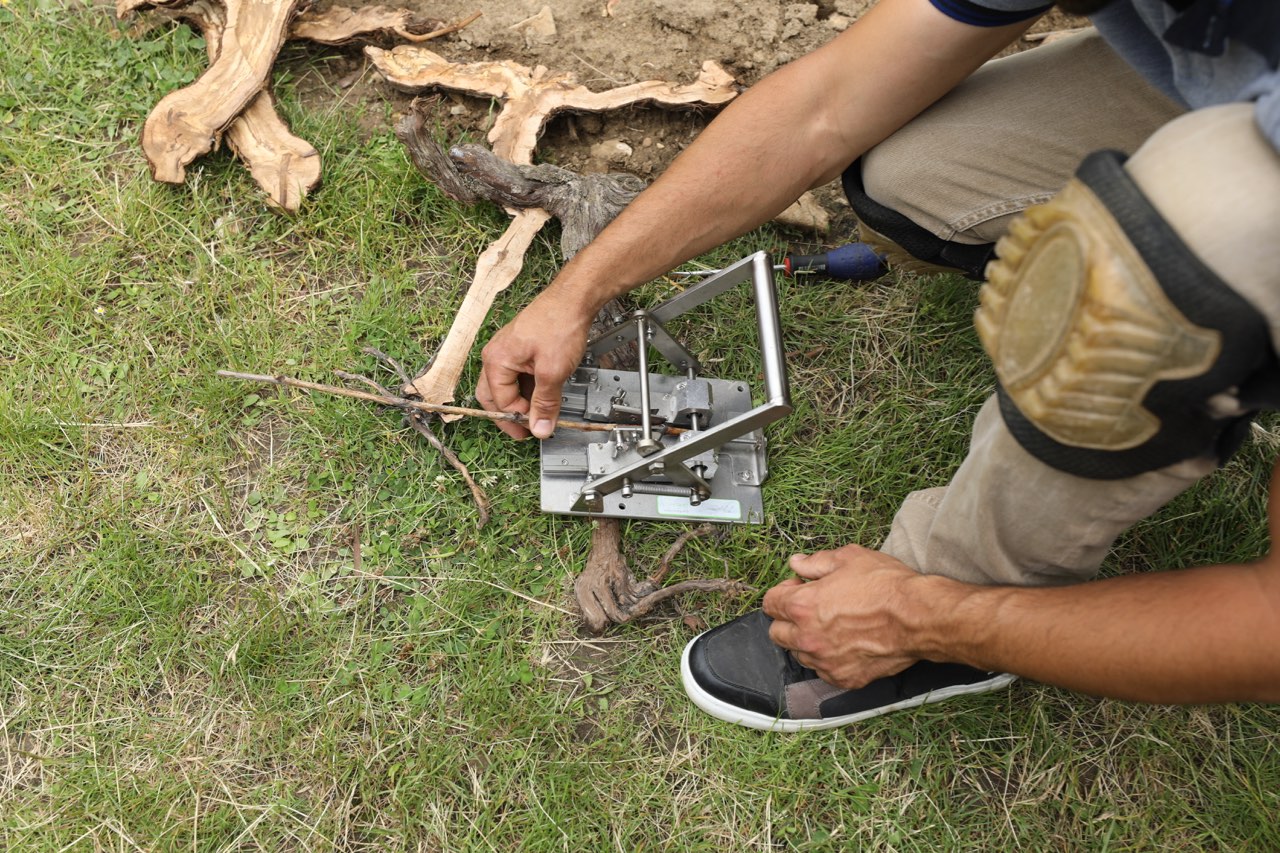
During visits last Tuesday to two domaines – Domaine de la Marinière (Chinon) and Domaine de Lavigne we were shown three different techniques –recépage, curetage and regrafting.
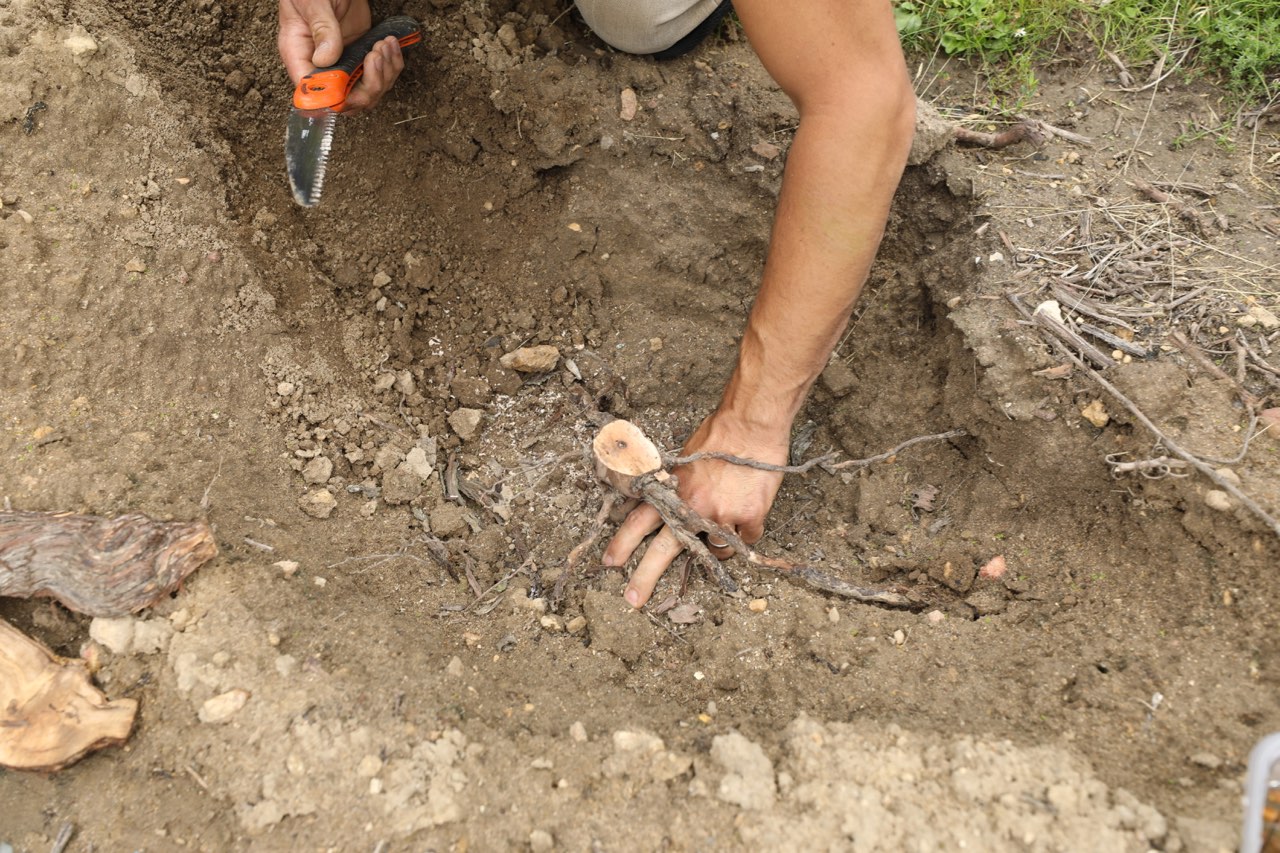
Curetage is the most dramatic as it involves using a small power saw to cut out the diseased parts of the vine's trunk. See the demonstration by Boris Desbourdes in the photos above. The second photo shows that the diseased wood has been cut away and the fungus exposed to the air, which kills it. Clearly this technique, which was trialled in Sancerre, requires considerable skill and a steady hand. It would only take a slight slip and your vine would be decapitated...
.
Recépage – detail
Recépage
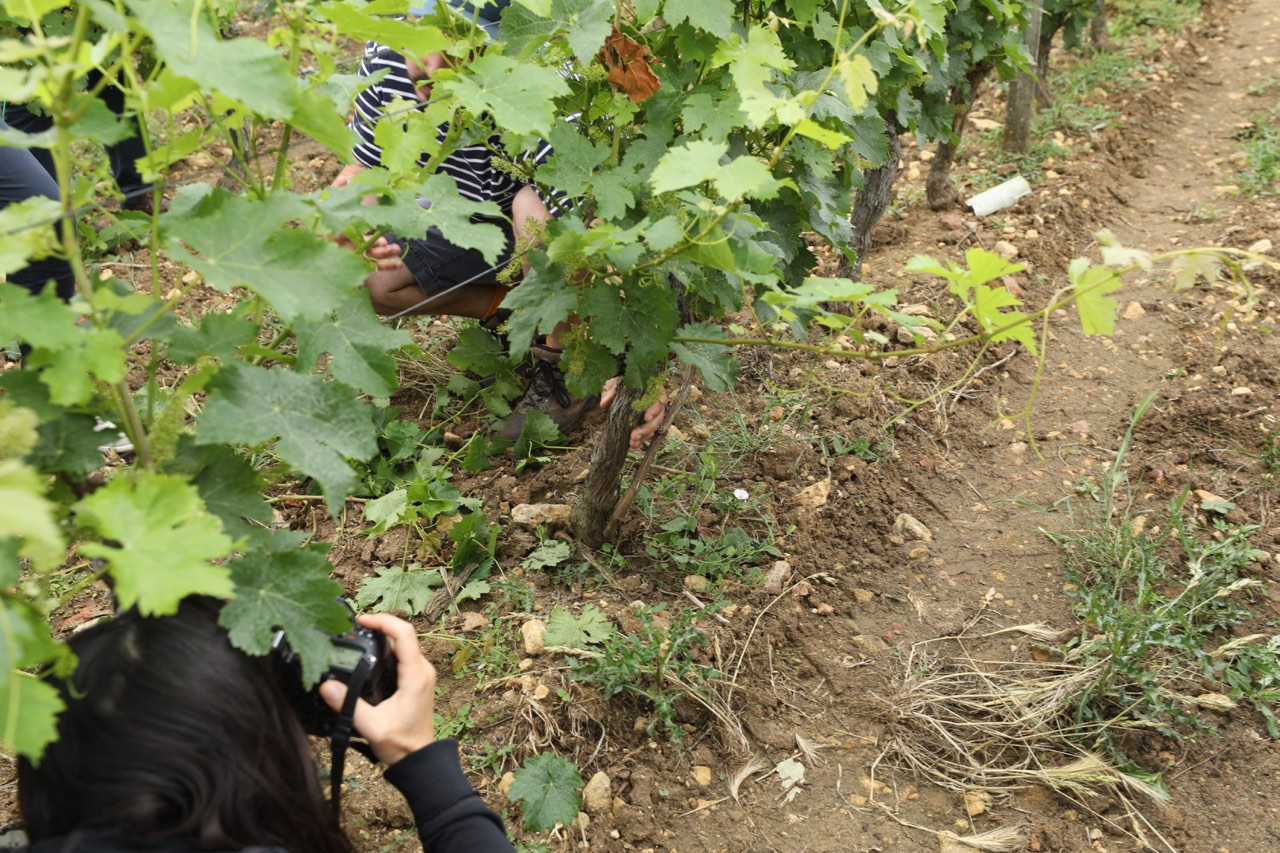
This is a technique that is quite widely used in Champagne. It involves using a branch from the base of the vine just above the graft and training it to replace the existing trunk. This procedure can then be repeated at regular intervals.
•••
Regrafting
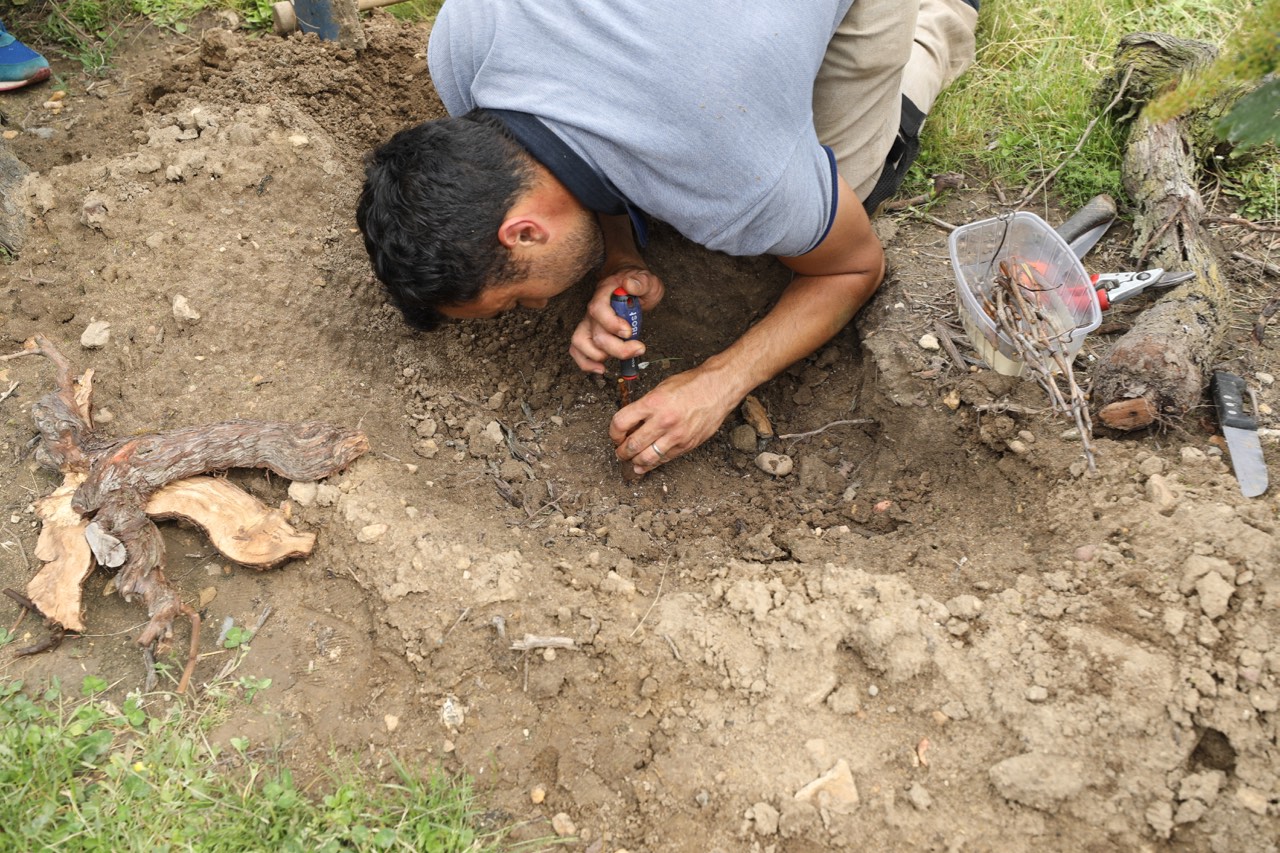
Thomas Chassaing with graft and a dead vine trunk

Preparing the vine graft

Thomas cutting just above the rootstock graft

After cutting the base for the graft

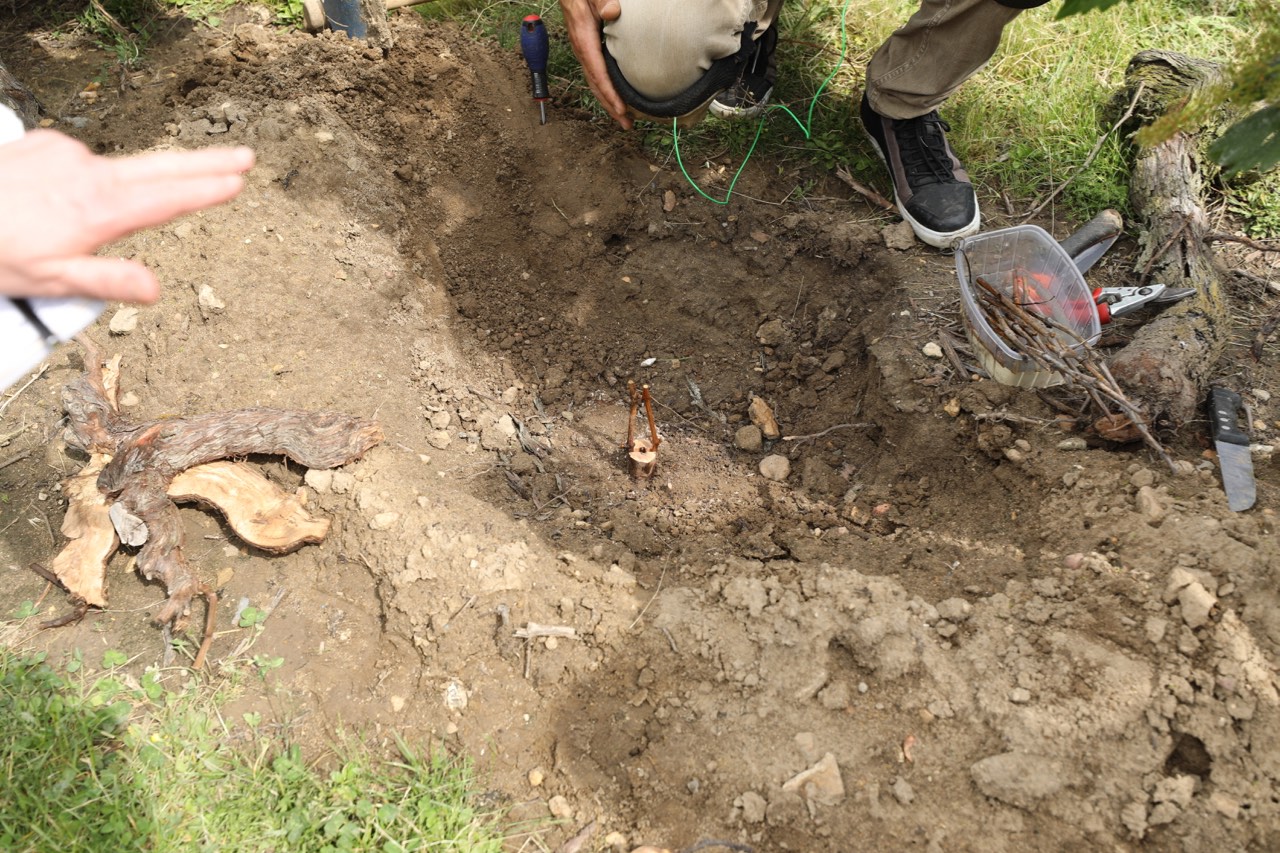
Two grafts – just to make doubly sure

Two grafts – detail
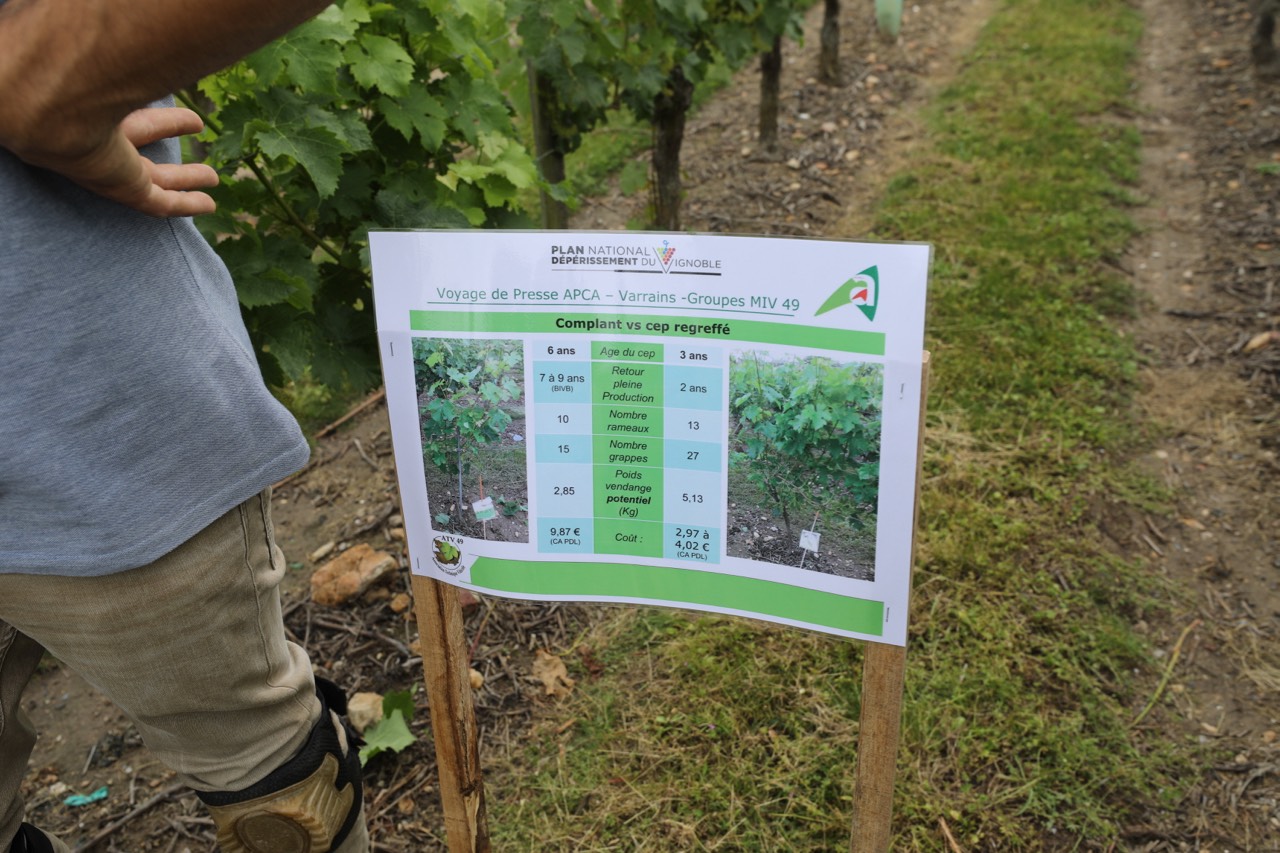
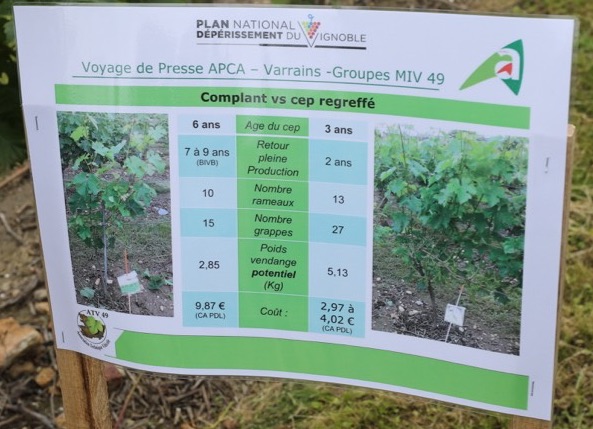
Chassaing and his charts showed that using regrafting would put your vine back in full production after two years compared to seven to nine years if you replanted. At six years for a replanted vine you could expect to harvest 10 bunches of grapes compared to 27 for regrafting – 'seems far too high to me' if you are looking for quality.
Importantly costs ranged from 2.97€ to 4.02€ for regrafting instead of 9.87€ to replant. Chassaing explained that once a producer has a 40% grafting success rate then this is the breakeven point,


Comparison of costs between replanting and regrafting
It will be fascinating to follows the combat against esca. Will there be a cure of will it be a question of choosing one or two strategies seeking to limit the effects of esca.
A suivré......
.
Tuesday, 29 May 2018
2018 VitiLoire – Plouzeau and Bonneau

New Chinon Blanc
I tasted the 2016 Silice the first Chinon Blanc from Marc Plouzeau – Château de la Bonnelière Marc planted his 50 ares of Chenin Blanc in 2013 on a south facing site. This rich and concentrated wine is vinified in 600 litre barrels. There are some wood notes present but these I expect will soon blend in.
Rapport qualité-prix in Saumur-Champigny
Domaine la Bonnelière
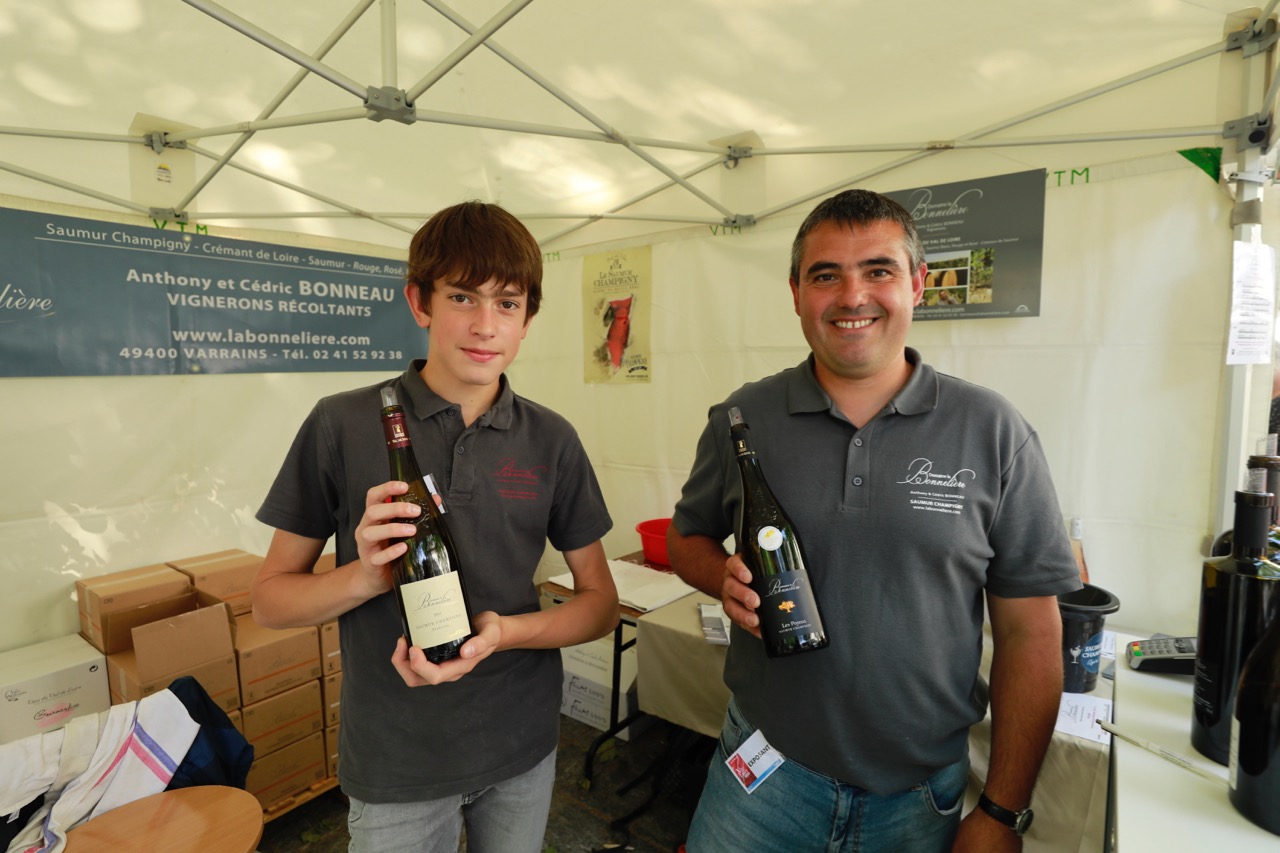
Son of Anthony Bonneau helping Cedric Bonneau on their stand
Domaine la Bonnelière in Varrains continues to offer remarkable value and quality with both their Saumur-Champigny Tradition (6€) and Les Poyeux (8.50€). The Tradition is currently 2017 and 2015 for Les Poyeux.
Thursday, 17 May 2018
Christophe Surget (Couly-Dutheil) – very sad news
I was very shocked and sad to learn yesterday of the sudden death of Christophe Surget, who looked after the commercial and export side of Couly-Dutheil (Chinon). Christophe was just 50 years old.
My thoughts and sincere condolences to his family and friends.
The funeral is tomorrow (Friday May 18th) at 11am at St Symphorien Church located in Couëron.
Wednesday, 11 April 2018
2015 Clos de l'Echo, Chinon, Couly-Dutheil
Just across from and to the west of the medieval fortress of the Château de Chinon, the Clos de l'Echo is one of the most famous and long-established single vineyards in the Loire. This is 100% Cabernet Franc. Echo was once owned by François Rabelais' family. In 1952 it was bought by René and Madelaine Couly.
The 2015 Clos de l'Echo has impressively ripe concentrated black fruits. Almost pure fruit, its concentration currently hides the wine's structure. This is an example of how forward even the top 2015 Loire reds are.
Wednesday, 7 March 2018
2017 Le temps des cerises, Chinon, Domaine de la Noblaie
2017 Le temps des cerises, Chinon,
Domaine de la Noblaie
Le temps des cerises (100% Cabernet Franc) is Domaine de la Noblaie's cuvée printemps (Spring wine). These Spring cuvées should be all about attractive, youthful fruit with light, soft tannins – ready to drink now to celebrate the passing of winter and the arrival of spring.
The 2017 Le temps des cerises is a very good example of a cuvée printemps with its delicious, lightly crunchy pure fruit and good balance of fruit and freshness in the finish. This is a wine to share and enjoy with friends – it is all too likely that the contents will disappear remarkably quickly.....! Another example of Jérôme Billard's wine-making skills.
Monday, 5 March 2018
Loire: increased frost protection – inc report from Chinon
Anti-frost wind turbine at
Saint-Nicolas de Bourgueil
Paulée Nantaise: October 2017
This April will be a particularly stressful month for many Loire producers: a third consecutive frost would be catastrophic for many growers who were hit by frost in both 2016 and 2017. Fortunately, the weather to date in 2018 has been cold, so bud break should be considerably later than it was in 2016 and 2017, so hopefully less worry. However, bud break was late in 2013, which didn't prevent some areas being hit by frost late in April.
Increasingly the Loire is investing in frost protection. This has long been in the case in low lying Quincy, which is very frost prone, with a number of wind turbines as well as other places like Noble Joué and the Clos Roche Blanche in the Cher Valley. Now, however, there is a more of a concerted effort to combat the frost menace. Below there is a press release from Chinon announcing that nearly 50% of areas at risk are now frost protected. Hopefully it will not be too long before all risk areas in the Chinon appellation have some protection.
In nearby Saint-Nicolas-de-Bourgueil they are also investing in wind turbines in the flatter gravel vineyards – vines on the limestone coteaux are rarely hit by frost.
In Muscadet, which was hit by frost in both 2016 and 2017, they are using imaginative ways of raising the necessary funds to invest in frost protection, especially wind turbines. A number of growers paired up with local chefs to hold special wine and food events in their restaurants – Paulée Nantaise – with proceeds going to help combating frost.
Press release from AC Chinon:
'Quatre à cinq jours de lutte contre le gel par an pour sauver une récolte : en 2018, 50% des zones à risque de l'AOC Chinon seront protégées
La protection contre le gel du vignoble de Chinon s'accélère : en 2018, ce sont près
de 50% des zones dites gélives de l'AOC Chinon qui seront protégées, soit 538
hectares sur les 1200 les plus exposés (l'appellation compte au total 2400 hectares
en production). Le mode de protection le plus utilisé sur l'appellation reste celui des
tours antigel amovibles ou fixes. Si cette lutte ne dure que 4 à 5 jours par an, elle est
une épreuve pour tous, dont l'issue heureuse est la préservation des emplois et de
l'économie de tout un territoire.
Les gels de printemps de 2016 et 2017 ont été un coup dur pour l'appellation Chinon, réduisant de moitié le rendement moyen par hectare en 2016 et d'un quart en 2017. Une perte estimée à 25 millions d'euros au total sur les deux années pour les 181 vignerons que compte l'appellation, à laquelle ils ont pu faire face grâce au stock de bouteilles qu'ils avaient conservé.
Les vignerons connaissent régulièrement des aléas climatiques mais il est rare d'enchainer deux années consécutives de gel intensif. Aussi, ils se sont organisés pour expérimenter plusieurs procédés de lutte, à l'image de la CUMA de Cravant Les Côteaux laquelle, après le gel de 1991 et 1994, avait mis des moyens en commun pour investir dans les tours antigel ou tours à brassage d'air. Fabrice Gasnier, Président de la CUMA de Cravant Les Coteaux met à présent son expérience à profit au Syndicat des vins de Chinon, où il est administrateur en charge du lourd dossier "aléas climatiques". Le Syndicat a d'ailleurs commandé une étude sur l'aspersion dont les premiers résultats seront connus au premier semestre 2018.
Les moyens de protection
Aujourd'hui, quatre moyens de lutte contre le gel existent sur le vignoble : l'aspersion, les tours antigel, les bougies et les frostguard (sorte de chauffage que l'on peut déplacer). Le mode de protection le plus utilisé sur l'appellation reste celui des tours antigel. Des moyens de lutte coûteux - pour exemple, une tour avec son installation complète coûte en moyenne 42 000 euros - pour seulement quelques jours d'utilisation dans l'année... mais qui peuvent sauver une récolte et faire toute la différence !
Le brassage de l'air avec les tours
Mélanger l'air froid situé au niveau des bourgeons avec l'air plus chaud présent en altitude permet de protéger une surface de vignes d'environ 5 à 6 hectares si la température ne descend pas au dessous de - 4°C. Les tours fixes ou amovibles fonctionnent comme un ventilateur géant avec des pales en action et sont particulièrement efficaces en cas de gelées blanches.
Le gel ... contre le gel, la protection par l'aspersion
Cela peut paraître contradictoire mais l'aspersion c'est à dire le principe qui consiste à envoyer de l'eau sur les vignes avec un système de brumisateur, crée un phénomène de protection contre le gel : quand l’eau gèle, le changement de phase liquide en phase solide est une transition exothermique. L’eau qui se transforme en glace libère donc des calories qui vont protéger ce qui est en dessous, à savoir les bourgeons. Il faut ensuite maintenir l’arrosage en continu, jusqu’à ce que la température remonte au dessus de +3°C.
Chauffer les vignes avec des bougies ou des frostguard
L'une des plus vieilles traditions de lutte contre le gel est l'installation de bougies au pied des ceps postées à intervalles réguliers, ou bien une sorte de chauffage que l'on fait circuler entre les rangs de vignes en période de gelées pour gagner 2 ou 3°C
A noter : Pour informer les riverains sur les moyens de lutte contre le gel, des réunions publiques d'information vont être organisées sur plusieurs secteurs de l'appellation : Cravant le 27 mars à 18h30 et Panzoult le 29 mars à 18h30 et Chinon le 3 avril.'
Fingers crossed for a frost-free 2018.
Les gels de printemps de 2016 et 2017 ont été un coup dur pour l'appellation Chinon, réduisant de moitié le rendement moyen par hectare en 2016 et d'un quart en 2017. Une perte estimée à 25 millions d'euros au total sur les deux années pour les 181 vignerons que compte l'appellation, à laquelle ils ont pu faire face grâce au stock de bouteilles qu'ils avaient conservé.
Les vignerons connaissent régulièrement des aléas climatiques mais il est rare d'enchainer deux années consécutives de gel intensif. Aussi, ils se sont organisés pour expérimenter plusieurs procédés de lutte, à l'image de la CUMA de Cravant Les Côteaux laquelle, après le gel de 1991 et 1994, avait mis des moyens en commun pour investir dans les tours antigel ou tours à brassage d'air. Fabrice Gasnier, Président de la CUMA de Cravant Les Coteaux met à présent son expérience à profit au Syndicat des vins de Chinon, où il est administrateur en charge du lourd dossier "aléas climatiques". Le Syndicat a d'ailleurs commandé une étude sur l'aspersion dont les premiers résultats seront connus au premier semestre 2018.
Les moyens de protection
Aujourd'hui, quatre moyens de lutte contre le gel existent sur le vignoble : l'aspersion, les tours antigel, les bougies et les frostguard (sorte de chauffage que l'on peut déplacer). Le mode de protection le plus utilisé sur l'appellation reste celui des tours antigel. Des moyens de lutte coûteux - pour exemple, une tour avec son installation complète coûte en moyenne 42 000 euros - pour seulement quelques jours d'utilisation dans l'année... mais qui peuvent sauver une récolte et faire toute la différence !
Le brassage de l'air avec les tours
Mélanger l'air froid situé au niveau des bourgeons avec l'air plus chaud présent en altitude permet de protéger une surface de vignes d'environ 5 à 6 hectares si la température ne descend pas au dessous de - 4°C. Les tours fixes ou amovibles fonctionnent comme un ventilateur géant avec des pales en action et sont particulièrement efficaces en cas de gelées blanches.
Le gel ... contre le gel, la protection par l'aspersion
Cela peut paraître contradictoire mais l'aspersion c'est à dire le principe qui consiste à envoyer de l'eau sur les vignes avec un système de brumisateur, crée un phénomène de protection contre le gel : quand l’eau gèle, le changement de phase liquide en phase solide est une transition exothermique. L’eau qui se transforme en glace libère donc des calories qui vont protéger ce qui est en dessous, à savoir les bourgeons. Il faut ensuite maintenir l’arrosage en continu, jusqu’à ce que la température remonte au dessus de +3°C.
Chauffer les vignes avec des bougies ou des frostguard
L'une des plus vieilles traditions de lutte contre le gel est l'installation de bougies au pied des ceps postées à intervalles réguliers, ou bien une sorte de chauffage que l'on fait circuler entre les rangs de vignes en période de gelées pour gagner 2 ou 3°C
A noter : Pour informer les riverains sur les moyens de lutte contre le gel, des réunions publiques d'information vont être organisées sur plusieurs secteurs de l'appellation : Cravant le 27 mars à 18h30 et Panzoult le 29 mars à 18h30 et Chinon le 3 avril.'
Fingers crossed for a frost-free 2018.
Saturday, 3 March 2018
Loire: some dates for your diary: Bourgueil and Chinon
16th Fêtes des Vins de Bourgueil à Tours
Saturday 24th March 2018
16th Fêtes des Vins de Bourgueil à Tours: Saturday 24th March 2018
Venez rencontrer une cinquantaine de vignerons de Bourgueil installés boulevard Heurteloup à Tours pour déguster et découvrir le millésime 2017.
En présence de la Commanderie de la Dive Bouteille de Bourgueil et Saint-Nicolas de Bourgueil, et de métiers de bouche qui proposent une restauration sur place, cette 16ème édition de la Fête des Vins de Bourgueil à Tours proposera également des animations pour les enfants autour du goût et de la dégustation.
••••
Château du Petit Thouars
Portes Ouvertes Saturday 31st March - Monday 2nd April 2018
Saturday 21st April 2018 – Chinon: Les Vignerons dans la Ville
Le
samedi 21 avril 2018, de 10h à 18h30 à Chinon (37)
Quoi de neuf pour l'édition 2018 des Vignerons dans la
Ville à Chinon ? Le millésime 2017 bien sûr ! On piétine déjà d'impatience à
l'idée de goûter les premiers jus, enfermés dans les cuves, barriques ou
amphores depuis les précoces vendanges pleines de soleil de l'année dernière. Avril est le mois de la libération du
vin ... et celui du partage, incarné par la manifestation "Les vignerons
dans la ville" : l'esprit de Chinon avec
ceux qui le font.
Monday, 26 February 2018
2015 Clos de l'Olive, Chinon, Couly-Dutheil
The Clos de l'Olive is one of Couly-Dutheil's top single vineyard sites. The 2015, although still young, is impressive with good concentration of fragrant Cabernet Franc, an attractively opulent texture and well integrated tannins. As I have already remarked the tannins in the Couly Dutheil range are much better handled than they were around a decade or more ago when many had a dry tannic finish.
The 2015 Clos de l'Olive certainly can be enjoyed now but also has the potential to age for a couple of decades or more, though I suspect many corks will have been pulled before then ...
Saturday, 17 February 2018
Encore Couly-Dutheil – 2015 Baronnie Madeleine
2015 Baronnie Madeleine, Chinon from Couly-Dutheil
Couly-Dutheil only release the Baronnie Madeleine cuvée in good vintages. 2015 is certainly on of them. Baronnie Madeleine comes from selected parcels on the clay limestone slopes or the plateau above these slopes. The 2015 has attractive concentration and plenty of soft black fruit. Very enjoyable to drink now it lacks, for the moment (?), an extra dimension. On the other hand it is noticeable that the tannin management is greatly improved over the last decade. Gone are the dry, harsh tannins that marred their wines in the first decade following the millennium.
Friday, 9 February 2018
2015 Domaine René Couly, Chinon, Couly-Dutheil
Domaine René Couly is another fine 2015 red from Couly-Dutheil. These vines are planted on clay and flint and from parcels selected by René Couly, the grandfather of the company's current MD – Arnaud Couly.
The deep coloured 2015 Domaine René Couly is considerably more concentrated than Wednesday's featured wine – 2015 Les Gravières. Although drinking well now, the René Couly has considerably potential to improve and age over several decades.
Wednesday, 7 February 2018
2015 Les Gravières, Chinon, Couly-Dutheil
This cuvée (100% Cabernet Franc) comes from vineyards planted on sand and gravel close to the River Vienne. Full of soft, black fruit it underlines what an attractive vintage 2015 is. Les Gravières sees no wood and is bottled at Easter time with the accent on its youthful fruit.
Tuesday, 6 February 2018
2016 Les Chanteaux, Chinon Blanc, Couly Dutheil
2016 Les Chanteaux, Chinon Blanc from Couly-Dutheil is the the first of six of their wines to try. Although with the integration the eight new communes to the west of the Chinon appellation has seen a significant increase up to 83 hectares in the amount of Chenin Blanc planted in the Chinon appellation, Chinon Blanc remains dwarfed by red Chinon.
The 2016 has attractive concentration – both floral and quince notes – with well balanced acidity in the finish. Les Chanteaux is good to drink now but will surely keep for at least a decade.
Saturday, 23 December 2017
2012 Pierre de Tuf, Chinon, Domaine de la Noblaie
Last night we opened a bottle of the 2012 Pierre de Tuf, Chinon from Domaine de la Noblaie in Ligré. It is interesting to compare the 2012 with the 2014 Pierre de Tuf, which has just been selected as one of Decanter's best wines of the year.
2012 was quite a difficult vintage following frost and widespread mildew along with a very wet October. Although the Cabernet Franc reds of 2012 are better than 2013, there is still not the ripeness and balance that you find in the 2014s. The 2012s have quite marked acidity in the finish – probably limiting their appeal to amateurs of Loire reds. 2014 vintage produced wines with a lovely balance, although the vintage was saved by a wonderfully warm autumn following a disappointing summer.
The 2012 certainly needs food to soften its appeal and to mask the acidity. So an enjoyable bottle but not at the same level as 2014 or 2015. There are some that claim 2012 is a good vintage for Loire reds – I have yet to be convinced.
Subscribe to:
Posts (Atom)