Awards and citations:


1997: Le Prix du Champagne Lanson Noble Cuvée Award for investigations into Champagne for the Millennium investment scams

2001: Le Prix Champagne Lanson Ivory Award for investdrinks.org

2011: Vindic d'Or MMXI – 'Meilleur blog anti-1855'

2011: Robert M. Parker, Jnr: ‘This blogger...’:

2012: Born Digital Wine Awards: No Pay No Jay – best investigative wine story

2012: International Wine Challenge – Personality of the Year Award


Showing posts with label Frost. Show all posts

Saturday, 2 May 2020

Now into May – looks like no serious Loire frosts this year


Frost damage in April 2016


Although with fingers still crossed, it looks like there will be no serious frost damage this year. We are now into May and although we are not yet through the Saints de Glace (11th-13th May) the long range forecast for Chenonceaux to Friday 15th May indicates no frost with temperatures not dropping below 8˚C on 6th and 12th. All other nights are forecast to be above this. 

It could have been considerably different as bud break was early – well before the end of March. On 26th and on several nights at the end of march and early April temperatures fell well below freezing but fortunately the ground was very dry and humidity low so damage was avoided obviously assisted by the anti-frost measures many producers have taken individually and collectively especially since the severe frosts of 2016.

With coronavirus knocking wine sales both in France and on export markets a bad frost in 2020 would have been devastating. It would have meant that the Loire had been badly hit by frost in four – 2016, 2017, 2019 and 2020 – out of the last five years...... Thankfully we appear to have escaped this year!!    

Now with the current bout of wettish weather there is now the threat of mildew. Better keep those fingers crossed!!

   

Wednesday, 2 October 2019

2019 Loire – has heat damage become a new challenge?

Chenin + heat 
2019 Chenin Blanc from the Clos Mosny,
Domaine de la Taille aux Loups, Montlouis

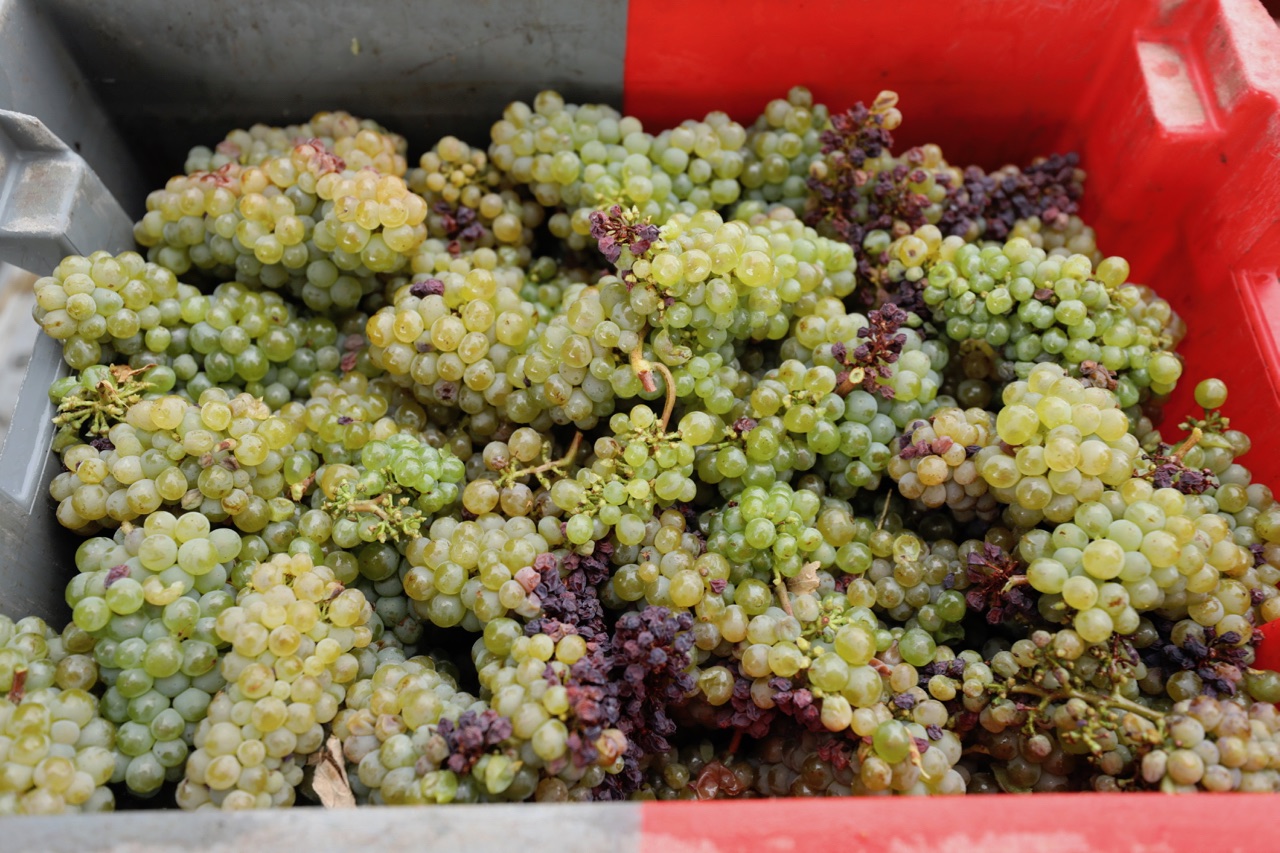
Frazzled
Frazzled bunch of Chenin Blanc: Clos Mosny

Unfortunately due to a number of family and work commitments, I haven't been able to make as many visits during the Loire harvest as I would like and normally do. However, it is clear that 2019 is once again a good to very good vintage in terms of quality with very like rot and very healthy grapes. In respect to the whites and rosés 2019 may well better than 2018, where some of the these wines are for me just too ripe and rich to be refreshing. For example, we quite often buy rosé from Domaine de la Grange (Bruno Curassier) in Bléré. I much prefer his fresher, leaner 2017 to the opulent 2018.
 
Jacky Blot (Domaine de la Taille aux Loups) is adamant that for whites 2018 is not a good vintage, although it is a good vintage for reds. Jacky is very pleased with the potential quality and balance of the 2019, although he was hit by both April frosts and grapes shrivelled by summer heat spikes of up to 40˚C. 

However, he has been pleasantly surprised to find that his Chenin has yielded more juice than he imagined. He thought yields would be around 25 hl/ha instead they are in the region of 35 hl/ha.

But quantity is down due to April frosts, poor weather due some of the flowering period, drought and as well as grapes frazzled by successive heat spikes.

Drought
A grey 'lawn' in Cher Valley
after four months of no rain – above and below

Droughta

In Eastern Touraine it was very dry from early June until 22nd September. Tours Weather Station recorded 1.2 inches of rain from 13th June to 21st September. The drought started to break on 22nd September. Everything looked very parched and when there were high winds in mid-September the emergency services were on high alert in case of fires spreading through the dry vegetation.

2019 is the sixth good quality vintage in a row starting from 2014. The Loire has never seen such a series. Previously it was exceedingly rare to have more than three successive good vintages. Looking back over this millennium only 2013 has been poor along with 2012 for sweet wines in Anjou. The days of rotten, unripe vintages in the 1960s, 70s and 80s now seems far away. Evidence, surely, of climate change.

At the International Chenin Blanc Congress at the beginning of July the South Africans said that the Loire, with its relatively small increase in temperature, would be feeling the benefits of climate change in contrast to their problems stemming from severe differences in climate. This may be so but changes are already having their effect in the Loire through increased incidences of frost plus sun frazzled grapes.

Xavier Frissant, vigneron at Mosnes and a leading actor in the push to promote Amboise to full cru status, has also been hit considerably by grapes being grilled by the sun. Incidentally 'grillé' is an expression used by the late Gaston Huet (Domaine Huet) to describe the heat of the 1947 vintage. Xavier's Chenin has been particularly hit by the sun. Grapes that face the intense afternoon sun are always the most likely to be frazzled. It was noticeable looking at some of Xavier's Côt that bunches that faced the morning sun had largely been spared, while those facing the afternoon sun had been badly hit.

"This year during the heat spikes there was a three hour danger period – from 2pm to 5pm. We may have to look again at our viticultural practices to see how we can better protect the grapes from intense sunshine."

When I first started reporting about the Loire from 1989 it was fairly common for vineyards to look like dense hedges and to have to search about for  bunches. Over the past 20 years or so opening up the canopy has become common along with spreading out bunches to facilitate ripening and avoiding rot by encouraging currents of air to help dry the grapes. Deleafing has also been popular. Periods of extremely high temperatures as seen this year, even if some of the heat spikes have only lasted a few days, raises a question as to whether this is still the right approach.


Saturday, 6 April 2019

Early Thursday morning – once again April frost hits the Loire

A young bud at risk of being destroyed by frost

Dramatic photo from Frédéric Mabileau's Facebook page
The very real danger is that the ice will magnify the sun's rays 
and burn the delicate young bud.

Aspersion at Domaine Frédéric Mabileau, 
Saint Nicolas de Bourgueil.
Provides protection by spraying water on 
the vines to make a protection coating of ice.


Thursday 4th April 2019 will be another black date etched in the memory of some Loire vignerons as yet another spring frost strikes part of the Loire Valley. 

Early on Thursday morning temperatures dropped in parts of the Loire to a low as minus 4. Wednesday afternoon and Thursday saw a lethal combination of factors. It rained during the latter part of Wednesday, which meant that there was a lot of humidity and that the vines are their young buds and leaves were wet. The skies cleared. The humidity turned to ice as the temperatures fell into Thursday and then on day break the sun rose in the clear skies. The ice around the young buds and leaves acted as a magnifying glass for the sun's rays burning those leaves and buds. This meant that even the temperatures didn't have to be as low for minus 4 for severe damage to be caused. In the Layon it fell to minus 2 with the humidity unfortunately accentuating the damage.  

This lethal combination of weather factors mirrors that of the very destructive frost of 21st April 1991. A damaging frost in early April has recently been rare, although in 2003 there was a frost on 8th April, which luckily caused limited damage. The destructive frosts have tended recently to come in the latter part of April.   

Reports from regions and producers (Friday 5th 2019)
Obviously these are initial reactions and it is too early yet to really know the extend of the damage. However, in general it seems that its is largely the vineyards to the west of Tours that have been affected. To date the vines in the Cher Valley 

François Robin, Vin de Nantes:  
"Yes we have some frost damage, especially in the areas, like Clisson, Mouzillon, Le Pallet and the Côtes de Grandlieu, where bud break is early. It is too early to know exactly how much the damage is. Fortunately 2018 was a big vintage so we have some stock in reserve. We had rain and hail during Wednesday. Then temperatures fell to minus 3 overnight."

Vincent Ogereau, Domaine Ogereau, Saint-Lambert-du-Lattay (Anjou)
"We have been very badly hit. It rained during Wednesday so there was a lot of humidity. Overnight the temperature fell to minus 2. The vines were completely white with hoar frost. Then the sun came up and burnt the buds and leaves. Savennières has been very badly hit. Unfortunately as the vines are well in advance this year the second generation buds may also have been affected." 


Ironically the 4th April was the 30th birthday of Emmanuel, Vincent and Catherine's son, who is now increasingly in charge of the domaine. The frost obviously put a considerable dampener on the celebrations.  

Ivan Massonnat, Domaine Belargus, Saint-Lambert-du-Lattay (Anjou)
'Bad news first: on a gelé à 60-80% dans la nuit de mercredi… Voila, je découvre la (vraie) vie de vigneron ! Sniff."


'Damage?'

'C’est un peu tôt pour le dire… Mais on a été le plus touché sur Quarts de Chaume, les Treilles et les Ruchères. Tough life ! On va croiser les doigts pour que les 2 semaines qui viennent nous redonnent un peu d’espoir…'

(Ivan, who set up his new domaine last year discovering sadly part of the reality of being a vigneron.)
     
Florence Chevallier, Château de Villeneuve, Souzay-Champigny (Saumur)
"A little damage but not serious for the moment. However, I am worried about a possible frost on the night of this Saturday to Sunday."

The north side of Saumur-Champigny is normally less prone to frost than the part of the appellation in the communes of Varrains, Chacé and St Cyr. From Antoine Sanzay's facebook it appears that his frost protection measures worked. However, there was frost damage in this sector including the lower part of the famous Les Poyeux vineyard as well as Chaintres. It is reported that in places the temperature fell as low as minus 5. 

Francis Jourdan, Domaine Jourdan-Pickard, Cravant-les-Coteaux, (Chinon) aussi président Vins de Chinon
"Dégâts estimés à 25% sur l'appelation ávec des 70% sur Cravant, Panzoult Crouzilles sur les zones non protégées. Point positif l'aspersion et tours antigel ont plutôt bien fonctionné.

Elodie Billard, Domaine de la Noblaie, Ligré (Chinon)
"Yes we have been hit. The buds are all open. Our parcel of Chenin close to the house has been totally grilled."

Natalie Mabileau, Domaine Frédéric Mabileau, Saint-Nicolas-de-Bourgueil
"In places where we didn't have any anti-frost measures we think we have lost 90% of the crop, although it is still too early to be sure. The apersion system proved to be the most effective, while the wind machines also worked. Unfortunately the five new anti-frost machines that we bought for this year did not work properly – one broke down and the four others gave a much more restricted area of protection than we had been promised. 

Unfortunately more frost is forecast for Sunday. Hopefully this will be proved wrong. There is nothing that we can do.'  

Patricia Boucard, Lamé Delisle Boucard, Ingrandes de Touraine (Bourgueil)
"It is like 2016 (Bourgueil was very badly hit in 16). Thankfully last year's vintage was generous but this is the third frost in four years – we can't continue like this. It's the vines on gravel that were hit. It is, however, still too early to know the full extent of the damage."

Alexis Caraux, director of Vins de Bourgueil
The temperature dropped to minus 3 and although the frost has caused some damage it is still too early to know the extent of the damage. We need to wait for a a few days to have a clearer picture." 


François Chidaine, Montlouis aussi président du syndicat des vins de Montlouis-sur-Loire
'Il semble que des secteurs de la commune de Saint Martin Le Beau soient touchés, mais ce gel  ne permet pas à ce jour d' être précis sur le pourcentage de perte.

Le mois d'Avril n'est pas terminé, et de nouveaux épisodes de froid peuvent arriver.
Il semble que Montlouis dans sa globalité ait plutôt bien résisté à ce froid, des efforts collectifs et individuels de lutte y sont pour beaucoup .

En ce qui me concerne , je n'ai que très peu de dégâts et j'en suis heureux.'


Corinne Collain, Communication AOC Touraine & ses dénominations
'Il semblerait que le gel ait fait des dégâts relativement importants dans le secteur d’Azay-le-Rideau. La température est descendue jusqu’à moins 4. Les autres secteurs n’ont pas été impactés.'

Benoît Roumet, director Bureau Vins du Centre (Sancerre, Pouilly-Fumé, Menetou-Salon etc.)
Fortunately we haven't been affected by Thursday morning's frost that hit other parts of the Loire. Wind machines in Quincy were switched on but there are no reports of frost damage."


Further update: Monday 8th 2019
All the vignerons are worried as we are only in early April. In places temperatures fell overnight – Sunday to Monday. Here in Epeigné our central heating thermostat registered zero. Benoît Gautier (Domaine de la Châtaigneraie, Parçay-Meslay reported on Facebook that the temperature early on Monday morning was down to minus 2 in places. Fortunately it was a misty start which was providing some protection against the sun's rays. Also Sunday was fine and dry so less moisture than on last Thursday morning. 

Further west Saumur and Saumur-Champigny have been hit by a severe frost this morning (Monday 8th) with temperatures apparently dropping to minus 4. 

We are still in early April and traditionally the risk of frost is not over until Les Saintes de Glacé, which this year runs from Saturday 11th May until Monday 13th. However, recently the major risk has during April, especially in the latter part.

My thoughts are with the vignerons and vigneronnes during these stressful nights.


This post will be updated as I get more news.   


Wednesday, 2 May 2018

Has the Loire escaped spring frosts in 2018?

Anit-frost pots out in the Regional de Cosne 
and du Charitois

While hoping that I am not speaking too soon but it looks as though the Loire has escaped any serious damage from Spring frosts in 2018. Last night and the night before were rather nerve jangling as temperatures dipped. 

However, Laura Semeria of Domaine de Montcy reported that there hadn't been any frost in her domaine in Cheverny, which is prone to frost and where the forecast for Tuesday/Wednesday showed -1˚C. In Ligre (AOP Chinon) Jérôme Billard reported that they had to light to the anti-frost candles at 4am this morning and that they proved effective. 

Initially this coming night – Wednesday/Thursday – was forecast to be tricky but during today the temperatures forecast have risen so the frost risk appears to have gone away with no low temperatures forecast for the coming 10 days or so. 

Even so – we should continue to keep fingers crossed for a while.....      

Tuesday, 1 May 2018

Tuesday and Wednesday nights – squeaky bum time in Eastern Touraine

 Météo France forecast for Cheverny, whose low lying 
vineyards are frost prone 

Cheverny - 40% possibility of frost 
Tuesday/Wednesday night  


Vignerons in parts of eastern Touraine look to be facing a sleepless couple of nights on Tuesday/Wednesday and Wednesday/Thursday as temperatures drop to close on freezing or just below.

Elsewhere in Loire the forecast is for a little above freezing – fine as long as the forecast is accurate. Tonight's forecast for Vallet shows a low of 2˚C and 0% chance of frost. 2˚C is getting a bit close for comfort – so fingers crossed!   

Monday, 5 March 2018

Loire: increased frost protection – inc report from Chinon

Anti-frost wind turbine at 
Saint-Nicolas de Bourgueil

Paulée Nantaise: October 2017


This April will be a particularly stressful month for many Loire producers: a third consecutive frost would be catastrophic for many growers who were hit by frost in both 2016 and 2017. Fortunately, the weather to date in 2018 has been cold, so bud break should be considerably later than it was in 2016 and 2017, so hopefully less worry. However, bud break was late in 2013, which didn't prevent some areas being hit by frost late in April.

Increasingly the Loire is investing in frost protection. This has long been in the case in low lying Quincy, which is very frost prone, with a number of wind turbines as well as other places like Noble Joué and the Clos Roche Blanche in the Cher Valley. Now, however, there is a more of a concerted effort to combat the frost menace. Below there is a press release from Chinon announcing that nearly 50% of areas at risk are now frost protected. Hopefully it will not be too long before all risk areas in the Chinon appellation have some protection. 

In nearby Saint-Nicolas-de-Bourgueil they are also investing in wind turbines in the flatter gravel vineyards – vines on the limestone coteaux are rarely hit by frost. 

In Muscadet, which was hit by frost in both 2016 and 2017, they are using imaginative ways of raising the necessary funds to invest in frost protection, especially wind turbines. A number of growers paired up with local chefs to hold special wine and food events in their restaurants – Paulée Nantaise – with proceeds going to help combating frost.  

Press release from AC Chinon:


'Quatre à cinq jours de lutte contre le gel par an pour sauver une récolte : en 2018, 50% des zones à risque de l'AOC Chinon seront protégées 


La protection contre le gel du vignoble de Chinon s'accélère : en 2018, ce sont près de 50% des zones dites gélives de l'AOC Chinon qui seront protégées, soit 538 hectares sur les 1200 les plus exposés (l'appellation compte au total 2400 hectares en production). Le mode de protection le plus utilisé sur l'appellation reste celui des tours antigel amovibles ou fixes. Si cette lutte ne dure que 4 à 5 jours par an, elle est une épreuve pour tous, dont l'issue heureuse est la préservation des emplois et de l'économie de tout un territoire. 

Les gels de printemps de 2016 et 2017 ont été un coup dur pour l'appellation Chinon, réduisant de moitié le rendement moyen par hectare en 2016 et d'un quart en 2017. Une perte estimée à 25 millions d'euros au total sur les deux années pour les 181 vignerons que compte l'appellation, à laquelle ils ont pu faire face grâce au stock de bouteilles qu'ils avaient conservé. 

Les vignerons connaissent régulièrement des aléas climatiques mais il est rare d'enchainer deux années consécutives de gel intensif. Aussi, ils se sont organisés pour expérimenter plusieurs procédés de lutte, à l'image de la CUMA de Cravant Les Côteaux laquelle, après le gel de 1991 et 1994, avait mis des moyens en commun pour investir dans les tours antigel ou tours à brassage d'air. Fabrice Gasnier, Président de la CUMA de Cravant Les Coteaux met à présent son expérience à profit au Syndicat des vins de Chinon, où il est administrateur en charge du lourd dossier "aléas climatiques". Le Syndicat a d'ailleurs commandé une étude sur l'aspersion dont les premiers résultats seront connus au premier semestre 2018.

Les moyens de protection
Aujourd'hui, quatre moyens de lutte contre le gel existent sur le vignoble : l'aspersion, les tours antigel, les bougies et les frostguard (sorte de chauffage que l'on peut déplacer). Le mode de protection le plus utilisé sur l'appellation reste celui des tours antigel. Des moyens de lutte coûteux - pour exemple, une tour avec son installation complète coûte en moyenne 42 000 euros - pour seulement quelques jours d'utilisation dans l'année... mais qui peuvent sauver une récolte et faire toute la différence !

Le brassage de l'air avec les tours
Mélanger l'air froid situé au niveau des bourgeons avec l'air plus chaud présent en altitude permet de protéger une surface de vignes d'environ 5 à 6 hectares si la température ne descend pas au dessous de - 4°C. Les tours fixes ou amovibles fonctionnent comme un ventilateur géant avec des pales en action et sont particulièrement efficaces en cas de gelées blanches. 

Le gel ... contre le gel, la protection par l'aspersion
Cela peut paraître contradictoire mais l'aspersion c'est à dire le principe qui consiste à envoyer de l'eau sur les vignes avec un système de brumisateur, crée un phénomène de protection contre le gel : quand l’eau gèle, le changement de phase liquide en phase solide est une transition exothermique. L’eau qui se transforme en glace libère donc des calories qui vont protéger ce qui est en dessous, à savoir les bourgeons. Il faut ensuite maintenir l’arrosage en continu, jusqu’à ce que la température remonte au dessus de +3°C. 

Chauffer les vignes avec des bougies ou des frostguard
L'une des plus vieilles traditions de lutte contre le gel est l'installation de bougies au pied des ceps postées à intervalles réguliers, ou bien une sorte de chauffage que l'on fait circuler entre les rangs de vignes en période de gelées pour gagner 2 ou 3°C 

A noter : Pour informer les riverains sur les moyens de lutte contre le gel, des réunions publiques d'information vont être organisées sur plusieurs secteurs de l'appellation : Cravant le 27 mars à 18h30 et Panzoult le 29 mars à 18h30 et Chinon le 3 avril.' 

Fingers crossed for a frost-free 2018.  

Saturday, 16 September 2017

2017 Muscadet – report on the vintage


Picking @Domaines Joseph Landron


We spent Monday and Tuesday of this week in the Pays Nantais looking at the 2017 vintage. It is well known that the Pays Nantais was badly frosted in late April. The effects of the frost are, however, very variable. Some lucky producers like Jéremie Huchet in Château-Thebaud only lost some 10%-15% of his crop. He did, however, lose 40% from frost last year. At the other end Fred Niger has lost 98% of his 2017 crop – making only three hl/ha. 

Much of the crop has now been picked – Jéremie Huchet finished on Friday 8th September having started on 28th August. Jo Landon was finishing either on Tuesday or Wednesday. By Monday (11th) Lieubeau were three quarters through their harvest – down 40% due to frost – having started on 31st August.   

There should be some very good Muscadet made this year, especially from vineyards not seriously frosted and from fruit picked early on as there was heavy rain on Sunday 3rd September. Following that downpour there is some rot appearing.

In vineyards heavily frosted the quality is more difficult as there is considerable variation in ripeness between the first generation grapes that resisted the frost and the second generation that came through after the frost.           

Wednesday, 13 September 2017

2017 Loire vintage: Muscadet – pickers in action: Bonnet-Huteau: 12th September


Late yesterday afternoon we dropped in to see Rémi and Jean-Jacques Bonnet (Domaine Bonnet-Huteau in the commune of La Chapelle-Heulin. Unfortunately they were badly affected by the late April frosts this year. Apart from greatly reducing the crop it has also made picking difficult due to the marked variation in grape maturity between those bunches not affected by the frost and those that were frosted so any fruit is second generation – inevitably less ripe than the first generation bunches.  

Jean-Jacques was entertaining a couple of Dutch journalists – Esme and Roland. We caught up with JJ and Rémi in a parcel of vines close to the chai where the day's picking was concluding.

Fashionable head gear – happy picker 
anticipating the looming pause 

Marie, who is doing a stage at Bonnet-Huteau, 
has clearly enjoyed her first day picking

Rémi Bonnet 

Jean-Jacques Bonnet being interviewed 
by the Dutch journalists 


Monday, 11 September 2017

2017 harvest in Pays Nantais – first impressions

 Melon de Bourgogne @Domaine Pierre Luneau-Papin 
Still a little green – will be picked later this week 
or early next week 

We arrived in the Pays Nantais this morning after a night in a cheap hotel close to Saumur. It is clear that many producers were badly hit this year by the frosts at end of April. Unfortunately April 2016 also saw bad frosts – again at the end of April. Ironically 2017 is very promising in terms of quality – such a pity that the frost was so damaging. 

Today we visited Domaine Pierre Luneau-Papin, Fred Niger (both in Le Landreau) and the Lieubeau family in Château-Thébaud. Fred is undoubtedly the worst hit as he has lost 98% of the crop – not funny as he lost 90% in 2016 and 85% in 2012. Fortunately he is part of 11 organic vignerons across France who help each other out by selling grapes/must when frost or hail strikes. Nevertheless it is very far from easy – very dispiriting when you get another vintage destroyed by frost over night.

For Pierre-Marie and Marie Luneau only their Butte de la Roche is yielding a normal harvest, while the Lieubeau family has a 40% loss from their 70 hectares.  

Understandably there are now projects underway to install frost protection systems. Clearly producers cannot survive such losses for very long.  

Marie Luneau, CRM and Eric Narioo (Les Caves de Pyrene) 
as well as wine @Vino di Anna 
on Mount Etna (Sicily)

Pierre-Marie and Marie Luneau (Domaine Luneau-Papin)

 Pierre Luneau with the new Stockinger wooden vats

 Monique Luneau – le grand chef with 
vegetables from the garden

 In the cellar of Fred Niger van Amphore 


Three of the Lieubeau family, who work on the domaine 
Right to left – Chantal, Marie her daughter 
and Vincent, her younger son

 Local priest to give blessing? 
With François Lieubeau, Vincent's elder brother
The local priests did bless the vignoble 
but unfortunately it was in late May/earlyJune.
In 2018 it will need to be in late March 
before the threat of April frosts

Lieubeau – Melon for their 2017 Cru Château-Thébaud

Arrival of the Lieubeau's 1st load of Gros Plant 
Le Ban des Vendanges was issued today.
Playing around with the ISO speeds


@ 20000 ISO

@ H2 – 102,400 ISO

Wednesday, 3 May 2017

2017 Loire – April frosts strike again

June 2016: the effects of frosts in a Touraine vineyard in 
late April 2016 still very evident nearly two months later


For the second successive year the Loire, along with many other vineyards both in France and elsewhere in Europe, has been hit by a series of April frosts. Just as in 2016 it has been a whole series of early morning frosts running over 10 days from 19th April through to 29th April. In some places it was up to five nights of frost in others it was even six.

This pattern of April frosts is strikingly different from before when it tended to be one night of frost as it was with the severe 1991 and the early April frost of 2003. Instead in both 2016 and 2017 Loire producers have faced a succession of frosts often striking different parts of the vineyard on different nights. 

Naturally successive frosts are very tiring and dispiriting to fight and the morale of many Loire producers is now low after the last fortnight of April, especially as mild weather in March had brought the vines on early.   

This year many Loire producers have fought back against the frost using helicopters, more wind machines than in previous years as well as burning bales of straw. Anything to raise the temperature. 

It is still too early to have a full picture of the damage. Nor is the damage evenly spread along the valley. In some places, like Muscadet, the damage is worse than it was last year, while overall in Touraine the damage is less than last year. Naturally this is of little comfort to producers who have suffered severe losses.
 

François Robin, La fédération des vins de Nantes 
'The 2017 frosts are more serious than last year with around 40%-50% of our vineyards affected, although we will not have a full picture until the end of this week. Damage is variable depending upon site and how far temperatures fell in particular areas.

Unfortunately the heart of the Sèvre-et-Maine – Vallet, Mouzillon, Clisson and La Chapelle-Heulin – are the worst affected. The south of the Sèvre-et-Maine, around Saint-Fiacre, for example, is not as affected nor overall the Coteaux de la Loire and Côtes de Grandlieu.' 

Marie-Anne Simonneau, Syndicat de Saumur-Champigny
We had five mornings of frost – April: 20th, 21st, 27th, 28th and 29th. Each time different parts of the appellation were hit including parcels usually are not frosted. Happily not all of the appellation has been hit but equally some domaines have suffered serious losses.     
 
Guillaume Lapaque, Vins de Bourgueil and directeur at Fédération des Associations Viticoles d'Indre-et-Loire et de la Sarthe 
Overall the 2017 frost has been much less devastating in Indre et Loire than in 2016. We calculate that the loss in the département is in the order of 15%, whereas last year it was 50%. 

There are, however, areas that have been very badly hit. These include Azay-le-Rideau (over 60% loss) with the exception of Château de l'Aulée which used a helicopter. Touraine Noble Joué has also been hit again – 45% in 2017 and even more last year – 85%. Savigny-en-Véron and Beaumont in Chinon are badly hit with producers losing virtually all their crop. In Touraine Amboise the area around the town was hit – in particular the Domaine la Grange Tiphaine – while Limeray, on the north bank of the Loire, wasn't affected. Unfortunately losses in Montlouis are around 40%.

This year producers fought back against the frost, while last year they were taken by surprise. We had seventeen helicopters – 7 in Montlouis, 5 in Bourgueil and 5 elsewhere.

The forecast on Saturday 29th was wrong as above freezing temperatures were forecast when instead they fell below zero. Unfortunately we had stood the helicopters down.

Patricia Boucard, Lamé Delisle Boucard
"Fortunately our losses through the frost this year are much less than last year – around 20%. The effects are very variable and seems to depend upon the air currents. We used a helicopter as well as burning bales of straw.

Jacky Blot, Domaine de la Taille aux Loups 
"Morale is low. Taking 2016 and 2017 together we have one harvest in two years. Fortunately Domaine de la Butte in Bourgueil wasn't touched. Also our wind machine saved most of the Clos Mosny – 80% of the Clos is OK with just between a hectare and 1.5 hectares affected. Also Clos Michet wasn't hit but the parcels we use for Rémus are very badly hit. Across in Vouvray we have a 50% loss in Bretonnière with the lower part badly hit. 

Inevitably our prices will have to rise with our bankers urging that prices have to go up. This wouldn't be the case if we regularly had a vintages like 2015 when we made around 37 hl/ha, which is what we aim for.'  

Benoît Roumet, director of Bureau du Centre Vignobles du Centre Loire
Benoît reports that it is a mixed picture in the Central Vineyards. 
"Pouilly and the Coteaux du Giennois have been hit by the frost but Giennois less than in 2016. The northern part of Sancerre around Sainte-Gemme-en-Sancerrois has been hit. Also Châteaumeillant has been seriously affected. Elsewhere those parts of Quincy not protected by wind machines have losses – but 80% of the appellation has wind machine protection and there are no significant losses in Reuilly. 

Menetou-Salon, which was very badly hit last year, has not been hit this year.'       


Saturday, 31 December 2016

2017 – not much to cheer I fear........!


Happy New Year but will it be?

There are many who will be very happy to see the back of 2016 – frost and mildew in the Loire and other northern French vineyards, Brexit lunacy in the UK and in the US the election of a spoilt child. 

Unfortunately the arrival of 2017 will not wave a magic wand to reverse the effects and after-shocks of 2016. 2017 will see us living with the consequences of 2016. 

Those Loire producers, who were severely hit by the frosts of 2016 April, will be feeling the consequences during the coming year with low wine stocks. There is no doubt that the Loire cannot afford another serious April frost. Fingers will be firmly crossed during Springtime.

It is increasingly clear that the UK cannot afford Brexit. Unfortunately May's incompetent and arrogant government appear to be all too likely to get the worst Brexit deal going. I just hope that the prospects of a hard Brexit will dawn on enough people to force a rethink.....

With a bit of luck we will see London's ridiculous Garden Bridge cancelled.

As for Trump .......


Wednesday, 21 September 2016

2016 Loire Harvest – Muscadet: a complicated year = small volume but hi quality?

Handpicking at Jo Landron: 20th September 


We have just spent just over 24 hours in the Pays Nantais looking at the start of the harvest. As elsewhere in the Loire 2016 is undoubtedly a complicated vintage and volumes will be small here due to a combination of factors – late April frost, heavy rain in late May/early June then severe attacks of mildew plus some unfavourable weather during the flowering followed by drought and high temperatures in July and August. Sadly the ravages of mildew are all too clear when wandering through the vines.

Today Jérôme Choblet (Domaine des Herbauges) told me that 2016 is estimated to be the smallest crop in Muscadet since 1949. Yields were lower in 1991 following the very widespread and severe frost but the area under vines was much higher then. The area of Muscadet has fallen from over 14,000 hectares to a little over 9000. Jérôme also said that around a third of the vineyard will not be picked this year – either because there is nothing there or there is so little that it is not worth harvesting.

Despite the paucity of the crop there are hopes that the remaining grapes will produce wines of high quality with good concentration, although in places acidities may be on the low side. Equally some producers have said that now that the nights are fresh acidity levels are fine.

Tuesday and Wednesday were glorious days weatherwise in the Pays Nantais and the forecast is favourable for the moment, so that producers can take their time. 

Some photos from yesterday and today:

Mildew affected bunch

Small bunch but with concentrated juice?

 Jo Landron confirms that his famous moustache 
has not be affected by mildew
(above and below)


The Gadais family across three generations:
Pierre-Henri, Michael, Christophe


Vincent Caillé in one of the famous Terre de Gneiss parcels 
enthusing about the quality of the soil due to biodynamic methods 


(above and below)


Domaine des Herbauges – fine bunch in 
parcel badly affected by the April frost

Grapes from the Clos des Allées, Domaine Luneau-Papin

Hod carriers – Domaine Luneau-Papin
 
Marie Luneau with 2016 juice just after it has been 
pressed and before it has had time to settle 
– tasted rich and concentrated