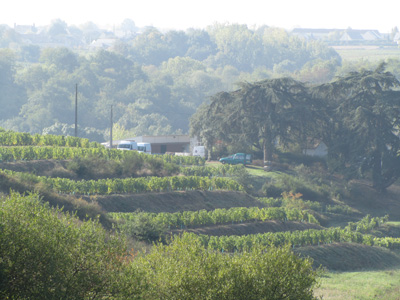
It is good to see another new project in Chaume and Quarts de Chaume joining the recently established Domaine Belargus.
Showing posts with label Château de Plaisance. Show all posts
Saturday, 1 February 2020
Château de Plaisance (Chaume et Quarts de Chaume) under new ownership
Vanessa Cherruau, Vigneronne coproprietaire
It was good to meet Vanessa Cherruau again. I had met her a number of years ago when she was employed at the ill-fated Château de la Genaiserie (Saint-Aubin-de-Luigné). She left Genaiserie when they ceased to pay her before the domaine collapsed first into administration (2010) and then into liquidation in 2013.
Last year Vanessa put together a group of investors along with herself to buy the 25-hectare Château de Plaisance from Guy Rochais, whose father Henri had acquired the domaine in 1960. Since 1995 it has been farmed organically and is now biodynamic.
Plaisance has 25 hectares of vines spread across 44 parcels in the following appellations Anjou Blanc, Savennières, Chaume and Quart de Chaume. The bulk of the vines are in Chaume with 1.5 ha in Quarts de Chaume and three hectares in Savennières around the Moulin de Gué. There are 21 hectares of Chenin, 2.5 hectares of Cabernet Sauvignon and the same area of Cabernet Franc planted as well as a small amount of Chardonnay. The average of the vines is 40 years old with some vines more than 120 years old. Picking is all by hand.
Guy Rochais was one of the leaders of the move to make high quality dry white wine in both Chaume and Quarts de Chaume and to campaign for cru status for this dry wine. This move is partly driven by how difficult it is now to sell substantial volumes of sweet wine even from a potentially top quality appellation like Quarts de Chaume. Guy also considered that the terroir of both Chaume and Quarts de Chaume had the potential to make great dry Chenin. For several years Guy has been looking to sell up and retire.
A duo of Savennières – 2018 and 2019
Vanessa is understandably excited by this new project, which was concluded literally hours before the 2019 harvest started. The documents were finally signed at the notaire (lawyer) at 10pm on 12th September and picking Chardonnay started the following morning at 9am! Furthermore, Vanessa was expecting a baby at any moment.
There will be a continued emphasis on dry Anjou Blanc from the Chaume vineyards. I tasted the 2019 from the Butte de Chaume, which was harvested on 18th September. "Our aim is to make a very precise and clean dry wine using no botytised grapes, so picking earlier than was Guy's practice," Vanessa explained.
In 2019 Plaisance's vines in Savennières were frosted both in April and early May and recorded an 80% loss of crop. I tasted the 2019 Savennières, which while unfinished is attractively vibrant and with potential. It is clearly a step up from the 2018 Savennières, which is pleasant enough but not special. Clearly by 2018 Guy wanted out and Vanessa explained that most of the domaine's 2018 was sold off to négociants.
It is good to see another new project in Chaume and Quarts de Chaume joining the recently established Domaine Belargus.
Vanessa pouring Plaisance's Quarts de Chaume
Thursday, 21 February 2019
Is Quarts de Chaume about to become very rare?

Green is Chaume 1er Cru and pink is Quarts de Chaume
Two new and wonderfully detailed maps of the Quarts de Chaume
and Coteaux du Layon 1er Cru Chaume
Source: Fédération Viticole Anjou-Saumur
and Coteaux du Layon 1er Cru Chaume
Source: Fédération Viticole Anjou-Saumur

Geological map of Coteaux du Layon 1er Cru Chaume
Clearly indicating how complex the soils are in this small area
2019 is a significant year for Quarts de Chaume – one of the world's greatest expressions of Chenin Blanc. It will be the last vintage that cryoextraction, or cryoselection as some prefer to call it, will be allowed under the décret of November 2011. This transitional arrangement comes to an end in 2019. From 2020 it will hopefully be impossible to make Quarts de Chaume from unripe, green grapes and foist it onto the consumer as the real thing.
However, despite a series of good to excellent vintages there is every prospect that Quarts de Chaume, already a small appellation of 40 hectares, will become increasingly rare. The problem is simple we are not buying and drinking enough sweet wine. Now there is a marked move to making dry Anjou Blanc from the vines of the Quarts de Chaume.

Hamlet of Chaume and the surrounding Q de C vines
The arrival of two important new players – Kathleen Van den Berghe and Sigurd Mareels (Château Suronde) and Ivan Massonnat (Domaine Belargus) – has highlighted the problem and the direction that a significant proportion of the production from vines in the Quarts de Chaume will take. Belargus has 10 hectares of vines in Quarts de Chaume and Suronde 5.5 hectares making a total of 15.5 ha or 38.75% of the appellation's total area.

View towards Suronde
'Château de Suronde is the perfect complement to Château de Minière (Bourgueil), with white wines from Chenin Blanc that can be sweet, semi-sweet and dry, both still and sparkling. Château de Suronde will produce mainly dry white wine, and will produce the iconic sweet Quarts de Chaume wines in the best vintages only.'
Only sweet wines that meet the appellation's criteria can be Quarts de Chaume – dry, semi-sweet will be Anjou Blanc, while the sparkling can be either Anjou Mousseux or Crémant de Loire depending on the production methods used.
Ivan Massonnat (Belargus) intends to make 80% dry wines from his 10 hectares. This percentage is likely to be even higher in average to poor vintages. It was Jo Pithon who fortunately persuaded Massonnat to make some Quarts de Chaume in 2018. Pithon pointed out that even though sweet wines are difficult to sell they can remain in a grower's cellar for many years without losing value.

Part of Belargus's holding in lieux-dit Les Quarts
Suronde and Belargus are not alone. Guy Rochais (Château de Plaisance) is also making dry wines in the Quarts de Chaume and is amongst those pushing for a superior appellation for the best of Anjou Blanc sec – in this case, perhaps, Anjou Blanc Chaume.
What of Domaine des Baumard's six hectares of Quarts de Chaume? From the 2020 vintage when cryo-extraction is banned making it impossible for the domaine to make some 80 hectolitres of ersatz 'Quarts de Chaume' as they did in the awful 2012 vintage when over 200 mls of rain fell during the crucial month of October.
Actually it was legally impossible in the 2012 vintage but the INAO chose to turn a blind eye – forget any notion that this organisation stands up for the consumer. In less than ideal vintages will Domaine des Baumard now choose make a proportion of dry white from their six hectares?
My guess is that producers, like Domaines de la Bergerie, Ogereau and others with just a small parcel in the Quarts de Chaume will continue to try to make 100% sweet wine from their parcels unless weather conditions make this impossible.
Stats from InterLoire show that between 2012 and 2016 the maximum area declared as Quarts de Chaume was 35 hectares (2014), while the lowest was 6 hectares in 2012...... Will the area declared reach 35 hectares in the near future?
It is difficult to blame the producers for choosing to reduce their production of sweet wine in favour of dry ones. How can you expect them to go on making wines that in order to be great require tiny yields, with the attendant big risks of late harvest and the additional expense of successive pickings, if they cannot sell them no matter how good these sweet wines are?
This development sets lovers of a sweet wine a challenge. If you want these wines to continue to be made in reasonable quantities you must be prepared to drink more of them. Here I am as guilty as anyone. I love sweet wines, especially those from the Loire with their magical balance of sweetness and acidity. However, when I reflect at the end of the year on the number of bottles of sweet wines that I have drunk – I may only need the fingers of one hand and only rarely more than two!
This lack of consumption is not peculiar to Quarts de Chaume or other Loire sweet wines, Sauternes and other great sweet wines face similar problems in a dry white market. Some would say let market forces rule. If a type of wine is difficult to sell them what's the problem if it disappears.... Although, of course, market forces are necessarily a major influence, if it wasn't for some stubborn and courageous producers some of wine's diversity would have been lost. The wine world would be a a sea of international wine varieties. The marvels of good sherry might well have disappeared. etc. etc.
It is still possible to enjoy and marvel at sweet Vourvays or those from the Layon from 1947 because a reasonable quantity was made. Will that still be the case for potential great vintages like 2018 and those to come in the future in 70 years time? For the sake of future generations of wine lovers I hope so!
As wine communicators we need to highlight the qualities of great sweet wine and the different occasions to drink them. It doesn't help that too many in the British wine and hospitality trade and in other countries foolishly and inaccurately describe these magical wines as 'dessert' wines.

Un Grand Vin du Monde – Quarts de Chaume by Jean Baumard
I don't often agree with Jean Baumard but I do agree with his book's title Quarts de Chaume – Un Grand Vin du Monde (published 2007) – assuming that the wine complies with the décret in force from the 2020 vintage. Unfortunately Quarts de Chaume is facing some testing times and is under a possible threat, which I hope will receive some airtime during the International Chenin Blanc Seminar at the start of July in Angers.
Tuesday, 29 January 2013
Millésime Bio: sweet Loires rare in 2012
2011 Quarts de Chaume, Grand Cru, Château de Plaisance
None made here in 2012 but the fine and beautifully balanced 2011 makes up for this.
Guy Rochais, Château de Plaisance, with his 2011 Quarts de Chaume Grand Cru
(Unfortunately I misjudged the depth of field required to get clear view of label
so took a close up of the bottle as well)
Had a good day at Millésime Bio yesterday and managed to see quite a number of the Loire producers present at the Salon. Unfortunately as I have to head back to London today I will have to try and catch up with as many of the rest as I can this coming weekend in Angers.
Naturally conversations often turned to discusssing what a pig of year 2012 was weatherwise, although there are some good wines from the vintage, so it shouldn't be written off. Volumes in many places are low to very low. It is clear that very little sweet wine was made in 2012 or should have been made. A number of producers including Patrick Baudouin, Philippe Delesvaux, Pierre Chauvin and Eddy Oosterlinck said that they hadn't made any due to the October downpour.
Philippe Delesvaux: "The sugar content actually went backwards. I had grapes that were at 13% natural when the rains started that had dropped to 9% when the rain eventually stopped." Understandably Philippe decided it was impossible to try to leave the grapes in the hope it might eventually be possible to make any sweet wine in 2012.
A few basic Coteaux du Layon cuvées have been made but will be surprising if anyone has managed to make anything more prestigious where the appellation requires a higher level of natural sugar. Even making a generic Layon may well have required the assistance of additional bagged up sunshine! With the recent Quarts de Chaume décret requiring a minimum of 18% potential it will be amazing if anyone managed make any in 2012.
Fortunately there are some very fine sweet wines from the 2010 and 2011 vintages to enjoy.
Subscribe to:
Posts (Atom)