Awards and citations:


1997: Le Prix du Champagne Lanson Noble Cuvée Award for investigations into Champagne for the Millennium investment scams

2001: Le Prix Champagne Lanson Ivory Award for investdrinks.org

2011: Vindic d'Or MMXI – 'Meilleur blog anti-1855'

2011: Robert M. Parker, Jnr: ‘This blogger...’:

2012: Born Digital Wine Awards: No Pay No Jay – best investigative wine story

2012: International Wine Challenge – Personality of the Year Award


Showing posts with label Domaine des Baumard. Show all posts

Thursday, 21 February 2019

Is Quarts de Chaume about to become very rare?

Cartographie Chaume et Quarts-de-Chaume sans géols

Green is Chaume 1er Cru and pink is Quarts de Chaume

Two new and wonderfully detailed maps of the Quarts de Chaume
and Coteaux du Layon 1er Cru Chaume
Source: Fédération Viticole Anjou-Saumur 

Cartographie Chaume et Quarts-de-Chaume avec géols
Geological map of Coteaux du Layon 1er Cru Chaume
Clearly indicating how complex the soils are in this small area

2019 is a significant year for Quarts de Chaume – one of the world's greatest expressions of Chenin Blanc. It will be the last vintage that cryoextraction, or cryoselection as some prefer to call it, will be allowed under the décret of November 2011. This transitional arrangement comes to an end in 2019. From 2020 it will hopefully be impossible to make Quarts de Chaume from unripe, green grapes and foist it onto the consumer as the real thing.

However, despite a series of good to excellent vintages there is every prospect that Quarts de Chaume, already a small appellation of 40 hectares, will become increasingly rare. The problem is simple we are not buying and drinking enough sweet wine. Now there is a marked move to making dry Anjou Blanc from the vines of the Quarts de Chaume.

QuartsdeC+hamlets
Hamlet of Chaume and the surrounding Q de C vines 

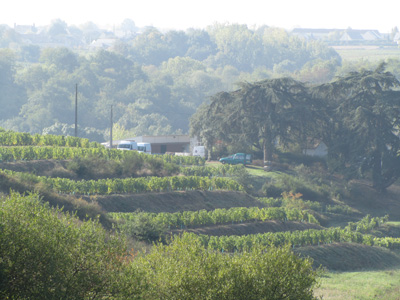
The arrival of two important new players – Kathleen Van den Berghe and Sigurd Mareels (Château Suronde) and Ivan Massonnat (Domaine Belargus) – has highlighted the problem and the direction that a significant proportion of the production from vines in the Quarts de Chaume will take. Belargus has 10 hectares of vines in Quarts de Chaume and Suronde 5.5 hectares making a total of 15.5 ha or 38.75% of the appellation's total area.   
Surondes
View towards Suronde

Suronde's website clearly sets out their wine producing policy.

'Château de Suronde is the perfect complement to Château de Minière (Bourgueil), with white wines from Chenin Blanc that can be sweet, semi-sweet and dry, both still and sparkling. Château de Suronde will produce mainly dry white wine, and will produce the iconic sweet Quarts de Chaume wines in the best vintages only.'

Only sweet wines that meet the appellation's criteria can be Quarts de Chaume – dry, semi-sweet will be Anjou Blanc, while the sparkling can be either Anjou Mousseux or Crémant de Loire depending on the production methods used.

Ivan Massonnat (Belargus) intends to make 80% dry wines from his 10 hectares. This percentage is likely to be even higher in average to poor vintages. It was Jo Pithon who fortunately persuaded Massonnat to make some Quarts de Chaume in 2018. Pithon pointed out that even though sweet wines are difficult to sell they can remain in a grower's cellar for many years without losing value.

E part of IM QdeC
Part of Belargus's holding in lieux-dit Les Quarts

Suronde and Belargus are not alone. Guy Rochais (Château de Plaisance) is also making  dry wines in the Quarts de Chaume and is amongst those pushing for a superior appellation for the best of Anjou Blanc sec – in this case, perhaps, Anjou Blanc Chaume.

What of Domaine des Baumard's six hectares of Quarts de Chaume? From the 2020 vintage when cryo-extraction is banned making it impossible for the domaine to make some 80 hectolitres of ersatz 'Quarts de Chaume' as they did in the awful 2012 vintage when over 200 mls of rain fell during the crucial month of October.  

Actually it was legally impossible in the 2012 vintage but the INAO chose to turn a blind eye – forget any notion that this organisation stands up for the consumer. In less than ideal vintages will Domaine des Baumard now choose make a proportion of dry white from their six hectares?

My guess is that producers, like Domaines de la Bergerie, Ogereau and others with just a small parcel in the Quarts de Chaume will continue to try to make 100% sweet wine from their parcels unless weather conditions make this impossible.

Stats from InterLoire show that between 2012 and 2016 the maximum area declared as Quarts de Chaume was 35 hectares (2014), while the lowest was 6 hectares in 2012......  Will the area declared reach 35 hectares in the near future?

It is difficult to blame the producers for choosing to reduce their production of sweet wine in favour of dry ones. How can you expect them to go on making wines that in order to be great require tiny yields, with the attendant big risks of late harvest and the additional expense of successive pickings, if they cannot sell them no matter how good these sweet wines are?

This development sets lovers of a sweet wine a challenge. If you want these wines to continue to be made in reasonable quantities you must be prepared to drink more of them. Here I am as guilty as anyone. I love sweet wines, especially those from the Loire with their magical balance of sweetness and acidity. However, when I reflect at the end of the year on the number of bottles of sweet wines that I have drunk – I may only need the fingers of one hand and only rarely more than two!

This lack of consumption is not peculiar to Quarts de Chaume or other Loire sweet wines, Sauternes and other great sweet wines face similar problems in a dry white market. Some would say let market forces rule. If a type of wine is difficult to sell them what's the problem if it disappears.... Although, of course, market forces are necessarily a major influence, if it wasn't for some stubborn and courageous producers some of wine's diversity would have been lost. The wine world would be a a sea of international wine varieties. The marvels of good sherry might well have disappeared. etc. etc. 

It is still possible to enjoy and marvel at sweet Vourvays or those from the Layon from 1947 because a reasonable quantity was made. Will that still be the case for potential great vintages like 2018 and those to come in the future in 70 years time? For the sake of future generations of wine lovers I hope so! 

As wine communicators we need to highlight the qualities of great sweet wine and the different occasions to drink them. It doesn't help that too many in the British wine and hospitality trade and in other countries foolishly and inaccurately describe these magical wines as 'dessert' wines.


JB-QuartsdeChaume_0001

Un Grand Vin du Monde – Quarts de Chaume by Jean Baumard

I don't often agree with Jean Baumard but I do agree with his book's title Quarts de Chaume – Un Grand Vin du Monde (published 2007) – assuming that the wine complies with the décret in force from the 2020 vintage. Unfortunately Quarts de Chaume is facing some testing times and is under a possible threat, which I hope will receive some airtime during the International Chenin Blanc Seminar at the start of July in Angers.

Wednesday, 15 October 2014

2014 Quarts de Chaume – prospects?

As usual with Chenin Blanc there are big variations 
in ripeness in the Quarts de Chaume 
Photos taken in various parts of the AC yesterday 
(14th October 2014)


AC criteria: a maximum of 1.8 kilos per vine?


Yesterday we went to the Layon Valley for the day. This included a look at the Quarts de Chaume to see how the 2014 Chenin is progressing here. Just as we I arrived I met David Grellier, who is in charge at Château Bellerive, who told me that the Ban des Vendanges for Q de C would be today (Wednesday). 

Later on I saw Claude Papin, president of the Syndicat des Quarts de Chaume, who explained that because of the unsettled forecast for today with some rain promised this afternoon and this evening a few producers including Domaine des Baumard had been given permission to pick yesterday. This permission was given by the INAO following an inspection of their vines. Of course AC's picking criteria still apply if the producer wants the harvest to qualify as Quarts de Chaume – Grand Cru or otherwise.

The good news is that after some further rain on Thursday evening the forecast from Friday through to the end of Monday is very good with lots of sunshine and temperatures up to 24˚-25˚C. Tuesday is less good with the possibility of some showers. This promised coming hot weekend should ripen the grapes rapidly. Potentially good news after two very difficult years – 2012 and 2013. 

My impression from walking around part but admittedly not all of the vineyards of the Quarts de Chaume is that few of the grapes currently meet the AC's criteria of 18% potential. Any picking yesterday and today I think will have to have been highly selective for the grapes to properly qualify as Quarts de Chaume. There is the potential to make some very good Q de C in 2014 – weather permitting – but on the whole a little more time is needed.

Although Claude Papin is pleased with the way Q de C producers are cutting down their yields in line with the 2011 décret (20 hl/ha and no more than 1.8 kilos per vine) there are still parcels where the yields look high. I counted some vines with 10-12 bunches of grapes – difficult to believe that the scales wouldn't top 1.8 kilos. The overall yield criteria may be easier to meet as the fungal disease esca is clearly a problem here as it is elsewhere. 

I have to wonder whether all of the Q de C producers have understood that consumers have the right to expect a top-quality product as Quarts de Chaume is now a grand cru or as Jean Baumard prefers – Un Grand Vin du Monde.

Un Grand Vin du Monde

Domaine des Baumard's 1er Tri yesterday in Quarts de Chaume:                  

Picking boxes laid out down the row ready to pick 

 Picking boxes laid out ready to start afternoon session
on a lovely October day


Filled picking boxes @southern end of the parcel awaiting collection 

Awaiting the return of the pickers after the lunchtime pause

Domaine des Baumard: some of the most advanced and 
mature grapes that I saw yesterday in the Q de C 
but was the Tri here sufficiently rigorous to meet the 
ACs minimum requirement of 18% potential?
I doubt it unless these grapes were sorted – given the proportion of green 
– once they reached the Baumard chai in Rochefort. 
Did the INAO gave the dérogation on the basis of a more severe tri?


Friday, 28 February 2014

Quarts de Chaume and Coteaux du Layon 1er Cru Chaume: appellations upheld on all counts by Conseil d'Etat


 Florent Baumard (Domaine des Baumard) 
and his father Jean challenged the décrets passed in November 2011

The judgment and decision from France's Conseil d'Etat (France's Supreme Court) has now been published on their site. It is on the ArianeWeb (jurisprudence) section and can be accessed by typing in the case number – 356103. 

Although I will readily admit that legal French strains my normally reasonable French to its very limits*, it is clear that the Conseil d'Etat upheld the two décrets passed in November 2011 and which established Quarts de Chaume Grand Cru and Coteaux du Layon 1er Cru Chaume. 

Jean and his son Florent Baumard (Domaine des Baumard) challenged these décrets on the basis that the state had exceeded their powers in signing them into law. The Conseil d'Etat rejected the Baumards' challenge on all counts. 

The decision by the Conseil d'Etat is based on the report from M. Guillaume Odinet, auditeur, and the conclusions of Mme Marie-Astrid Nicolazo de Barmon, rapporteur public (also here); These were presented at the hearing on Wednesday 29th January 2014. Before and after the conclusions were given the Baumards' lawyer from law firm SCP Waquet, Farge Hazan addressed the court.

The grounds for the Baumards' challenge:
a)
'En ce qui concerne la légalité externe :

3. Considérant, en premier lieu, qu'il ressort des pièces du dossier que, conformément à l'article L. 641-6 du code rural et de la pêche maritime, l'organisme de défense et de gestion a été consulté sur le cahier des charges homologué par le décret attaqué, et en particulier sur l'interdiction du processus de cryosélection ; qu'aucune disposition législative ou réglementaire n'imposait à l'INAO de communiquer aux membres de l'organisme un dossier technique et scientifique sur chacune des modifications du cahier des charges envisagées ; qu'il ne ressort pas des pièces du dossier que l'organisme se serait prononcé sur la base d'informations erronées ; que, dès lors, il n'a pas été irrégulièrement consulté ;

4. Considérant, en second lieu, que, contrairement à ce que soutient la requérante, aucune disposition ni aucun principe n'imposait la consultation des organismes de défense et de gestion de l'ensemble des appellations d'origine contrôlée de vins du Val de Loire avant l'adoption d'un cahier des charges permettant l'usage d'une mention traditionnelle telle que la mention " grand cru "' 

It was claimed that there should have been a wide consultation process in particular in relation to the banning of cryoselection and the use of 'grand cru'. Rejected.

b) 
En ce qui concerne la légalité interne :

S'agissant du lien existant entre le milieu géographique et le produit :

This is a quite lengthy section (so I'm not quoting it), which I don't claim to fully understand at present but judgment affirms that the zone of the Quarts de Chaume zone is properly delimited and there is a clear link with the production rules that apply to Quarts de Chaume.  

c)
S'agissant de la possibilité de compléter l'appellation " Quarts deA... " par la mention " grand cru " :

The reputation of the Quarts de Chaume is sufficient to justify the term Grand Cru and won't cause confusion with other wines from the Coteaux du Layon. 
 
d)

S'agissant de l'interdiction du recours au procédé de cryosélection :
(Banning of cryoselection)
17. Considérant qu'il ressort des pièces du dossier que le procédé de cryosélection, qui permet de sélectionner les grains de raisin les plus concentrés et sucrés et d'isoler les grains les plus aqueux en portant l'ensemble des grains cueillis à température négative, a été regardé par la commission d'enquête de l'INAO comme relevant des " pratiques peu ou pas recommandables en matière d'AOC " au motif qu'il conduit à un affaiblissement du lien spécifique du produit avec son terroir en incitant à récolter en début de vendange plutôt que d'attendre la surmaturation, soumise aux conditions climatiques d'arrière-saison, du raisin sur pied ; que, si ce procédé permet une amélioration substantielle du rendement de la vigne, il ne ressort pas des pièces du dossier qu'il serait indispensable à la rentabilité de l'exploitation des vins de Quarts deA... ; que, contrairement à ce que soutient la société requérante, le niveau de rendement de la vigne fixé par le cahier des charges n'est pas un seuil à atteindre mais un maximum ne pouvant être dépassé ; qu'il ne ressort pas des pièces du dossier que ce procédé serait indispensable pour atteindre le titre alcoométrique volumique naturel minimum fixé par le cahier des charges ; que doit, dès lors, être écarté le moyen tiré de ce que le pouvoir réglementaire aurait commis une erreur manifeste d'appréciation en homologuant un cahier des charges interdisant le recours au procédé de cryosélection ;

Cryoselection works by allowing the more concentrated grapes to be separated, following freezing, from more watery ones.
The INAO regards cryoselection as '
pratiques peu ou pas recommandables en matière d'AOC ' – techniques that can barely be recommended if at all for AOC wines. This technique allows to substantially increase yields and means that grapes can be picked at the beginning of the harvest rather than waiting for surmaturation. The maximum yield allowed is not a threshold to be attained but a maximum that must not be exceeded.The use of cryoselection could mean that the required natural minimum degree of ripeness for the grapes on the vine might not be met. 

The objection to the banning of cryoselection was dismissed. 

The challenge to the Quarts de Chaume and the Coteaux du Layon 1er Cru Chaume was based on other objections, which I will try to cover shortly but in brief they were:

S'agissant de la possibilité pour les vins de l'AOC " Quarts deA... " de se replier dans l'appellation " Coteaux du Layon ", complétée des mentions " premier cru " et " A... " :

S'agissant des mesures transitoires relatives à l'application des nouvelles règles de conduite de la vigne :

Sur les conclusions tendant à l'annulation du décret du 23 novembre 2011 relatif à l'appellation d'origine contrôlée " Coteaux du Layon " :

En ce qui concerne la possibilité de compléter l'appellation " Coteaux du Layon " par la dénomination géographique " A... " :
En ce qui concerne la délimitation de l'aire parcellaire de production des vins susceptibles de porter la dénomination géographique complémentaire " A... " :

The judgment concludes with:  Article 1er : Les requêtes de la SCEA Domaine des Baumard sont rejetées.

Please note that any mistakes made from translation are my own.


* I'm reminded of this scene in the Marx Brothers: A Night at the Opera.

Thursday, 27 February 2014

Breaking news – Quarts de Chaume: Conseil d'Etat upholds Grand Cru

Quarts de Chaume sign


Breaking news: 
The Conseil d'Etat has rejected the Domaine des Baumard's attempt to have the Conseil d'Etat annul the 2011 décret that established Quarts de Chaume Grand Cru, while tightening the regulations.

Apparently the judgment, which is due to be posted on the Conseil d'Etat's website, runs to 10-pages. According to Claude Papin (Château Pierre-Bise), who is the president of the Quarts de Chaume syndicat, the judgment opens the way to favoured sites in the Layon gaining premier cru status. Sounds similar to Burgundy's premier cru. 

Naturally the INAO is very pleased that the changes and the establishment of the Loire's first Grand Cru that they approved in 2011 and was signed into law in November 2011 has been upheld 

This is very good news and hopefully will finally bring the conflict over the status of Quarts de Chaume and Chaume to an end as there is I understand no appeal on a decision by the Conseil d'Etat – it is France's Supreme Court after all. 

Time for the producers to concentrate on making great sweet wine from a very special site and to accept that there will be vintages when this won't be possible. 

Time also to work for a revival in the appreciation and popularity of these great wines – they are far more versatile than is often imagined!    

More to follow once the judgment has been published.

 2011: The first vintage of the Loire's first Grand Cru – Quarts de Chaume
and the Loire's first 1er Cru: Coteaux du Layon 1er Cru Chaume

Sunday, 20 October 2013

2013 Loire vintage: a dérogation in Quarts de Chaume? + a peek@Savennières


Friday was a gloriously sunny autumn day with temperatures around 20˚C and a good drying east wind. If the Loire had been blessed with more days like this we would be hailing 2013 as a good vintage here.

Savennières
After spending the night in Angers at L'Hotel du Mail, my hotel of preference there, we headed to Savennières.

First stop was to Damien Laureau in Savennieres. "We started picking on Monday 7th with a small tri with our main picking starting on Thursday 10th. It's been a complicated year. At the moment I'm waiting for the grapes to become more concentrated. Our potential degrees have been between 11.5 to 12. It is a year with high acidity."

 Catherine Ogereau picking: 18.10.13


Ogereau Savennières from 4th tri 

Emmanuel Ogereau, Catherine and Vincent's son

Close up of Emmanuel picking

Up at Le Moulin de Beaupréau (Savennières) we found Catherine and Emmanuel Ogereau with a small team of pickers busy on the fourth tri of their parcel here. They told us that the first tri here had been on Monday 13th. They had picked Cabernet Franc yesterday and would pick again tomorrow (Saturday). Apart from a small parcel, all of their Cabernet Sauvignon was rotten. "It was no good waiting any longer – just a question of picking what was still good."  

We bumped into Patrick Baudouin in the small centre of Savennières, who told us: "Yes it's another difficult year but 2013 is better than 2012. Talking to my parents, it reminds them of some vintages 30 to 40 years ago, when the degrees were low. At 11˚-12˚the fruit is ripe. We finished the reds yesterday – they are at 11˚-12˚ potential."

Quarts de Chaume
The Ban des Vendanges for Quarts de Chaume has yet to be declared, although it has for the Coteaux du Layon. This is because of the stricter ripeness requirements for Quarts de Chaume. The grapes have yet to reach the required level of potential alcohol 18%.

Domaine des Baumard has requested a dérogation to allow them to start picking early as enough of their grapes have reached 18.2%. In order to get a dérogation the vines have to be inspected by someone from the INAO to check that the grapes do indeed meet the appellation's rules and so can be picked early.  

 Edge of Baumard's vines on flatter ground above terraces 
(above and below)

 Examples of bunches from these Baumard vines
Some look the part but is the necessary concentration there yet?


From Savennières we crossed over the Loire to have a look at the Quarts de Chaume, to see how the grapes had changed since we were there on 3rd October. I had thought they might be adversely affected by the rain earlier this week. However, I was very pleasantly surprised as they still look promising with botrytis developing rapidly, although, from the individual grapes I tasted, mostly without any great concentration. But they do have more concentration than any I have tasted during our visits throughout the Loire this autumn. They have also come on very considerably in the last 15 days. See report on visit on 3rd October.

Driving down to the hamlet of Chaume we passed Guy Rochais (Château de Plaisance) who was testing a parcel of Chenin (at the entrance of the driveway to Plaisance) that would be going into making Anjou Blanc Sec – the degrees were between 14.5˚ and 15˚. He added that there is a move to create a Chaume'Anjou appellation for dry whites from here. The aim would be to give producers a hopefully more prestigious appellation than plain Anjou Blanc sec, which could be particularly useful in difficult years like 2012 and this year.   

Low concentrations of sugar has been a feature of 2013 throughout the Loire. It has been rare to find sugar levels about 12% potential alcohol and even rarer for them to be over 13%. It will be very interesting to see what the INAO representative finds in the grapes of Domaine des Baumards. 

I looked at some of the Baumard vines on the parcel on the flatter ground above the terraces. Of the vines I saw in Q de C on Friday these certainly are amongst the most advanced in the appellation (see photos above). I deliberately didn't taste any of the Baumard grapes. Instead tasted a few at the same stage from a nearby plot. They were becoming concentrated but I doubt if any were at the required 18˚ still with some dilution from the recent rain (Tuesday and Wednesday), although I didn't have a mustimeter so have no actual readings. However a few days of weather similar to Friday would I think concentrate sugars very quickly.

Unsuprisingly grapes in the opulently green leafed vignes larges at the top of the terraces overlooking the Layon are considerably less advanced. So, too, are grapes on the terraced vines either side of the rough track that leads down to the Layon. As you walk down from the entrance to Château de Bellerive to the small road alongside the Layon (laid on the old railway track that ran beside the Layon towards Chalonnes and then across to Savennières), it is noticeable that this part is more sheltered, so grapes here benefit less from the drying action of the wind. I suspect also that here there are shorter hours of sunshine than for the vines higher up. 

Grapes from just above the hamlet of Chaume 


 Vines by the entrance to Château Bellerive
+ grapes below


Lower part of QdeC terraces by road  along Layon

 Erosion in terrace on left hand side of track as you descend from hamlet of Chaume


 Lower part of Baumard's terraces on right hand side of track

 Baumard grapes on these terraces – 
less advanced than those on flatter ground
(above and below)


If the weather gods behave themselves there could well be the potential for some good Quarts de Chaume this year. There is plenty of rot – all that is needed is some favourable weather to concentrate the sugars. By the 19th October 2012 the weather station at Beaucouzé (just west of Angers) had recorded 187 mm of rain – for 2013 it's 43mm. The average for the whole of October (1981-2010) is 71.8mm.

Update: 22nd October 2013
The INAO inspected the Q de C vines of Domaine des Baumard on Friday and have granted a dérogation. I understand that the premier tri has now been done.