Awards and citations:


1997: Le Prix du Champagne Lanson Noble Cuvée Award for investigations into Champagne for the Millennium investment scams

2001: Le Prix Champagne Lanson Ivory Award for investdrinks.org

2011: Vindic d'Or MMXI – 'Meilleur blog anti-1855'

2011: Robert M. Parker, Jnr: ‘This blogger...’:

2012: Born Digital Wine Awards: No Pay No Jay – best investigative wine story

2012: International Wine Challenge – Personality of the Year Award


Showing posts with label Esca. Show all posts

Tuesday, 12 June 2018

A day of combatting esca

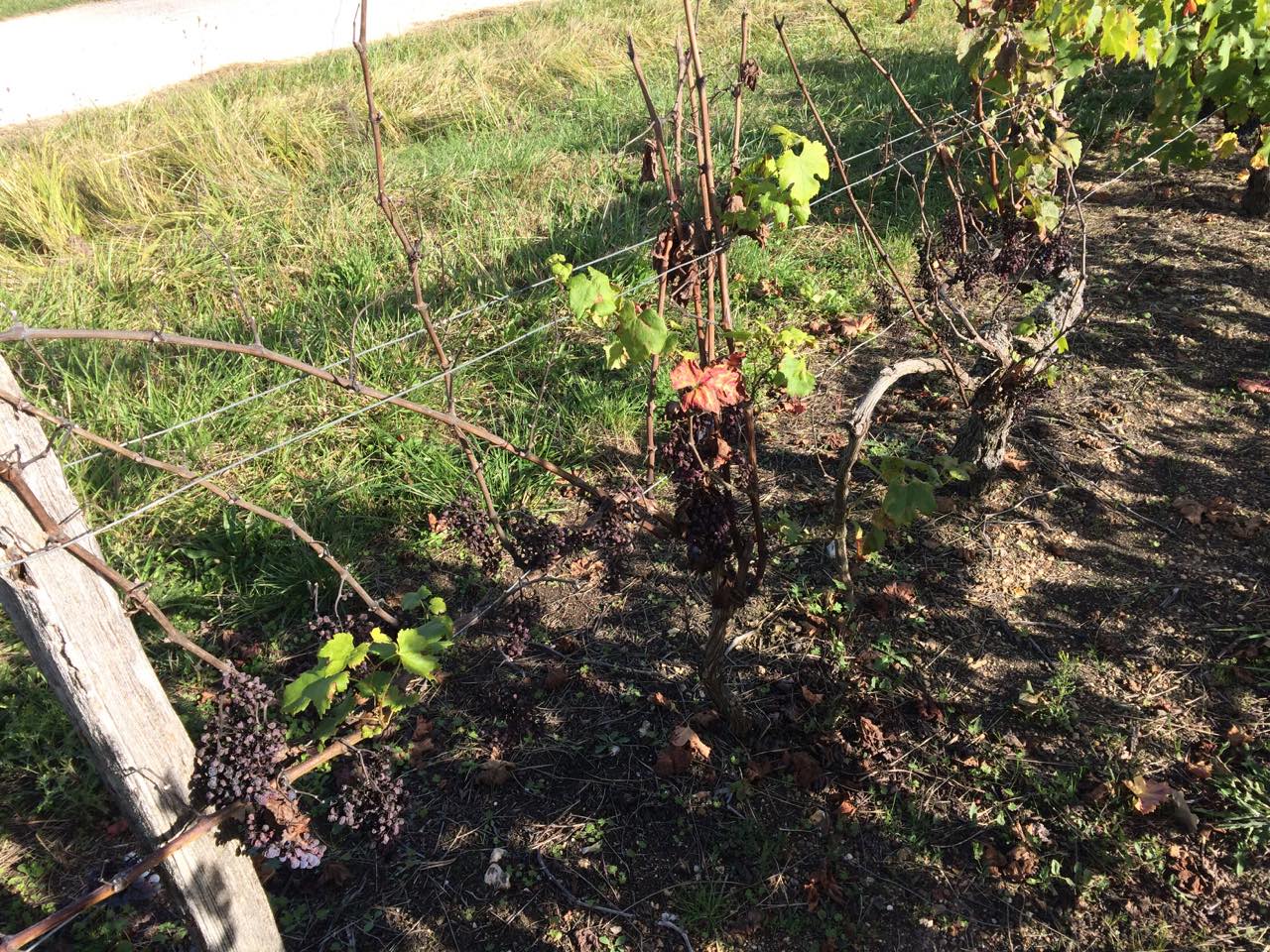
Several infected vines
Vines affected by esca – note the loss of leaves and the shrivelled grapes:
September 2017 (above and immediately below)
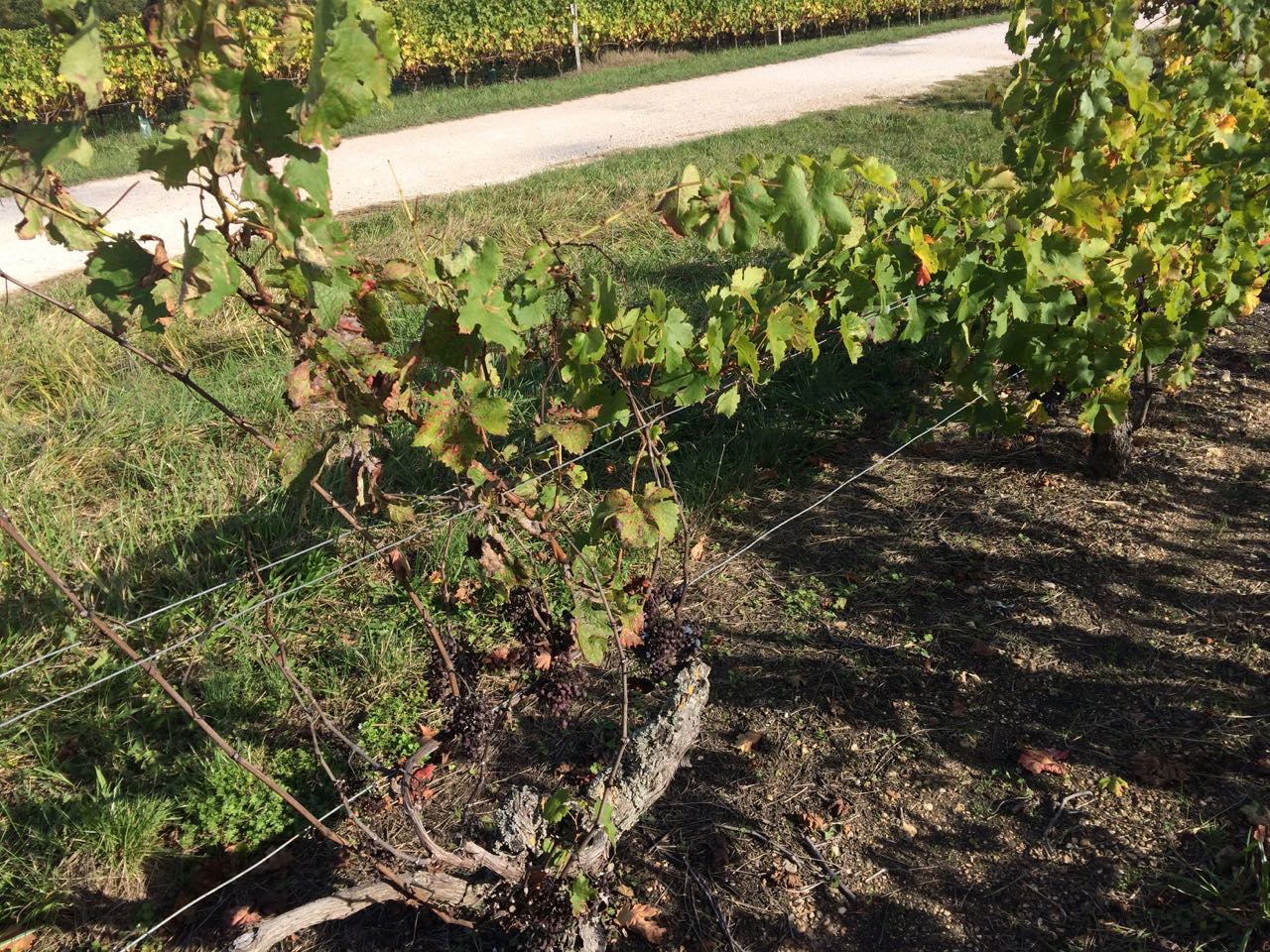
Dying vine 


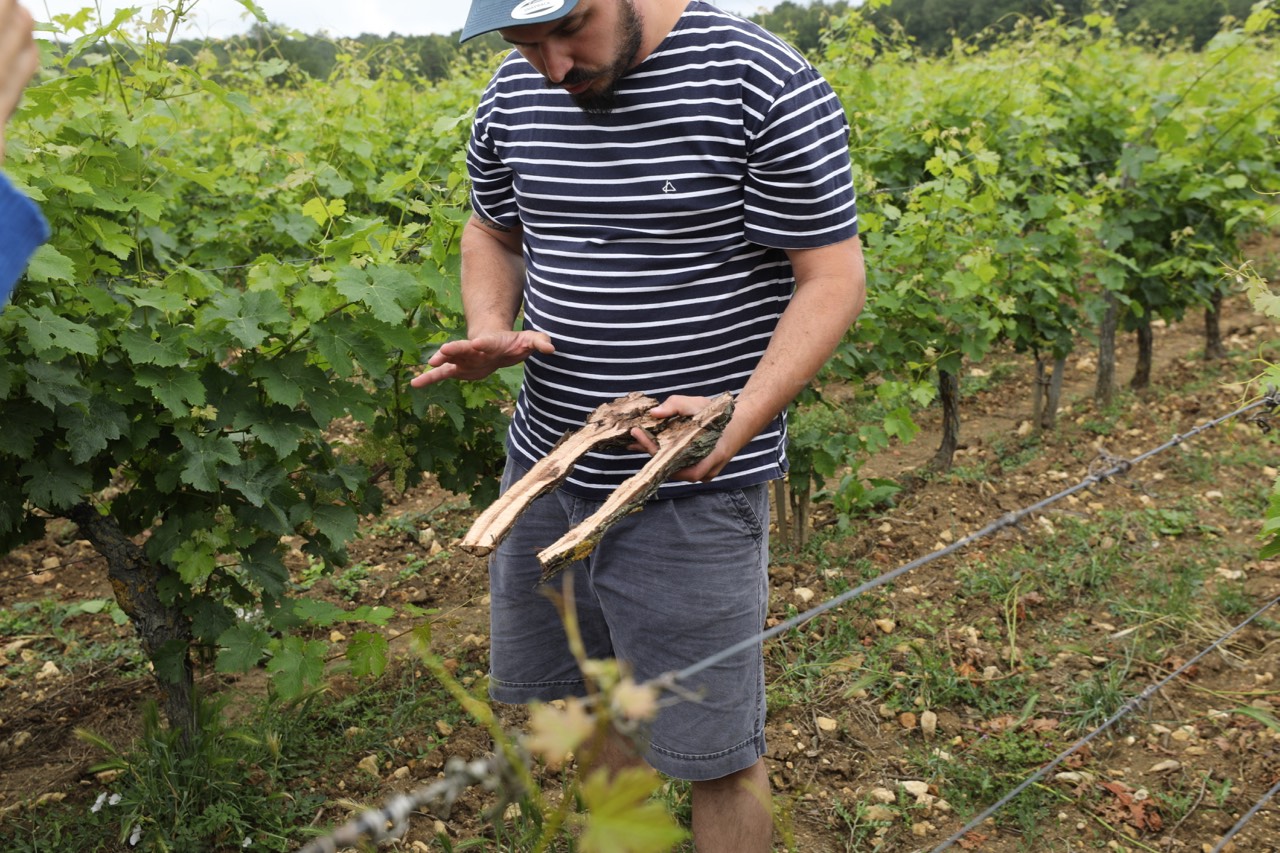
Boris & progress of esca
Boris Desbourdes, Domaine de la Marinière, Chinon  – shows
the progress of esca through a trunk of a vine 

Last Tuesday (5th June 2018) I was invited on a day-long press trip to learn more about the fungal vine disease, esca, and the methods used to combat or alleviate it.

Esca is a major problem causing a significant proportion of vines to die every year. Annual mortality estimates vary from around 2% to 10% or more. This depends upon a number of factors including the year and the stress the vines are under as well as the grape variety. Worryingly for the Loire, especially Touraine and the Central Vineyards, Sauvignon Blanc is particularly susceptible to the disease.

There are numerous initiatives now underway to combat and to eventually find a solution. These initiatives put the vignerons at centre of the research. Unfortunately it is currently not known what has triggered esca – what the causes are. There are a number of theories – nurseries supplying below quality plants, excessive use of chemicals weakening/ killing off the micro-organisms around the roots, errors in pruning etc. There may, of course, not be one factor but a whole number of them.

Until 2001 arsénite de sodium was used to control esca. I understand that it wasn't a cure but helped to keep esca under control. In 2001 it was banned because it caused a number of cancers, especially amongst vineyard workers.

Esca is a fungal disease that apparently works it way down the trunk of a vine until it eventually cuts off the supply of sap which is carried up by two 'arteries'. Once this happens the vine dies very quickly – like a human hit by a stroke.

Methods of combatting/alleviating the disease
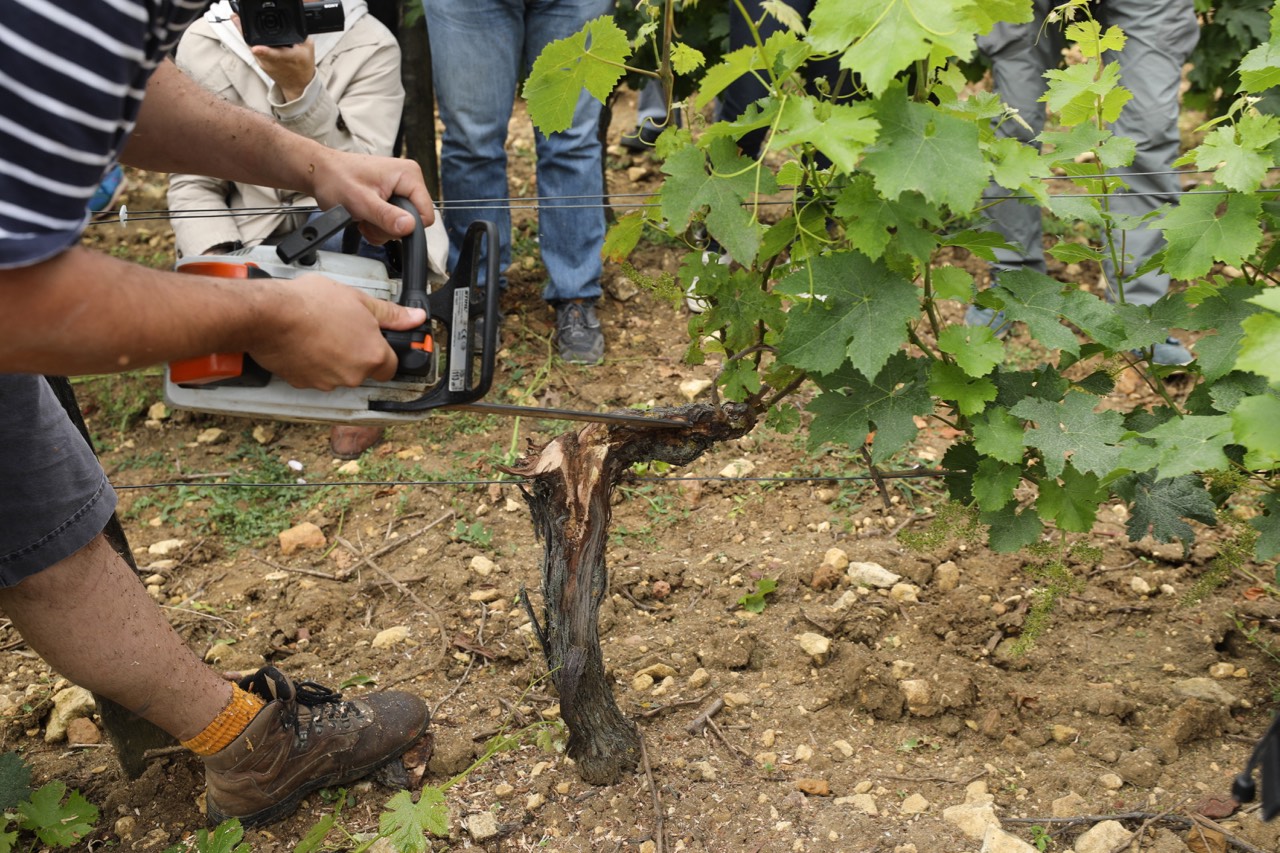
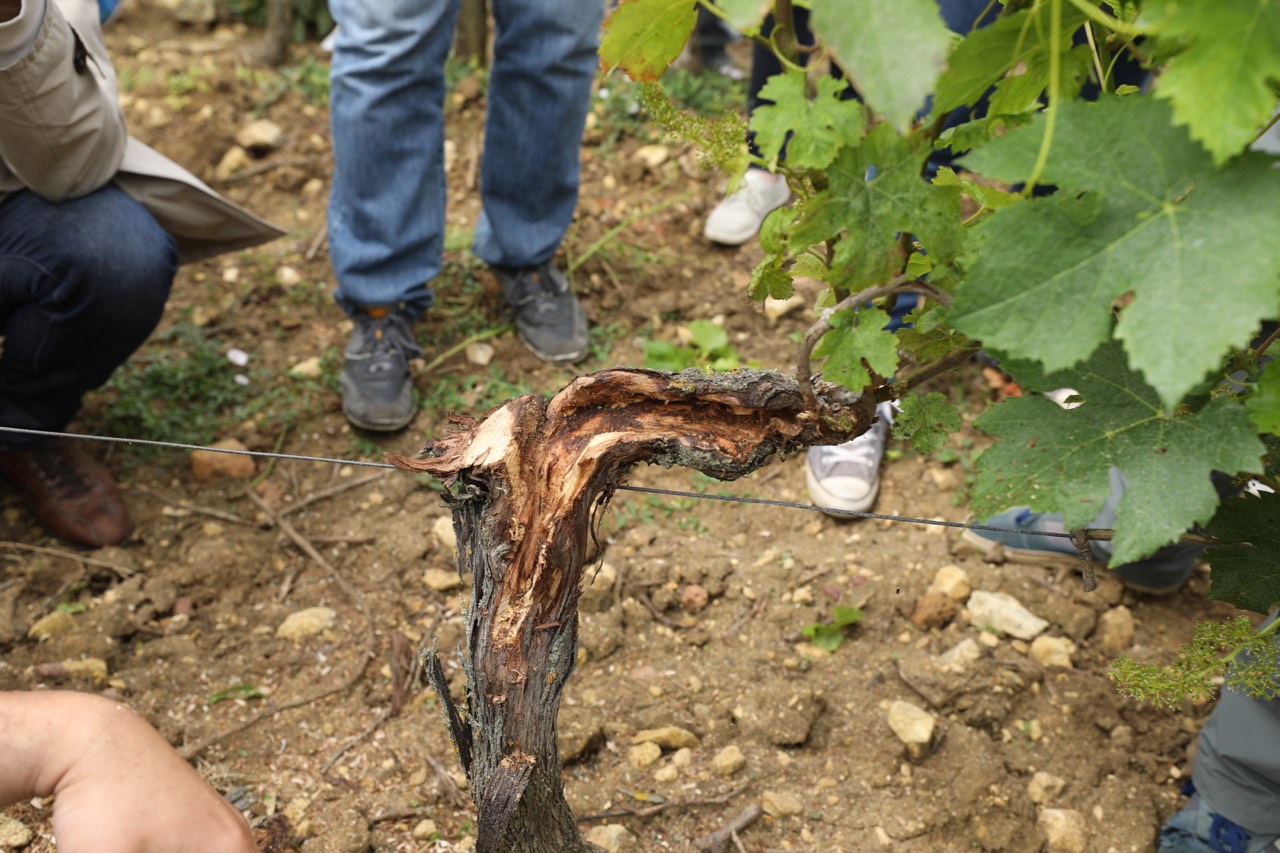
Curetage1
Curetage – the most dramatic method

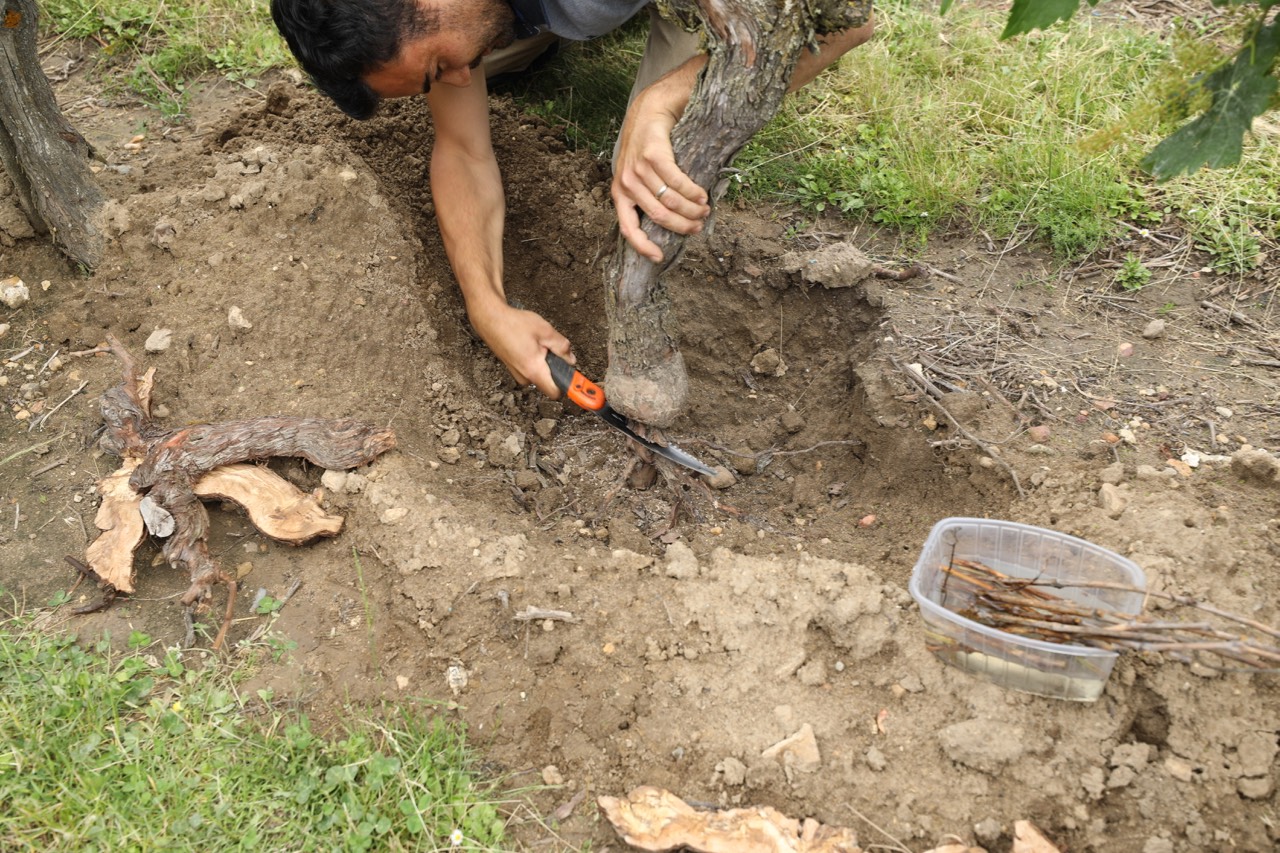
Curetage2
Job done – diseased wood cut out and trunk exposed to 
the air

There are a number of methods being used to fight/ alleviate esca. The main methods include taking care when pruning of the flow of a vine's sap, complantation, curetage, regraftinging and replanting.

During visits last Tuesday to two domaines – Domaine de la Marinière (Chinon) and Domaine de Lavigne we were shown three different techniques –recépage, curetage and regrafting.

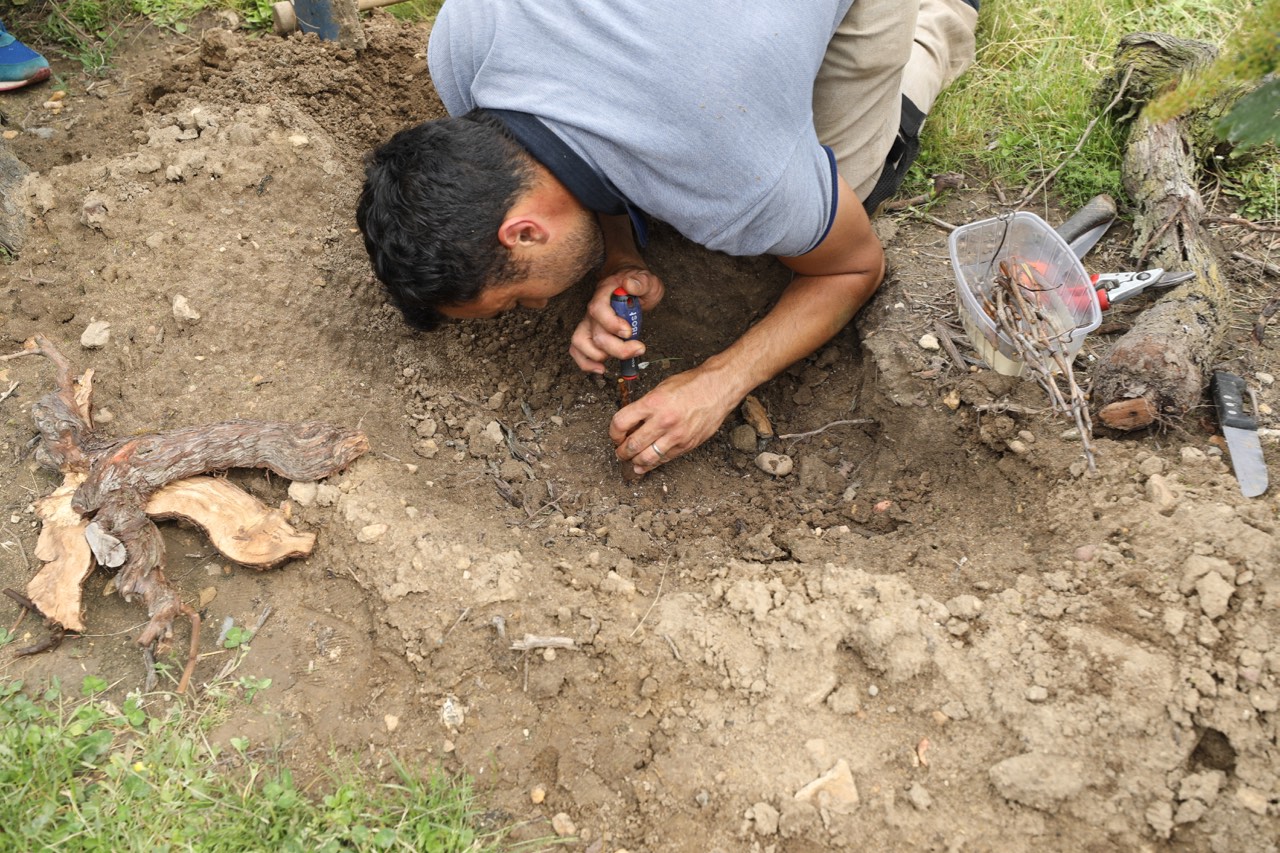
Curetage is the most dramatic as it involves using a small power saw to cut out the diseased parts of the vine's trunk. See the demonstration by Boris Desbourdes in the photos above. The second photo shows that the diseased wood has been cut away and the fungus exposed to the air, which kills it. Clearly this technique, which was trialled in Sancerre, requires considerable skill and a steady hand.  It would only take a slight slip and your vine would be decapitated...
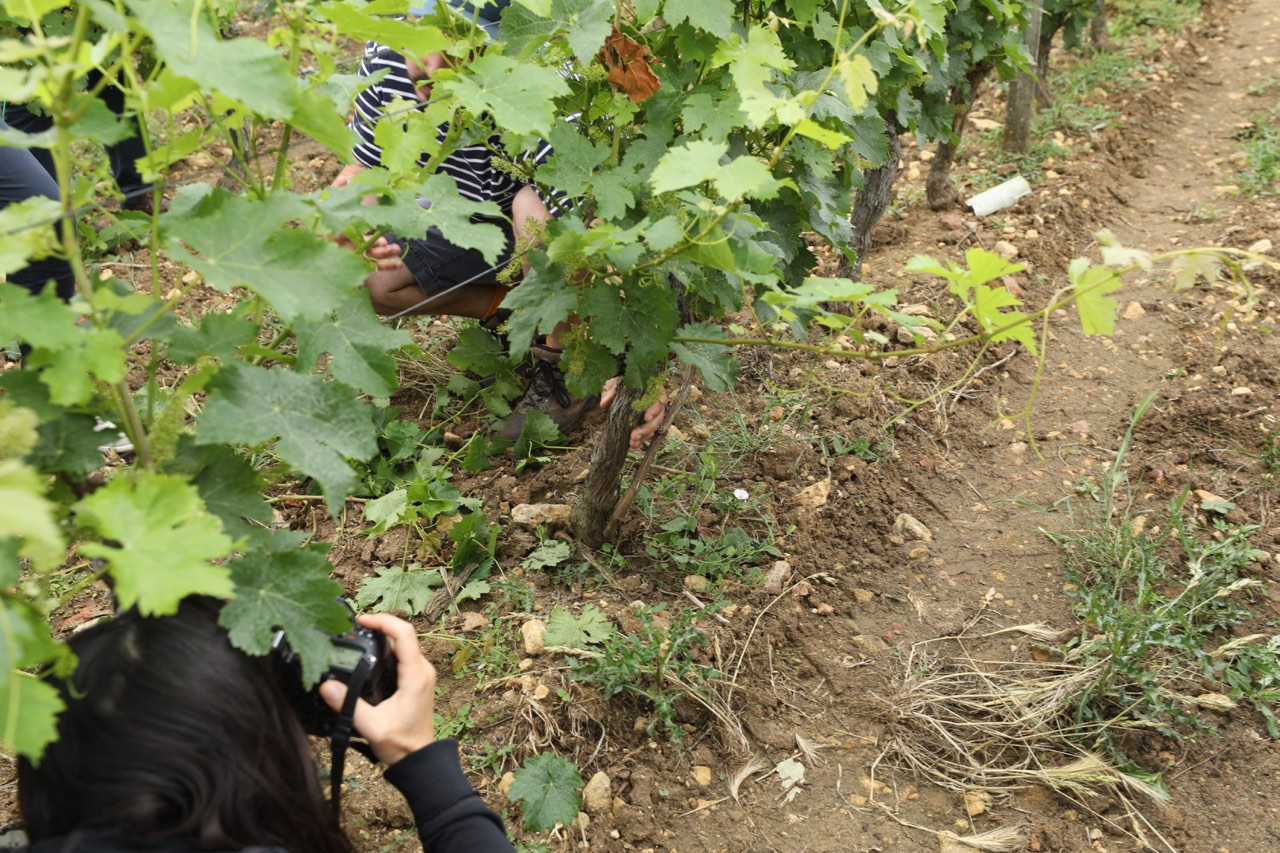
Complantation.

Complantation-detail 
Recépage – detail

Recépage
This is a technique that is quite widely used in Champagne. It involves using a branch from the base of the vine just above the graft and training it to replace the existing trunk. This procedure can then be repeated at regular intervals.

•••

Regrafting
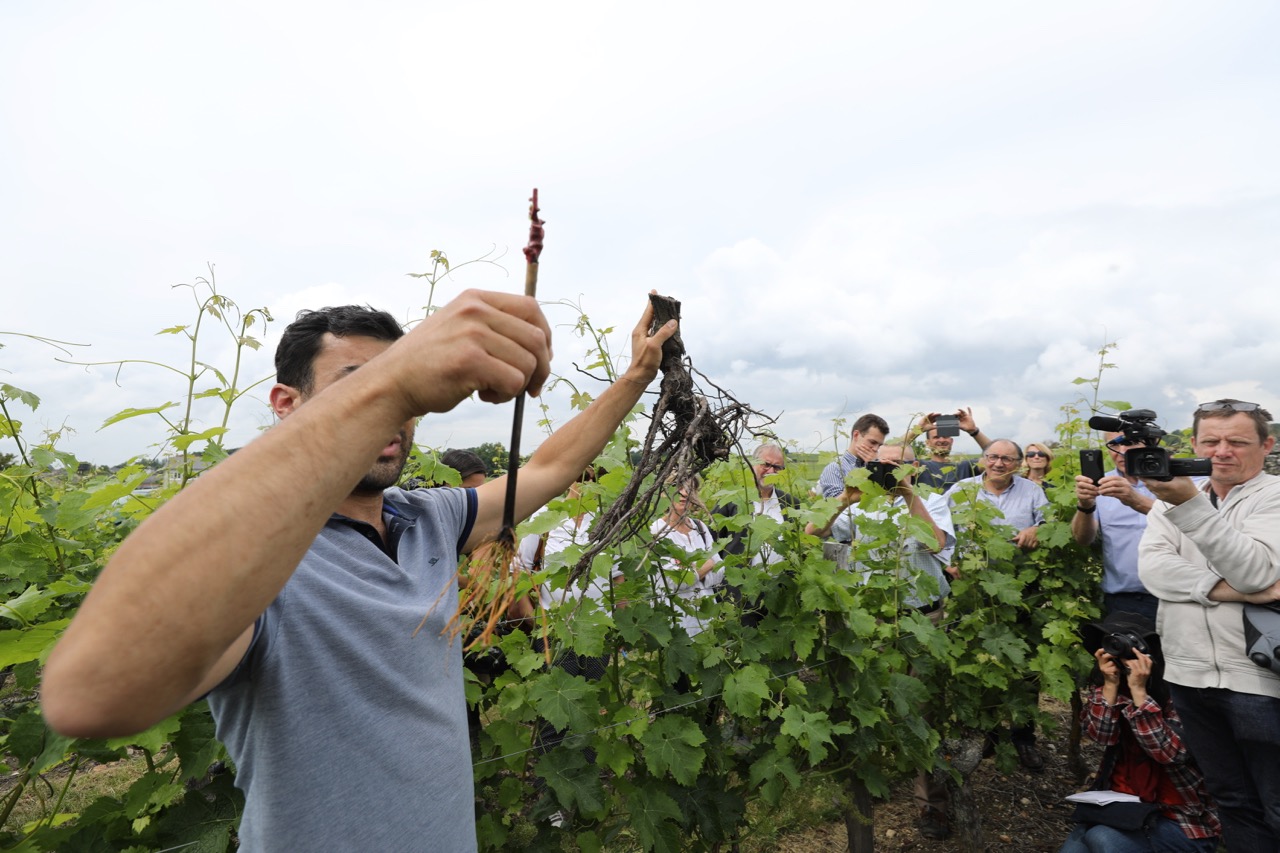
Graft1
Thomas Chassaing with graft and a dead vine trunk
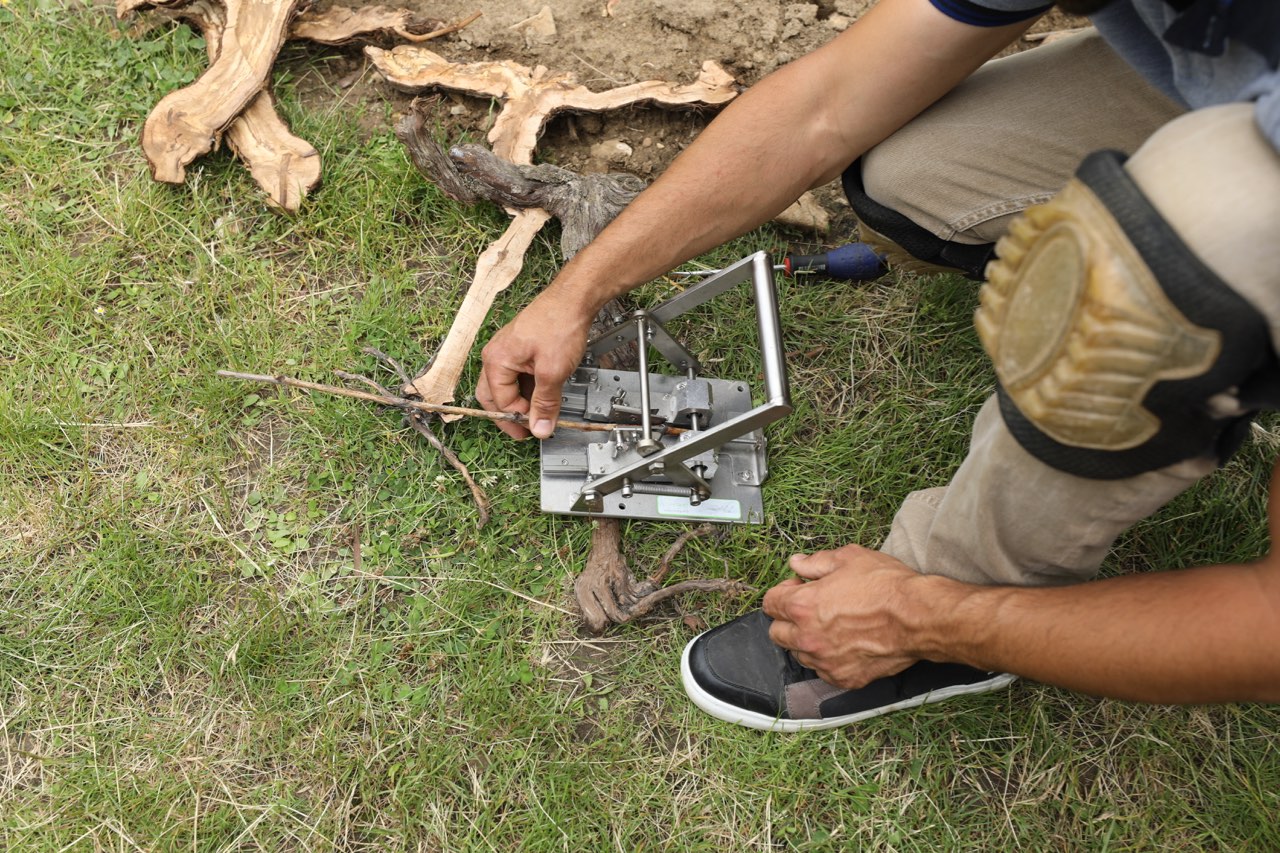
Preparing the graft
Preparing the vine graft

Cutting-2
Thomas cutting just above the rootstock graft
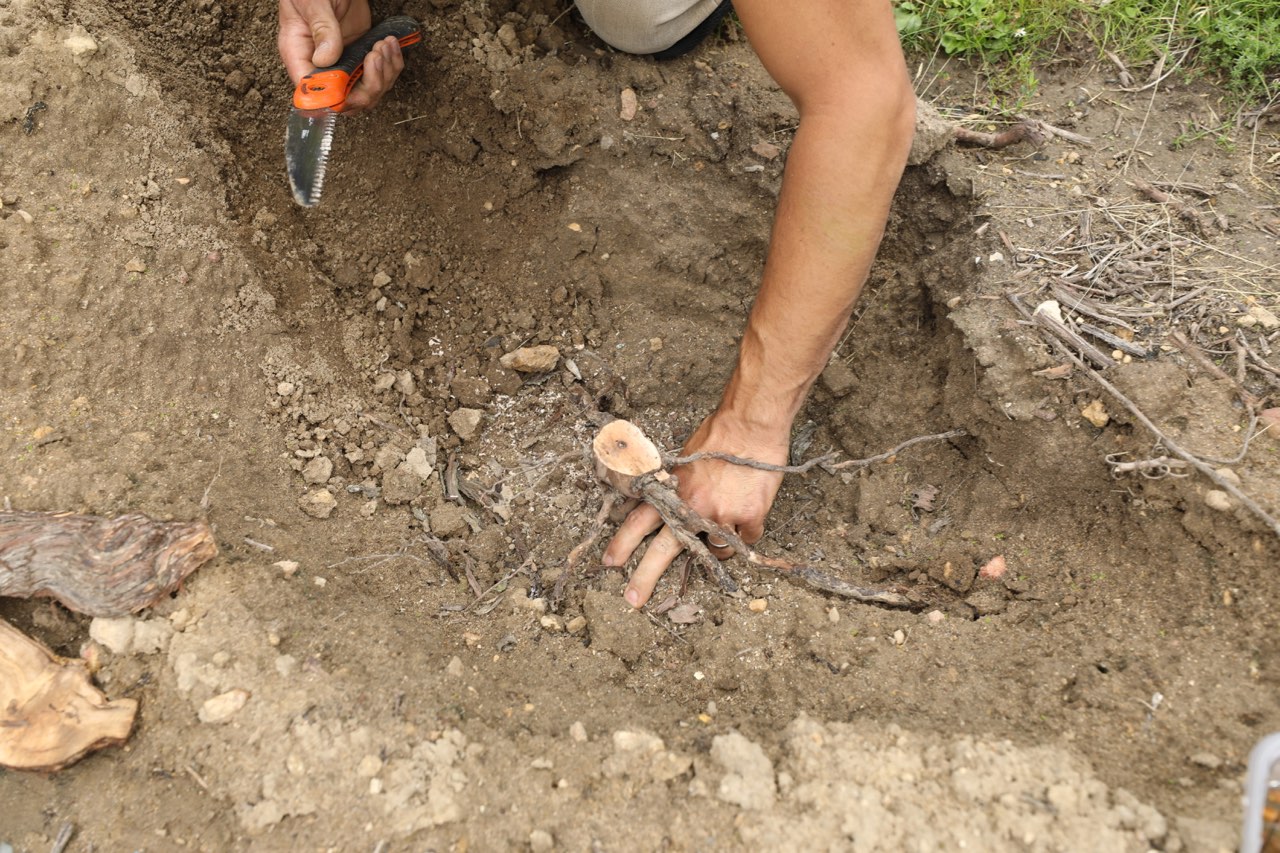
Graft base
After cutting the base for the graft
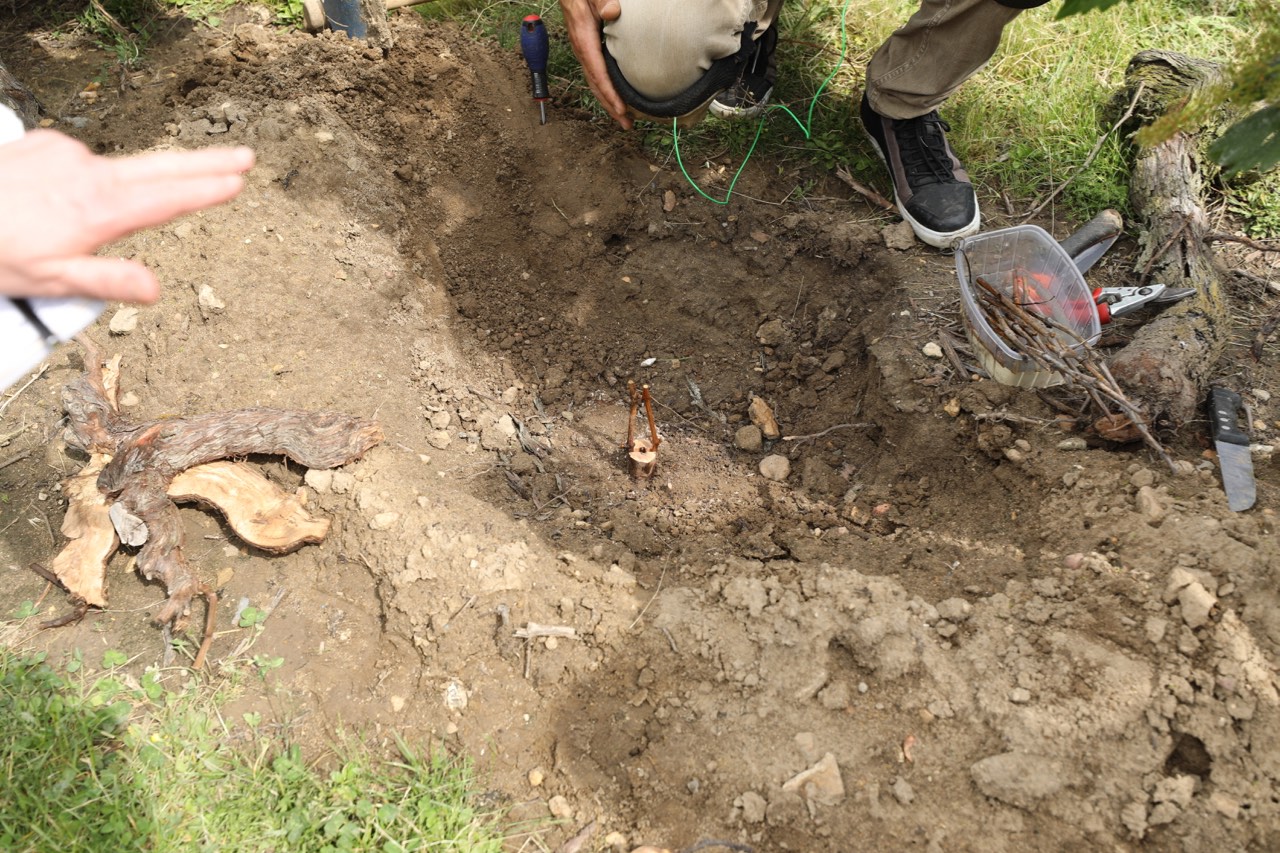
Inserting the graft 

Two grafts
Two grafts – just to make doubly sure
Two grafts - detail
Two grafts – detail

In Saumur we saw an example of regrafting performed by Thomas Chassaing of the Chambre d'agriculture du Maine et Loire. Chassaing showed us several different ages of graft. He was keen to stress the advantages of regrafting in comparison  to grubbing up dead vines and replanting. He argued persuasively that by using regrafting that the vine returned to production much earlier and was much cheaper.

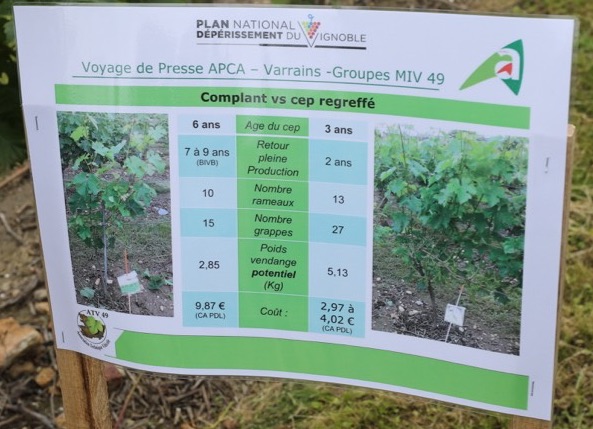
Chassaing and his charts showed that using regrafting would put your vine back in full production after two years compared to seven to nine years if you replanted. At six years for a replanted vine you could expect to harvest 10 bunches of grapes compared to 27 for regrafting – 'seems far too high to me' if you are looking for quality.

Importantly costs ranged from 2.97€ to 4.02€ for regrafting instead of 9.87€ to replant. Chassaing explained that once a producer has a 40% grafting success rate then this is the breakeven point,
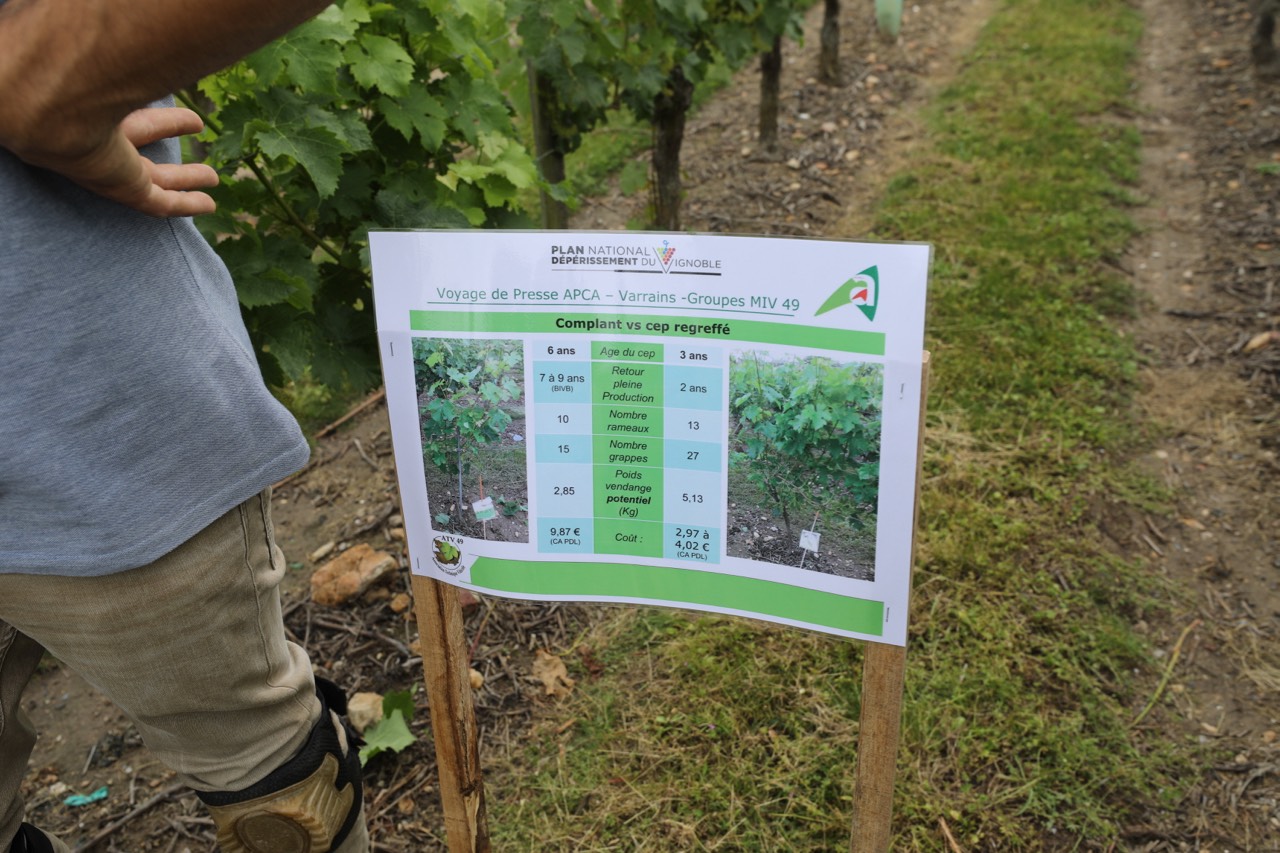
Comparison
Comparison-det
Comparison of costs between replanting and regrafting


It will be fascinating to follows the combat against esca. Will there be a cure of will it be a question of choosing one or two strategies seeking to limit the effects of esca.

A suivré......


.


Saturday, 12 December 2015

The curse of Esca: can 'A-list' pruners combat this vine disease?

 
 Dying vines affected with esca 
(above and below)


Once the vintage is over the first task for many wine producers now is grubbing up and removing vines that have been killed during the year by wood vine diseases, in particular Esca. You see trailers being hauled out of vineyards loaded up with dead vines – a very sad sight for the spectator but even more dispiriting for producers. 

Current estimates suggests that around 10% or more of vines in France are being killed by Esca and other wood diseases with some grape varieties such as Sauvignon Blanc particularly susceptible to the ravages of this disease. 

Jane Anson in her weekly Thursday column for Decanter last week wrote about Simonit & Sirch, an Italian duo, who are the first to elevate the highly important but often hidden craft of pruning to A-list celebrity status.  

They claim to have a way of combating esca:
‘Our approach grew out as a response to the serious vine disease Esca that we identified in Friuli several decades ago, and that is now widespread globally,’ he continues. ‘Esca can enter the vine through the cuts left behind by pruning, and repeated careless pruning will weaken the wood fatally. Our method offers natural protection, without chemicals, by working with the flow of the sap instead of against it’.
(Read more at http://www.decanter.com/wine-news/opinion/news-blogs-anson/anson-on-thursday-the-prada-of-vineyard-pruning-285051/#MYeGEoflmtRbSX3W.99)
If their claim has substance, then this will be a big step forward in getting esca under control. 


Wednesday, 3 October 2012

2012 Loire Vintage: some pics from Pouilly

Domaine Didier Dagueneau

 2012 grapes@Domaine Didier Dagueneau

Charlotte Dagueneau operating the controls to lift the grapes up to the press above


Grape bin rising up


 Working@the press 

Benjamin Dagueneau: mostly it's all go ...

... but there are moments to relax.

Esca: an increasing problem with Sauvignon Blanc particularly susceptible (above and below)


Domaine Jonathan Pabiot 

Jonathan Pabiot: emptying a grape trailer – grapes and droplets of juice

 Grapes heading towards the press 

 Checking 

Jonathan Pabiot and Nina Schomakers (Domaine Jonathan Pabiot, Les Loges)
(above and below)


Friday, 16 December 2011

Bourgueil and Saint Nicolas de Bourgueil: the fight against eutypiose, BDA and esca


 Dying vine in Montlouis


From an article in Vitisphere (15.12.2011)

Le développement de l'ESCA, du BDA (black dead arm) et de l'eutypiose provoque des dégâts inquiétants dans le vignoble depuis l'interdiction en novembre 2001 de l'arsénite de sodium, seul traitement connu.

Le vignoble ligérien se mobilise : en octobre 2010, la Fédération des Associations Viticoles d’Indre-et-Loire et de la Sarthe avait présenté une étude chiffrant le coût des maladies du bois entre 12 et 14 millions d’euros par an pour le seul vignoble d’Indre-et-Loire.


Fatal wood diseases in vines are a growing problem as this article highlights with the cost running to between 12 and 14 million euros for Indre et Loire alone. 

Saturday, 25 September 2010

Getting into bed with Esca!

A vine affected with esca

I'm afraid if you clicked on this page expecting to read some sensational new exposé about some famous footballer and their 'steamy' sessions with an exotic prostitute I fear you will be disappointed. This post is about esca – the deadly vine disease.

Over the past couple of weeks La Nouvelle République has carried several articles that reflect mounting alarm about Esca and its increased prevalence this year. Esca like eutypiose attacks the roots and the wood of the vine blocking off the sap. The consequences for the vine are usually fatal, although it appears that there is a slow acting version of Esca and one that kills the vine rapidly. 

'En attendant, l'esca fait des ravages. Tout particulièrement cette année, où la maladie s'est développée à la faveur de longues périodes de sécheresse. « Auparavant, on avait 2 à 5 % de mortalité. Là, on dépasse les 10 % pour les cépages sauvignon notamment. C'est devenue une préoccupation majeure », témoigne Serge Bonnigal, vigneron à Limeray.' (From La Nouvelle République 20.9.2010.  Read the rest here.

These are apparently not new vine diseases. Until 2001 they were kept in check by using sodium arsenite. However, its use has been banned because it is a dangerous chemical and can leave residues. To date there is no alternative treatment, although Didier Barouillet (Clos Roche Blanche, AC Touraine) suggests that vines that have always been cultivated organically show a lower incidence of the disease and that the planting of wild leeks can help the vine to resist and even overcome esca,

In Touraine, Sauvignon Blanc is particularly prone to the ravages of Esca. This, of course, is the sole variety that will be permitted for AC Touraine if the reforms go ahead. A true stroke of genius by those responsible!

Furthermore Hervé Lalau reports on his Chroniques Vineuses that the UK's passion for Sauvignon Blanc may be abating. See here.

I suspect that the impetus behind making Sauvignon Blanc, the only permitted variety for AC Touraine, is to avoid having to use the name of the grape variety on the label. I will be amazed if AC Touraine will ever be sold in the UK without Sauvignon Blanc appearing somewhere on the label. Almost all Bourgogne Rouge sold in the UK mentions Pinot Noir somewhere on the label and Chardonnay for Bourgogne Blanc. I cannot see why Touraine Sauvignon will be any different.    


Nearly dead vine

Wednesday, 19 August 2009

La Lionnière, a dead vineyard and some interesting rainfall figures


Very enjoyable dinner with friends at La Lionnière last night with the highlight being an excellent terrine made from a blend of the lamb, chicken and goat liver. The choice of main course was lamb or coq au champignons with the lamb being the better deal. A bottle of 2008 Gamay from the Clos Roche Blanche – good concentration, spice, certainly drinkable now but will be better in six months to a years time – started us off. Then we had a well made and attractive 2006 Cabernet from Jean-Christophe Mandard (Vignoble du Haut Bayneux). Someone else that I need to go and visit!

Sauvignon Blanc 2009

The La Lionnière farm is organic, which unfortunately is far from the case for the producer who owns the completely blitzed vineyard just to the north. Before sitting down to dinner I have a quick look at the vines. The grapes (probably Sauvignion Blanc) looked healthy enough apart from those being shrivel on a vine rapidly dying of Esca but the vineyard was a sad sight entirely devoid of any biodiversity.

Dying vine – grapes now shrivelling but shows how rapidly Esca (equally eutypoise) can kill a vine as it must have been reasonably healthy very recently for the grapes to be this far advanced

Dying vine – dead earth


Monoculture – only vines no other life here

Driving over to La Lionnière much of the pasture was brown showing how dry it has been recently. There are some interesting rainfall figures for 2005 to 2009 (June to August) on the Living the Life in St-Aignan blog. These are recorded by Ken Broadhurst and his partner Walt.

2009 is the driest year so far with just 76 mm (3.0 in) since the beginning of June, although we still a third of August to go. 2007 was easily the wettest with 230 mm (9.1 in). Contrary to popular belief 2008 was actually a dry summer – 112 mm compared to 119 mm (2005) and 124 mm (2006). I suspect it was the 2008 cold summer that makes people remember it as being wet.

Although we have had some hot days this August with temperatures up to 35˚C, it has been nothing like as hot as 2003 (around 40˚C). Nor has it been anything like as continuous and the nights have been much fresher – around 14˚/15˚C compared to staying over 20˚C.

Weather figures in Tours and elsewhere
Following on from Mark Robertson's comment, the Méteo-France figures show that it has hardly rained in Tours since 23rd July (1 mm recorded so far for August) and that July's total was just under 40 mm, some 12 mm below normal. June's rainfall at over 50 mm was above average but around 35 mm of that fell on Monday 8th June – a day of torrential rain. From 11th June virtually no rain fell for the rest of the month.

Not everywhere in the Region du Centre has been so dry – Chartres has had 7.4 mm, Orléans 7.2 mm, Bourges 14.6 mm, Châteauroux 11.6 mm, Nantes 17 mm (all in one day) and Beaucouze (near Angers) 5.4 mm.

Frédéric et Françoise Bouland, Ferme Auberge de la Lionnière.
1 rue de la lionnière, 41110 Mareuil sur Cher
Tel: 02 54 75 24 99
Email : fa-lionniere@wanadoo.fr

Sunday, 19 July 2009

Didier Barrouillet and a cure for esca? – Wine Terroirs

Following on from the end of my last post with some small, high-quality Loire producers deserting appellation contrôlée because of its perceived failure to incorporate environmental concerns within its rules, Bertrand Celce has another excellent article on his blog – Wine Terroirs. It's an interview with Didier Barrouillet of the Clos Roche Blanche. Didier explains how he uses plants to build micro-diversity in his vineyards and micro-bacteria in his soils. He claims success against esca, which is a grave threat to the Sauvignon Blanc vines. Didier is convinced that there is a link between esca and the widespread use of Roundup that in time leaches down to a vine's roots killing the micro-bacterial life that can protect a vine. Typically the INRA (France's vine research institute) considers Didier to be a 'lunatic'!


... and this is sane!?

I was aware, and Bertrand's article confirms this, that Didier, like Claude Papin and others, has grave doubts about turning the soil over and thus destroying its profile.

Didier is nearing retirement – he and Catherine Roussel have reduced the size of Le Clos Roche Blanche to nine hectares – and he intends to concentrate on his work in the vineyard. It would be good to see Didier set up a website or a blog to spread his ideas and findings to a wider audience.

See also here comments on Bertrand's article on the Clos du Porteau blog – Aynard is very concerned by the threat that esca poses to his Sauvignon Blanc.

Also a very brief report here on the Porteau blog on Esprit Vif held yesterday at Château des Couldraies in Saint-Georges-sur-Cher. It appears to have been a success.


(This post was originally tacked onto the my previous post but I think it makes more sense to post this separately.)


Sunday, 8 February 2009

Leeks and esca

Didier Barrouillet

Very good post on Peter Liem's Besotted Ramblings about Didier Barrouillet's experiments of growing leeks at the Clos Roche Blanche in Touraine to counter the fungal disease esca.