Awards and citations:


1997: Le Prix du Champagne Lanson Noble Cuvée Award for investigations into Champagne for the Millennium investment scams

2001: Le Prix Champagne Lanson Ivory Award for investdrinks.org

2011: Vindic d'Or MMXI – 'Meilleur blog anti-1855'

2011: Robert M. Parker, Jnr: ‘This blogger...’:

2012: Born Digital Wine Awards: No Pay No Jay – best investigative wine story

2012: International Wine Challenge – Personality of the Year Award


Showing posts with label Gamay. Show all posts

Monday, 22 June 2020

Côtes d'Auvergne: excellent visit to Yvan Bernard


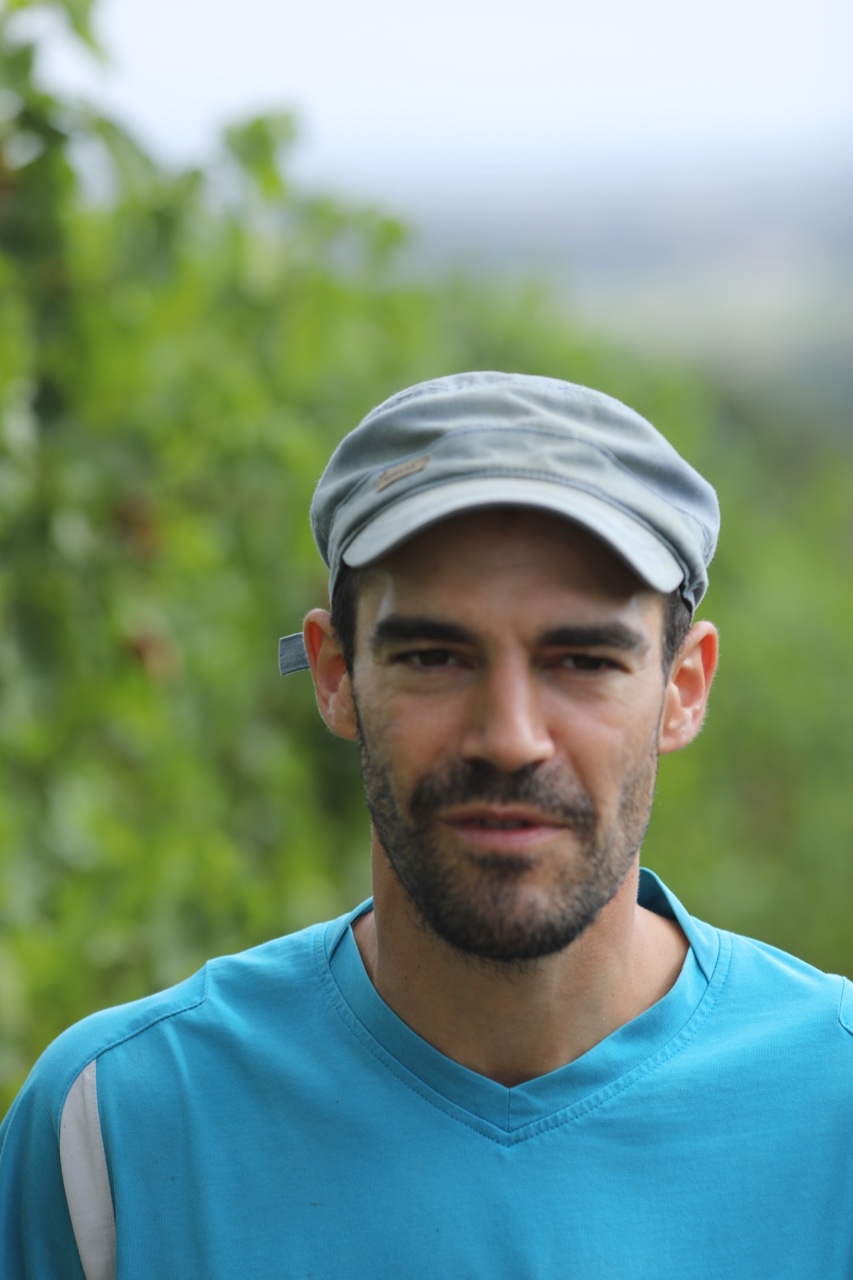
Yvan Bernard outside his caveau in Montpeyroux


CRM, Wink Lorch, Lyn Parry and I spent three nights in the Auvergne visiting some producers in a small but an increasingly interesting wine region.

Our appointment with Yvan was for 4.30pm. When we arrived his caveau in Montpeyroux was closed, so we phoned his mobile. Yvan was in the vineyards and soon arrived. Initially we spent some time in front of his caveau with Yvan talking about his history and how he works.

He now has 8 hectares of vines in a number of different parcels – some in Montpeyroux and a parcel in Boudes. He has 1.20 ha of Chardonnay, 2ha Pinot Noir, 0.5 Syrah and the rest is Gamay.

Yvan doesn't come from a family of vignerons. Although his grandfather, who was a coal miner, had some vines he only made wine for the family's own consumption. Yvan studied marketing. However, in 2000 he decided that he wanted to become a vigneron, so started studying in Beaune. The following year he studied oenology and did a stage in Brouilly (Beaujolais).

Then in 2002, when Yvan was 23 years old, the maire of Montpeyroux offered him his current caveau, which is classified for its historic interest and belongs to the commune. At the same time he acquired some vines, which were in a very bad state and included some Gamay as well as some hybrids. Yvan now has 8 hectares of vines, which are all organic apart from his parcel in Boudes. In addition to Gamay he has Pinot Noir, Syrah, Chardonnay and has planted some Aligoté as well as some Côt (Malbec) as an experiment.

From the start Yvan had wanted to be organic but waited until 2007 when he was ready to start the conversion process gaining certification in 2010. He will soon be moving to biodynamic viticulture.

Yvan has outgrown his cramped premises in the centre of the picturesque and historic village of Montpeyroux and will soon start building a new winery in the vines outside the village, which he expects to complete in 2022.

Yvan talked about the wine history of area compared to the present when there is between 400-450 hectares planted with vines grown between 300 and 550 metres.

"Before 1870 there was a lot of Pinot Noir planted but with the huge surge in demand because of destruction wrought by phylloxera elsewhere in France, Gamay was planted because it was easier than Pinot Noir. There were 55,000 hectares planted in the Puy de Dôme départment and neighbouring areas before phylloxera arrived here late in 19th Century. Because of the demand in Paris and elsewhere there were fortunes made from wine. There were ports on the River Allier to transport wine towards Paris."

"Unfortunately the Auvergne vineyards did not recover from phylloxera. Quality dropped during the boom times, so the region gained a bad reputation. Producers here were slow to graft, while at the same time industry arrived in particular the Michelin tyre factory, so people moved away from the land."

"The renaissance here started during the 1990s when producers recognised that they had to up the quality of the wines made here. Over the last seven or eight years our wines have become more fashionable helped by the natural freshness and acidity in our wines unlike wine from regions like Languedoc, where alcohol levels are now high with low acidity. At this time we were one of the VDQS vineyards."

(This category, which was created in 1949, ceased to exist in 2011 and almost all the VDQS's were promoted to appellation status.)

"We then had 25 different crus, which was far too many for the INAO when we applied to be promoted to appellation status, so we had to choose those with a real identity. Now have just five crus – all for red wine except for Corent, which is only for rosé."

Unfortunately the 2019 vintage in the Côte d'Auvergne was very small due to spring frosts, hail and drought. Last year Yvan only harvested 50% of a normal crop due to April frost and drought, August and September were particularly dry. Some of the soils, especially the sandy ones, here do not retain water unlike clay limestone, so are very susceptible to drought. 

Clermont-Ferrand and its surrounding area are in a rain shadow formed to the west by Le Mont Dore (1840 metres) and Le Puy de Sancy (1886 metres) that have substantial annual rainfall while the area around Clermont-Ferrand has considerably less. The annual rainfall at the Mont-Dore ski station is 1582.3 mm, while the average (2011-2019) annual rainfall at the weather station at Clermont-Ferrand has been 536.4mm. Clermont-Ferrand is now drier than it was for the period 1981-2011 when the average annual rainfall was 578.9 mm – down by 7.4%. 

Yvan: "We have three main types of soil here in the Côtes d'Auvergne: clay-limestone, volcanic over limestone and lava flow."


Yvan Bernard in his tasting space in Monteyroux

Tasting: We then had a comprehensive tasting of Yvan's wines. I was impressed by his wines – it was certainly one of the best tastings we had in our three-day visit to the Auvergne. Here are my favourites:


2019 Fleuve Tranquille, VDF, 100% Aligoté 12.5% alc 10€
This was made from grapes bought in Burgundy as although Yvan has recently planted some Aligoté it won't be in production until next year when he plans to make a Chardonnay/Aligoté blend from vines on basalt.

Bottled in February this is crisp and refreshingly lemony with an attractive texture. A good apéro or with shellfish.


2019 Corent Côtes d'Auvergne Corent 7.70€
Made from old vine (between 40 and 100 years old) Gamay d'Auvergne, which has large, tightly compact bunches and keeps its acidity. This is pressed without any maceration (pressurage direct). A crisp rosé with attractive weight and freshness. Overall I was impressive with the rosés we tasted on our trip, especially those from Corent. 

2019 Les Dômes Côtes d'Auvergne 8€
Yvan's first red is a blend of 90% Gamay with 10% Pinot Noir. Mid-plum colour with notes of violets, good concentration and texture but with some refreshing acidity in the finish. A bottle to enjoy with friends. 


2019 Echalas, Côtes d'Auvergne Boudes 8.20€
Boudes is both the most southerly of the Côtes d'Auvergne Crus and the southern limit of the Côtes d'Auvergne. It is also on a level with the most southerly of the Côtes de Forez communes. Echalas is the name for the vertical stakes traditionally used on the steep slopes around Boudes but which are increasingly being replaced by vines trained on wires. 


This is Yvan's non-organic vineyard on red clay. 100% Gamay and made from low yielding old vines, it has attractive peppery, red fruit notes and good mouth-filling texture.


2018 Arkose, Côtes d'Auvergne 12€
From old vine Gamay in Montpeyroux planted on granite with very low yields – 20 hl/ha. This is bottled without the addition of sulphur. Dense and quite deep colour this is a very concentrated Gamay with soft black fruits, complexity, structure and long finish. A decidedly impressive Gamay.    

    •
We also tasted 2019 Banlieue Rouge VDF made from Gamay St Romain bought in the Côte Roannaise to make up for the very small harvest of 2019, the 2018 Les Terrases IGP (100% Syrah) and two vintages (2018 and 2015) of Petrosus (Latin for Montpeyroux and 100% Pinot Noir).  

I will be posting more reports on the visits we made during our three days in the Auvergne.


Yvan and his vineyard worker


Monday, 28 January 2019

Charles Sydney Loire Benchmark Tasting, London + Loire's @2019Millésime Bio

 2018 Gamay in the Côte Roannaise


Last Thursday (24th January) was the annual Charles Sydney Wines Loire Benchmark tasting in London. Charles Sydney Wines, offering a courtier service, was set up by Charles and Philippa Sydney in 1989. They have now retired and Chris Hardy, previously of Majestic Wines has taken over. Chris has now been joined by Alex Meunier.

Although I did taste the 2018 wines at Domaine Belargus and some at the sparsely attended French Wine Discoveries (15th January) where the ripe and concentrated 2018 Muscadets from Alexandre Déramé stood out, the Sydney tasting was my first chance to taste more than 100 of these wines following their fermentation. 

My overall impression – bearing in mind these white wines (Muscadet and Sauvignon Blanc forming a substantial majority) are still very young and many of them were quite cold – is that they are very clean and precise wines. I suspect that they will tend to take on considerably more weight over the next few months. Chris Hardy emphasised that growers should take their time before bottling this vintage to give it a chance to reveal its potential. Of course if you are short of stock following frost in 2016 and 2017 this may well not be easy. Tasting at Millésime Bio (Montpellier) today it is clear that a number producers, who are very short of stock following the successive frosts of 2016 and 2017, have already started bottling some of their 2019, especially some whites and rosés. Fortunately 2018 is a generous vintage and it may only be necessary to bottle a small amount of stock now. 

Tasting whites today at Millésime Bio they seemed more generous than in London probably due to being mainly tasted at slightly warmer temperature. It also be that the wines when in London were adversely affected by the misery of Brexit.... Amongst the 2018 whites I tasted today I was impressed by Bonnet-Huteau – their Muscadet but also a Gros Plant in very limited quantity – only 1500 bottles.

Vincent Pineau, who has joined his 
Domaine de la Roche with Bonnet-Huteau

For the first time I met and tasted with Michel Delhommeau, Les Vignes Saint Vincent and was impressed by his 2018 Muscadet Sèvre et Maine, especially the Clos Amand from old vines. It was good to taste with Denis Jamain (Reuilly) – fine 2018s in all three colours including a richly textured Reuilly Rouge (Pinot Noir).  

There are some lovely ripe, rich Loire reds in 2018 – most, of course are not in bottle yet. I have yet to taste many 2018 Cabernet Francs. One of the few I tasted today was the 2018 Clos de Bienboire, Saumur-Champigny, Château de Villeneuve – ripe concentration of delicious black fruits – very recently bottled. In London I was impressed by the Saumur Champigny from Domaine des Sanzay and and the Chinon from Noblaie. I have now tasted rather more 2018 Gamay than Francs including some wonderfully seductive  Gamays from Touraine – Domaines Sauvété and Domaine L'Aumonier – and the Côte Roannaise – Domaines Sérol and des Pothiers. 

Back in London I tasted a few sweet wines from 2018 – from this limited evidence there could well be some great sweet wines to enjoy. 

Note to myself – I must drink more sweet Loire Chenins in 2019! 


One half of Hall B2 


Millésime Bio continues to expand:
This year there are some 1100 organic/biodynamic producers exhibiting at the 2019 edition with four large halls now in use to cope with this expansion. It shows the marked increase in the number of domaines, who are now either organic or biodynamic. As all regions and countries are mixed up it is now a considerable feat of organisation to get to see producers in the most efficient way possible. I guess that from one end of Millésime Bio to the other is not far off the distance from Rablay-sur-Layon to Champs-sur-Layon. 

Doubtless one of the shows' sponsors is Fitbit......   


Thursday, 20 September 2018

Loire 2018 – round up of harvest news


Since we arrived in the Loire we have seen producers from Muscadet Sèvre et Maine to the Côtes de Forez – just about from one Loire vinous extremity to the other.

In Touraine Vincent Ricard started picking on Monday 3rd September. He is happy as he has avoided any serious attack of mildew but at the cost of treating his vines 14 or 15 times. His Sauvignon is coming in at between 12.5˚ potential with the acidity averaging 5.2. Yields at 50-55 hl/ha. He expects to finish harvesting the middle of next week.

Vincent Roussely (Angé) started picking on Monday 10th September. Due to the heat they are only picking in the morning. I saw some Sauvignon Rosé that they had picked – the grapes very healthy and clean.

Luc Poullain, Domaine des Echardières – also in Angé – like Vincent Roussely also started on Monday but picking Chardonnay. He warned that vines on clay were coping well with the drought – just 10mm of rain in two months – but other on easy draining soils were suffering with maturation blocked especially if they were young vines.

In Montlouis Jacky Blot started on Thursday (6th) – earlier than he had originally thought but with the grapes ripening rapidly he didn't want the alcohol levels to shoot up and the acidity to fall away, especially as he picks by hand – three teams of pickers in action.

In certain parcels he has been badly hit by mildew with very small yields. However, the incidence is very irregular with his best parcels like the Clos Mosny and Clos Michet resisting well.

Jacky and a team started picking his top Vouvray (Vin de France) from the Clos de Venise on Thursday 13th September.


On our way to the Côte Roannaise last Thursday (13th) we dropped in quickly to see the Pinards  – Vincent, Florent and Clément – in Bué and then Domaine Fouassier in Sancerre itself. The Pinards started picking their Pinot Noir on Thursday 6th and have subsequently picked some of their Sauvignon Blanc. They are very happy with the results to date with the Pinot coming in at 12.4˚ to 13.5˚ potential with acidity averaging around 5. Florent and Clément thought that the 2018 reds will be easy to drink and easily digestible.

Sauvignon Blanc
2018 Sauvignon Blanc (Sancerre)

Pinot Noira
2018 Pinot Noir (Sancerre)


Benoît Fouassier was also very happy with their 2018s. They started on 5th and have been picking both Pinot Noir and Sauvignon Blanc. The Pinot, which they have nearly finished, coming in at up to 14˚, while the Sauvignon Blanc is between 12.5˚ and 13.5˚ and an acidity on 4-4.5.

From Sancerre we headed south to the small town of Renaison in the heart of the Côte Roannaise where we stayed at the Hotel Central, which is in town square. The hotel is very reasonably priced and is run by the very welcoming Arlette, who appears to have boundless energy as she is on the go from the early morning until late at night.

The Côte Roannaise we saw Carine, Stéphane and Robert Sérol (Domaine Robert Sérol). Their chai and some of their vineyards are up above Renaison and is one of the appellations top domaines. They started picking at the end of the previous week –  Gamay for their pétillant rosé naturel – Turbullent. Picking Gamay for their reds had started this morning.

Gamay-a
2018 Gamay, Domaine des Pothiers, Côte Roannaise

Gamays
Early on the Friday we also saw Romain Paire (Domaine des Pothiers) – another top Roannaise estate. Romain had started that morning – kicking off with his Pinot Gris (13˚ potential) before moving onto his Gamay. The juice tasted very clean and promising. Indeed everywhere the fruit in the Roannaise and the Forez looked very clean and healthy with apparently much less mildew than you can find in parts of Touraine. We also saw Simon Hawkins, an English guy who with his French wife bought the Domaine de Fontenay in 1991 and started making wine leaving the textile business behind.
We had left the car in Renaison and instead explored the Roannaise on our e-bikes. Along with the Côtes de Forez and Sancerre I think that the Côte Roannaise is one of the three most picturesque Loire appellations. The vines are planted on the lower slopes of the granite hills that quickly rise to 1000 metres or more – so an electric bike is certainly a good investment, especially if you are of pensionable age. There are plenty of quiet roads both through the charming little villages and up higher in the hills.
Sorting
Gilles and his team sorting Gamay @Domaine de la Madone
– little sorting needed this year

Friday we headed the just over 50 kilometres south to Champdieu and Gilles Bonnefoy Domaine de la Madone. Gilles was generally  happy with the way the harvest was progressing, although he had some parcels of vines that were suffering from the drought. We tasted some Gamay that he had picked the day before which had already taken on good colour even after one day but without much tannin in the skins. Gilles was happy with the potential degrees – between 11.5˚ and 12.5˚ – as his clientele appreciates wines with relatively low alcohol levels.

Max
Max @Verdier Logel, Côtes de Forez

Leaving Domaine de la Madone we stopped off briefly at the Cave Verdier-Logel and saw Odile, Max and Jacky. They were preparing to start picking yesterday  (17th September). Max was hoping that there would be no rain despite the drought because any rain was now too late to be beneficial. Instead rain was all too likely to provoke rot.

Jean with his Portuguese worker
Jean Teissèdre (left) with his Portuguese worker 

On our way back to Touraine we made a first visit to Domaine des Bérioles in Saint-Pourçain in the hamlet of Cesset, to the west of the town of Saint-Pourçain, Bérioles has been rightly building a reputation since Jean Teissèdre took over the domaine in 2011, when it had 7 hectares. He was later joined by his sister Sophie and her husband – Jérôme Roux. The domaine has now more than doubled in size with 15 hectares in production and two more planted.

On the Friday when we visited they were picking Chardonnay, which was very clean and healthy. The nearby Pinot Noir looked equally healthy with no sign of rot. During the visit it was very interesting to see a parcel of ripening Tressalier, the local grape which will be picked last.

Tressalier
Tressalier grape also known as Sacy outside Saint-Pourçain
– note pinkish tinge @Domaine des Bérioles

Due to the artificial constraints imposed by the appellation rules – 100% Tressalier and 100% Pinot Noir are banned - a very significant part of their production is sold as IGP. "This makes no difference to our sales" says Jean "as we now have established a reputation but it is a pity for the appellation."

Wednesday, 21 March 2018

Attractive 2017 Cabochard Rosé, Côte Roannaise, Sérol


Another good 2017 – this time the 2017 Cabochard, Côte Roannaise Rosé from Domaine Sérol. 100% Gamay – vibrant pink colour, lively, refreshing but not acidic rosé. Good to drink even during the winter but should shine even more brightly in the summer. Stéphane and Carine Sérol's wines are consistently good. 

Although the Côte Roannaise is only a small appellation there are a group of good producers here who are well worth discovering – both for their Côte Roannaise appellation wines (red and rosé) but also for their IGP whites from a range of grape varieties including Rousanne and Viognier.  


Wednesday, 14 March 2018

2017 Éclat de granite, Côte Roannaise, Domaine Sérol


This is my first 2017 from the Côte Roannaise. Eclat de granite is na early bottling from Domaine Sérol, one of the best domaines in the Côte Roannaise. This long established estate is now run by Stéphane and Carine Sérol. Granite is the predominant soil here and Gamay, the sole grape variety permitted. 

The 2017 Eclat is delicious with soft vibrant red fruits and an attractive texture. This is very much a wine to enjoy its youthful fruit rather than to analyse. Another good vintage from this far flung part of the Loire.     

Thursday, 8 February 2018

Coteaux du Giennois celebrates 20 years of appellation status


Appellation Coteaux du Giennois is celebrating its first 20 years this year. In 1998 it was promoted from VDQS to full appellation contrôlée status. The VDQS category was created in 1949 and was intended as an in-between status between vin de pays and full appellation. Giennois became a VDQS in 1954. VDQS came to end on 31st December 2011. Most VDQSs were promoted to full appellation status. In the Loire this was eventually the case: all the previous VDQSs were promoted to full appellation status.  

Coteaux du Giennois produces wine in all three colours – Sauvignon Blanc for the whites and Gamay and Pinot Noir for the reds and rosés. Prior to promotion to AC status it was possible to make 100% Pinot Noir and from my tastings these were the most successful reds. Unfortunately the INAO insisted that all the Loire VDQSs, who had Gamay and Pinot Noir, had to agree not to make 100% Pinot Noir. Instead if a producer used Pinot Noir it had to be blended with Gamay. This demand has always appeared to be political rather then following any tradition. In contrast 100% Gamay is permitted. 

Currently there are 194 hectares producing Coteaux du Giennois, this is slightly down on on 2016 when there were 204 hectares. Annual production averages at 7721 hectolitres from 37 producers. In 2016 83% of Giennois' sales were in France with just 17% exported. 

The majority of the reds are easy drinking with most to be drunk in their first few years. The best are those with a very high proportion of Pinot Noir..... The whites are attractively fresh and lemony. Unfortunately the appellation has been considerably hit by frost in both 2016 and 2017.


Friday, 20 October 2017

Le Mercy, Saint-Georges-sur-Cher – an excellent lunch


 A good motto that Le Mercy certainly follows

Today we had an excellent celebratory lunch at Le Mercy in the square at the centre of Saint-Georges-sur-Cher. This was our first visit to this restaurant, which recently changed hands reopening on the 19th May 2017. Previously it was called Le Delice des Mets, which didn't have very encouraging reports so I never ate there.

However, having had very good reports from friends who have eaten at the new restaurant we decided to try it out. Not only has the restaurant now got a new name – Le Mercy – but also a new, ambitious and refined style of cooking. It is run by Christine, who manages the front of house, while Erwan very effectively rattles the pots and pans.

The three of us were very impressed with the welcome and service, the high quality of the food along with an interesting and well chosen selection of Loire wines.  The only negative point about the wine list is that it does not include vintages.

We started with a glass of sparkling Vouvray from Bernard Fouquet, one of Vouvray's best producers. We chose from the 23.50€ menu that offers three course with four choices for each course. During the week there is a two course lunch at 15.90€.


 Part of the dining room 

First courses:

 Gâteau de truite

Pumpkin soup

2016 Pyros, AC Touraine, Les Pierres d'Aurèle, 
Saint-Georges-sur-Cher 


After the Vouvray we chose the 2016 Pyros from Les Pierres d'Aurèle. This is the domaine where Vincent Roussley used to be based before he moved back to Angé once he got back the family vineyards and cellars that had been rented out. Pyros is 100% Gamay and it was deep coloured with an attractive concentration of black fruits. 

Main courses 

Perfectly cooked, succulent salmon 

Beef marinated in saké with salsify 

Desserts:

Crème brulé

Seasonal fruit salad in Vouvray

We will certainly be going back to Le Mercy and wish the new owners every success. The restaurant is open for lunch and dinner from Wednesday through to Sunday – closed Monday and Tuesday. The restaurant is very accessible for anyone in a wheelchair and has disabled toilet facilities. 

Le Mercy, 15 Place Pierre Fidèle Bretonneau, 41400 Saint-Georges-sur-Cher
Tel: 02.54.32.04.14 / le-mercy@orange.fr

Saturday, 4 March 2017

2014 L'insolite, Coteaux du Giennois, Domaine de Villargeau


Not only are the Cabernet based reds from 2014 vintage delicious but so too are the Central Vineyard reds with Pinot Noir often to the fore.

However, the 2014 L'insolite, Coteaux du Giennois from Domaine de Villargeau shows that 100% Gamay here can be a success as this has very attractive, juicy blacks fruits. Certainly enjoyable now, this red is still youthful and should show well for the next three to five years.  

It has to said that L'insolite is very much better than their website, which is over-complicated.     

Friday, 30 September 2016

2016 Loire vintage – une année compliquée ! (Part 1) – pics from Vouvray


 Michel Autran (Noizay) – among the first Chenin Blanc 
grapes to be picked in AC Vouvray 
These were picked early because of the threat of rot 

First pressings

 Michel's Gamay
 

 Michel with a student from Fondettes, who has a 14-day 
work experience placement with him 


 Bunches with some tiny berries is apparently a feature this year

Chenin Blanc in the commune of Vouvray 
 

 Luiz Alberto, founder of #winelover community, 
getting to grips with Vouvray
(above and below)


With Michel we tasted hos two recently bottled 2015s:
Les enfers tranquilles and Ciel Rouge 
– loved the precision and weight of Ciel Rouge