Awards and citations:


1997: Le Prix du Champagne Lanson Noble Cuvée Award for investigations into Champagne for the Millennium investment scams

2001: Le Prix Champagne Lanson Ivory Award for investdrinks.org

2011: Vindic d'Or MMXI – 'Meilleur blog anti-1855'

2011: Robert M. Parker, Jnr: ‘This blogger...’:

2012: Born Digital Wine Awards: No Pay No Jay – best investigative wine story

2012: International Wine Challenge – Personality of the Year Award


Showing posts with label Pinot Gris. Show all posts

Sunday, 5 April 2015

First salon professionnell @Reuilly = bunfight!

The crowd jammed into the Salles de Fêtes @Reuilly
Virtually impossible to move 


The invitation for Le salon professionnel des Vins de Reuilly – 1er édition came through Le Bureau Interprofessionnel des Vins du Centre (BIVC). A salon open 'aux professionnels et à des ambassadeurs privilégiés du vin de Reuilly' with possibility of tasting the wines from 15 Reuilly producers. Being able to taste a good range of Reuilly wines was decidedly an attraction, so I accepted.

After a low point during the 1980s when AC Reuilly had shrunk to considerably less than 100 hectares, recent years have seen a renaissance with 230 hectares now in production. 

Yesterday we drove the 110 kms from Epeigné to Reuilly looking forward to a good, detailed look at a significant slice of the current vintages available from Reuilly. Sadly we found a bunfight rather than a 'professional salon' with a mass of people crammed into the main room of Reuilly's Salles des Fêtes intent on eating and drinking – most of spittoons were as dry as the Sahara. Nothing wrong with this but don't call the event a 'professional salon'!  

Seeing the packed room my first instinct was to head straight back to Touraine but decided having made an effort to get here I would try to taste with some of the producers. Pushing through the melée I found Denis Jamain. As ever his wines are excellent in particular the delicious and delicate 2014 Pinot Gris Reuilly Rosé (10€) ready for the hoped for sunny days and evenings of spring and summer, 2014 Les Fossiles Reuilly Blanc (Sauvignon Blanc) and the finely textured and structured 2009 Les Chênes Reuilly Rouge (Pinot Noir). 

After I finished tasting with Denis Jamain I tasted with another four producers before giving up the unequal struggle. I was particularly impressed with the wines of Damien Aujard of Domaine Aujard. He has a good 2014 Pinot Gris Rosé with length and a touch of spice and his 2014 Les Varennes Reuilly Blanc from a single vineyard stood out. His Reuilly Rouge had attractive weight and texture, albeit with a slightly rustic finish.

From Gérard Bigonneau (Domaine Bigonneau) the 2014 had weight and concentration. The 2014 Pinot Gris Demoiselles Tatin Rosé was my preferred wine from Domaines Tatin. I think their Quincys very good and more successful than their Reuillys. For their Reuilly Rouge they have opted for a light, fruity style with relatively high yields – 50 hl/ha (2013) and 58 hl/ha (2014).  I also tasted the wines of Christian Dyckerhoff (Domaine Dyckerhoff).  


Damien Aujard, Domaine Aujard 
(above and below)


Maroussia Wilk Tatin (Domaines Tatin, Reuilly and Quincy)


Jean Tatin, Domaines Tatin (Reuilly and Quincy) – father of Maroussia


Saturday, 12 October 2013

2013 Loire Vintage: a Reuilly happy vigneron!

Denis Jamain, Domaine de Reuilly

Sadly, but not surprisingly, it is difficult to find Loire producers who are really happy with the vintage. There are a number who think they are doing pretty well given what nature has dealt them this year but unalloyed joy is rare. We did, however, find it in Reuilly on Thursday afternoon (10th October) when we dropped in on Denis Jamain (Domaine de Reuilly).

Denis expressed his delight with his 2013 harvest and was convinced that it was his long adoption of organic viticulture and his more recent conversion to biodynamics, which had paid off in 2013. "2013 for me is excellent both in quality and quantity. The Pinot Noir is superb, although the Sauvignon Blanc was more difficult, especially the vines on sandy soils while those of clay limestone resisted better. Last year it was very different with the frost on 18th April 2012 when we lost 50% of the Pinot Noir."

The 2013 yields will have made up for the frost-affected shortage in 2012. "The Pinot Noir is at 50 hl/ha +, the Sauvignon Blanc at 55 and the Pinot Gris 59. Potential alcohols range from 11.5˚ to 12.5˚ and acidity between 4.5 to 5.5. We will finish harvesting either later this afternoon or on Friday."

Reuilly and Quincy always harvest a good week or more before Sancerre and Pouilly. This will have paid off for them this year as the forecast for today and next week isn't very good and these appellations will now have finished their harvest. Here in Epeigné-les-Bois it started raining heavily around 4am this morning, gradually easing off before stopping around 8.30am. It has rained again early this afternoon, although it now appears to have cleared up and we have some blue sky. Although it is difficult to be sure how widespread this rain is, the Météo-France indicates that there is rain across the Loire Valley today. 

This is not good news for producers in Sancerre and Pouilly, who still have a good part of the harvest to finish nor for the Cabernet Franc in Touraine. There will be a separate post on Friday's visit to Western Touraine.

Denis Jamain in one of his Pinot Noir vineyards           


Tuesday, 18 December 2012

2011 Pinot Gris from Odile Verdier and Jacky Logel

2011 Pierrelune, Pinot Gris sur granite, Odile Verdier and Jacky Logel

This Pinot Gris from Odile Verdier and Jacky Logel is the last of the fascinating range of samples I was sent from the Côtes de Forez and the Côte Roannaise. Where I was disappointed with their Côtes de Forez, I really liked the quite opulent fruit and balance of this 2011 Pinot Gris, which is very much in an Alsace rather than a typical Italian Pinot Grigio. Although the fruit has richness it is not overblown – the alcohol is 12.5% – and as I say well balanced. 

Pinot Gris remains a rarity in the Loire with some grown here. There is a little in Reuilly used to make the traditional gris rosé and small amounts in Touraine, particularly in Touraine Noble Joué and then a presence in the Coteaux d'Ancenis. In Ancenis it goes under the name Malvoisie as it does in Touraine when it is made as a sweet wine, largely for the producers' own consumption.

Will certainly be making a trip to the vineyards of Forez and Roanne in 2013. 

Sunday, 4 November 2012

More excitement in Roannaise and Forez

2011 Viognier la vigne d'Aldebertus vin de pays d'Urfe Ch & D Mondon et L. Demeure

Rather than starting with the reds from Forez and the Roannaise once again it is the quality of the whites that has really surprised me. Which is not to say that the reds are poor, it is just that the whites are particularly impressive and, for me, newsworthy.

Let's start with two Viogniers (IGP Urfé) from a couple of producers in Boisset Saint-Priest in the Forez and around 15k south of Montbrison 


2011 Viognier la vigne d'Aldebertus vin de pays d'Urfe Ch & D Mondon et L.Demeure
Mid-yellow in colour with luscious ripe fruit – delicate apricot. Very attractive Viognier. Well balanced and impressive – a lovely drink.


2011 Viognier Stéphane Real, Aldebertus, IGP Urfe
First vintage from these vines and a whopping 16% alc! Certainly rich, powerful - floral and apricot. Doesn't have hot flush but after a few sips you are aware that you are drinking something decidedly strong. Not sure what to do with this – a small apéro. Certainly the Viognier from Mondon-Demeure easier to drink and better balanced. However, impressive as a first attempt at Viognier from this small 5 hectare estate, which dates from 1998.  


2011 Pinot Gris, Hors Pistes, IGP Urfé, Domaine des Pothiers 


2011 Pinot Gris, Hors Pistes, Domaine des Pothiers
Good wine, if slightly two dimensional, with some rich weight and texture. Lightly spicy fruit but in the Pinot Gris style rather than Pinot Grigio. Makes an attractive apéro. Pothiers is a family domaine handed down over the centuries from generation to generation. It is now run by Georges, Denise and Romain Paire with some 10 hectares of vines.
The reds:      


2011 Domaine des Pothiers Côte Roannaise Clos de Puy, organic, Villemontais
Lovely spicy blackberry and blackcurrant. Good concentration. Deliciously easy-drinking mid-weight Gamay. Just shows how good this grape can be. Don't analyse - just drink!


Initially quite soft and attractive red fruits but quite marked acidity present when drunk by itself. However, this acidity is well hidden with food. 5.50€ TTC from the domaine.


Mid plum, mid-depth, attractively soft spice and typical Gamay slightly sooty which can be typical of Gamay. Some acidity just enough to encourage you to take another mouthful. Certainly not as aggressive as a few of these 2011s have been. Black fruited. Domaine's website is unnecessarily complicated. 


2010 Côtes de Forez Cuvée des Vieux Ceps, Domaine duPoyet
Different vintage (2010) but more rustic and earthy in style, although some attractive fruit, mid-weight. Interesting to see the increasing number of individual domaines in Forez. This one has nine hectares of vines – the vast majority Gamay but with a tiny amount of Chardonnay bottled under IGP Urfé.


2011 Vieilles Vignes, Domaine Robert Sérol
Bright vibrant, red fruits with good refreshing acidity - not at all green. More delicious drinking from this fine domaine. Stood up well to food at the Lahore Kebab House – an excellent traditional Pakistani restaurant on Umberton Street/Commercial Road in East London. Not sure, however, that this is what Stéphane Sérol had in mind when he made this. Perhaps it's the acidity that helps it match the spice and pepper?  


2011 Les Loges, Côtes du Forez, Les Vignerons Foreziens
 

2011 Les Loges, Côtes du Forez, Les Vignerons Foreziens
From the Cave Coopérative with vibrant red fruits, light to mid-weight, some acidity but not as marked as some. Easy drinking from 45 hl/ha with a production of 13,300 bottles.

Les Loges is named after les loges de vignes that were built out of stone on the side of the steep hillsides. They had two floors – the upper level was living quarters, while the lower was used to store tools and carts, etc.


2009 Opera Fleur de Vigne, Stéphane Guillot
Impressively rich – of course 2009 was an exceptional vintage here just as it was in nearby Beaujolais. Lovely rich fruit, excellent concentration. Vivacious black fruits with enough acidity to encourage another sip or so. Excellent! Unfortunately Guillot was badly hit by hail in early August 2012.


Friday, 12 October 2012

2012 in La Loire (week 1): from catastrophic to nearly normal

halfanafternoon-swork.jpg
Half an afternoon's work by one picker@Noëlla Morantin in Pouillé


(In a spirit of green journalism I will be posting the three articles on the 2012 Loire vintage that were first published on Les 5 du Vin. Week one was posted on 25th September.) 
         
From driving around a few parts of the region it is already clear that there will be very wide variations between the different parts of the region. The widest variations look to be in terms of quantity. In parts of the Cher Valley, for example around Pouillé it really is a question of playing hunt the bunch of grapes following an acculmulation of spring frost, poor flowering and mildew. To find two good bunches of Sauvignon Blanc per vine is noteworthy! In contrast there are some other parts of the Cher where quantities are reported to be much closer to normal.
 
Since it is such a small crop the grapes have ripened quickly – they already have 13%-13.5% potential alcohol, although the acidity levels are still quite high – between 5.5 and 6.5. Ironically after all the rain between April and July producers could have done with a little rain just to help the grapes swell and ripen plus lower the acdity. Since July it has been amazingly dry with only 11mm being recorded in Tours from the beginning of August through to 20th September. Those who waited did some rain on Friday afternoon and some more over the last couple of days with the wind and weather now coming from the west instead of the east. Give the malign conditions of 2012 this change may signal a prolonged downpour – let's hope not!
 
PinotGrisbunchess.jpg
Pinot Gris@Le Vau, Evres-sur-Indre
 
The Noble Joué vineyards (a rosé made from three Pinots: Gris, Meunier, Noir) were reported to have been badly hit by the frost of April 16th-17th. On Saturday, however, we had a look at the vines around Esvres-sur-Indre, where the majority of the vineyards for this small appellation are, and although it clearly isn't a bumper harvest and I can't claim to have looked at all the vineyards, the crop here is considerably more plentiful than further east. Variable ripeness, due to the extended flowering, is a major concern and this was evident here.
 
Chenin-Aulees.jpg
Grapes@Château de l'Aulée 
 
As we were on our way to Café de la Promenade (David Cobbold's pied à terroir in the Loire) in Bourgueil for the Bourgueillothérapie, we also had a quick look at the Chenin@Château de l'Aulée in Azay-le-Rideau where they estimate a loss of 20% in overall production due to the adverse conditions. 
 
The vines at Bourgueil and Saint-Nicolas-de-Bourgueil look in good shape. Yes, the crop is probably down a little on normal but this should produce more concentrated wines. They had a little rain on Friday – 8mm according to Jean-Claude Mabileau (Vignoble de la Jarnoterie). Jean-Claude would be happy with another 12mm.
 
CF12-Minieres.jpg
2012 Cabernet Franc@La Minière, Ingrandes-en-Touraine (Bourgueil – above and below)

CF12-Miniereas.jpg
Jean-Claude-Mabileaus.jpg
Jean-François Mabileau 
 
Returning from Bourgueil today we drove around through the gravel vineyards of Cravant-les-Coteaux and Panzoult. Again, although the crop is reduced in places the grapes are plentiful in comparison to examples in the Cher Valley to the east of Tours. Again this is from a quick impression driving around with a few stops to walk into the vines. Harvesting Cabernet Franc in Bourgueil, Chinon and Saint-Nicolas-de-Bourgueil for the reds is unlikely to start much before the 8th October with most producers, who were involved in the 2012 Bourgueillothérapie, saying they would start between the 8th and 15th October – depending, of course, on the weather.  
 
12CFGravieres.jpg
2012 bunch of Cabernet Franc in Chinon
 
CF12Loss.jpg
Chinon: just a few grapes left but this was a rare sight
    
Tomorrow we are off to Muscadet where picking should now be fully underway. 
 
Shirts.jpg

Friday, 20 April 2012

Loire frost: video of damage in Touraine Noble Joué


Frost protection in Noble-Joué – this may have worked better than the frost pots shown in the video but is obviously a much more expensive option
(foto: 28.8.2011)


La Nouvelle République has a video here of producers in Touraine Noble Joué in their vineyards assessing the frost damage. Rémi Cosson and Michel Rousseau  (Rousseau Frères) are featured. It is interesting to see how irregular the damage appears to be with some buds surviving just because of their position on the vine. Cousson estimates damage to be around 30% of the crop but says things with be clearer in a fortnight. 

Frost pots were lit in the vineyard to trying to raise the temperature but the temperature was too low – down to -5˚C – and there was no wind so the heat from the pots just went straight up. Fortunately the vines here seem to be less far advanced than in other parts of Touraine with still some quite closed buds, which will have reduced the amount damage. Elsewhere already in leaf, especially early starting varieties like Chardonnay and Cabernet Franc.

I think the NR has the date of the frost wrong as it occurred over the night Monday to Tuesday and not Tuesday to Wednesday as they say. 
  

 Vignes and chai of Rousseau Frères, Esvres
Note vines are grassed over in the centre of the rows

Noble Joué has its own small appellation within Touraine for their unusual rosé which is made from three Pinots – Gris, Meunier and Noir. Although the name comes from a suburb of Tours, the majority of the vines are now in the commune of Esvres in the Indre Valley. The vineyards are mainly to the north west of the small town of Esvres.    


Further report in La Nouvelle République today again reporting on Noble Joué but also of some frost damage in Vouvray. The NR now has the day right but the picture shows a vineyard blitzed by weedkiller, so the frost has only helped to complete the destruction already inflicted by the producer. Noble Joué sells well so there ought to be no economic excuse for resorting to 100% weedkiller treatment.


Blitzed vines in Noble Joué: late August 2011  


Late news flash: Vouvray also hit
Contrary to earlier reassuring reports I now gather that Vouvray was hit by Tuesday morning's frost. Benoît Gautier tells me that overall damage is now estimated to be between 20%-25%. Parts of Montlouis may also have been hit.   

Friday, 28 October 2011

2011 Loire vintage: Chantal Wilk and Jean Tatin (Reuilly and Quincy)


Chantal Wilk with the 2011 Reuilly Pinot Gris and Jean Tatin with the 2011 Reuilly Blanc

After seeing Denis Jamain and Anne (see here) we headed across a short distance eastwards to see Chantal Wilk and Jean Tatin at Domaine du Tremblay. Chantal and Jean have vines in both Reuilly and Quincy. Their 2011 vintage had been more complicated than for Denis, especially in Quincy where they had been hit by hail on 2nd May. Quincy appears to be decidedly susceptible to hail as it often seems to be hit. Perhaps it is a question of storms travelling up and down the Cher Valley. 

Jean: "Between 12th July and the end of August we had 200mm of rain, so there was a real threat of rot. Yields for the Reuilly Rouge (Pinot Noir) is 50 hl/ha, while the Sauvignon Blanc for our Reuilly is between 50-55hl/ha. We picked the white twice – by hand when it was just getting ripe and getting rid of rotten grapes. Then later we went back to pick the ripe and healthy grapes later by machine. we picked between the 10th and 15th September."

'Our Pinot Noir in Reuilly come from a parcel in Preuilly, which the grandfather of my grandmother acquired in 1873. It is planted on gravel, so it produces a light red." In 2010 they planted some Pinot Noir on clay and limestone in the commune of Reuilly itself."   

"In Quincy only have 50% of a normal crop. One third of our vines were untouched, while in the remaining two thirds damage ranged from 30%-100%. The storm that hit us on 2nd May travelled across from the south west to the north west. We have only made 10-15 hl/ha in the affected parcels and didn't pick until later – at the beginning of October. The Sauvignon is around 12.7% alcohol with 5.5 acidity. Fortunately we had a good quantity of stock from the 2010 vintage which will make it easier to manage the shortfall in 2011."          


Tuesday, 11 October 2011

Denis Jamain: Actualités: edition spéciale vendanges 2011@Reuilly

Denis Jamain and Anne with Les Chênes 2009

Vintage report from Denis in French and English

*Conditions climatiques du millésime
Chaque millésime a ses caractéristiques propres et 2011 ne déroge certainement pas à la règle, essentiellement parce-que, une fois de plus, les conditions climatiques n'ont pas été ordinaires.
L'annèe 2011 aura indéniablement été marquée par un printemps très chaud et sec qui avait beaucoup accéléré la croissance de la végétation, à tel point qu'a la mi-juin nous avions presque trois semaines d'avance par rapport à la norme habituelle. Pendant deux où trois semaines la vigne a alors souffert d'un manque d'eau qui a ralenti la croissance végétative. Et puis nous avons connu un été très pluvieux (200 mm de precipitations entre le 15 juillet et la fin Aout) avec des orages fréquents qui heureusement ont épargné notre vignoble de la grêle tellement redoutée, et favorisé la croissance végétative ce qui a précipité la date des vendanges.

*Climat et caractéristiques des vendanges
Elles ont débuté le 1er septembre, ce qui est très précoce puisque à l'exception du millésime 2003 qui avait été marqué par la canicule exceptionnelle, jamais les vendanges n'avaient été si précoces au cours des 20 dernieres années. Elles se sont deroulées avec des conditions météorologiques mitigées, avec une alternance de journées de grisaille et des journées de forte chaleur, mais heureusement sans pluie, et nous avons pu également profiter pleinement de la longueur des jours de ce début de mois de septembre pour rentrer la récolte dans de bonnes conditions. Compte tenu des conditions climatiques particulières de ce millésime, nous n'avons pas retrouvé la même chronologie de maturité par parcelles et par cépages que nous avons habituellement. En fait cette année, quasiment toutes les parcelles et les trois cépages, sauvignon, pinot noir et pinot gris, sont arrivés à maturité en même temps pendant les dix jours entre le 2 et le 12 septembre et c'est ce qui a rendu particulièrement délicat ces vendanges car il a fallu intervenir rapidement sur l'ensemble du domaine. Pendant cette première semaine de septembre, les gains en sucre ont été très conséquents et il ne fallait pas trop tarder à récolter pour ne pas avoir des niveaux d'alcool trop élevés, d'autant plus que les niveaux d'acidité cette année sont plutôt plus bas que la norme. La qualité de la vendange etait très saine et ce pour plusiers raisons. Tout d'abord le charge de raisins etait relativement faible avec des rendements moyens de 50hl par ha. soit 20 à 25 % de moins que le niveau autorisé par l'appellation. Ensuite un gros travail d'effeuillage avait été conduit en debut d'été pour permettre une bonne aération du vignoble. Enfin nous étions passés systématiquement dans tous les rangs pendant la période du 15 au 30 août pour faire tomber toutes les grappes que nous ne jugions pas suffisament qualitatives.

*Conditions de vinification
Toutes les bennes de raisins qui ont été rentrées ont donné des mouts avec des niveaux de sucre qui vont se traduire par un niveau d'alcool compris entre 12.5° et 13°; il n'y a donc eu aucune chaptalisation à envisager pour cette vendange. L'une des caractèristiques de ce millésime est que les mouts sont très fermentescibles. Les fermentations alcooliques sont parties tres vite y compris celles des cuves où nous avons uniquement laissé les levures indigènes agir, sans aucune addition de levures chimiques. Les niveaux d'azote assimilable dans les mouts etaient relativement conséquents et cela explique en partie la facilité des fermentations.

Celles ci ont été egalement rapides et progressives sans discontinuité, ce qui a permis d'obtenir des vins secs en sauvignon et pinot gris après seulement 10-12 jours de fermentation alcoolique.

En ce qui concerne le pinot noir, la qualité de la vendange etant très saine, nous avons pu effectuer une macération prefermentaire à froid avant de laisser la fermentation alcoolique s'opérer.

Nous avons également profité de cette belle qualité de vendange pour vinifier quelques cuvées speciales: Une cuvée de sauvignon avec une macération pelliculaire de 5 heures dans le pressoir et une autre que nous avons logée dans des demi-muids de chêne de 400 litres en début de fermentation alcoolique. Nous avons également utilisé une dizaine de barriques (type bourguignone de 228 litres) pour la vinification de la cuvée « Les Chênes ». Ces barriques ont été fabriquées à partir de chênes selectionnés par nos soins dans la forêt familiale d'Hableau située à d'une quinzaine de kilometres de Reuilly.

A ce jour l'ensemble des cuvées semble très prometteuses: Les précurseurs d'arômes dans les sauvignons laissent augurer des sauvignons bien typés en final avec leurs arômes d'agrumes habituels et nous avons su préserver un niveau d'acidité qui assurera leur vivacité. Les pinots gris ont déjà cette belle couleur délicate de pelure d'oignon qui les caractérise et des notes de fruits mûrs (poires, litchis) et d'épices.

En ce qui concerne les Pinot noirs il y a eu une bonne extractibilité de la couleur, les anthocyanes libérant facilement celle ci, et les tannins sont souples, sans agressivité compte tenu de l'excellent niveau de maturité des baies et des pepins.

Toute l'équipe du Domaine de Reuilly est particulièrement heureuse du résultat qualitatif de ces vendanges et nul doute que vous retrouverez cette qualité dans le produit fini dans quelques mois après les premières mises en bouteille.

Denis and Anne considering the 2009 Les Chênes

Special Edition 2011 Harvest
Climatic Conditions of the 2011 Vintage
Each vintage has its proper characteristics and 2011 certainly doesn't go against the rule, essentially because, once again, the climatic conditions were not ordinary.
The year 2011 will have undeniably been marked by a very hot and dry spring which accelerated the growth of the vegetation, at which point by mid June we were about three weeks in advance of the norm. During the following two to three weeks, the vine then suffered from a lack of water that slowed down the growth of the vegetation. After that, we had a very rainy summer (200mm of precipitation between July 15 and the end of August) that favoured the growth of the vegetation and hastened the date of the harvest. Although we had frequent storms, our vineyard was fortunately saved from the dreaded hail.

Climate and Conditions of the Harvest
The harvest started on the 1st of September, the earliest date for 20 years except for 2003 which was caused by an exceptional drought. We had mixed weather conditions, alternating between very hot days and grey days, but happily without any rain. We were also able to profit from the length of the days, all which enabled us to enter the vintage in good conditions.

Considering the specific climatic conditions of this vintage, we did not end up with the same chronology of maturity by parcel and by grape variety that we normally have. In fact, this year, practically all the parcels and the grape varieties (sauvignon, pinot noir, pinot gris) matured at the same time, between the 2nd and the 12th of September. And it was that which made their harvesting particularly delicate because it was necessary to intervene quickly throughout the whole domaine. During the first week of September, the gains in sugar were very substantial and we could not wait very long to harvest as we did not want the alcohol level to rise too high, all the more reason since the acidity levels this year were much lower than normal. The quality of the harvest was very healthy for many reasons. First of all, the amount of grapes was relatively low with an average return of 50 hectoliters per hectare, which is 20-25% less than the authorized level for the appellation. In early summer, we removed many leaves which permitted good aeration for the vines. And finally, between the period of August 15th and 30th, we systematically passed through all the rows and cut out any grapes that we felt were not of sufficient quality.

Conditions of the Winemaking
All of the wagonloads of grapes that were entered at the winery have given a « must » with a sugar level that will translate into 12.5° and 13.0° alcohol, thus there was no need for any chaptalization in this harvest. One of the characteristics of this vintage is that the « musts » are very fermentable. The alcoholic fermentations took off very quickly and included those tanks where we uniquely left the indigenous yeasts to ferment without the addition of chemical yeasts. The levels of assimilated nitrogen in the « musts » were relatively consequent and this explained in part the facility of the fermentation. These were equally rapid and progressive without interruption that permitted us to obtain the dry wines of sauvignon and pinot gris after only 10-12 days of alcoholic fermentation.

In regards to the Pinot noir, the harvest was very healthy and we have been able to make a prefermentation maceration at very low temperature before the start-up of the alcoholic fermentation. We have also taken advantage of this very good quality harvest to make a few special cuvées: One cuvée of sauvignon with a skin maceration of five hours in the press and another one that we have put in oak barrels of 400 liters at the beginning of the alcoholic fermentation. We have also used a dozen barrels (Burgundy type of 228 liters) for the winemaking of the cuvée « Les Chênes ». These barrels have been made with oak that we selected ourselves from the family forest of Hableau located 10 miles away from Reuilly.

As of today, all of the cuvées seem very promising. The precursors of aromas for the sauvignon let us think that we will end up with typical sauvignon with their usual citrus aromas and we have been able to keep the acidity level to insure their freshness. The Pinot gris has already developed its delicate color of pale onion skin and notes of ripe fruits (pears, litchis) and spices. As far as the Pinot noir is concerned there has been a good extractibility of color due to the action of the anthocyanes. The tannins are supple and non-agressive thanks to the excellent level of maturity of both the grapes and the seeds.

All the team of Domaine de Reuilly is especially happy with the quality level of the harvest and no doubt you will find this quality reflected in the finished product in a few months after the first bottling.


Monday, 29 August 2011

Touraine Noble Joué: pre-harvest Sunday afternoon visit

La Fête des vendanges in Esvres on 11th September
Yesterday we had a quick trip over to the vineyards of Touraine Noble Joué in the commune of Esvres-sur-Indre. Picking can start here from today. Overall the grapes looked in good condition, although in places there was some rot, which had mainly dried out so probably not serious as long as the weather remains dry.
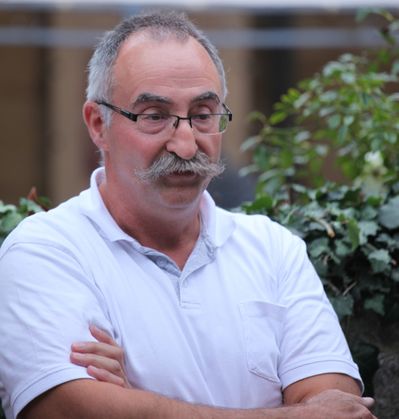
There are just 28 hectares of vines for Noble Joué, mainly in the commune of Esvres. It is always a rosé and made from a blend of three Pinots – Gris, Meunier and Noir.

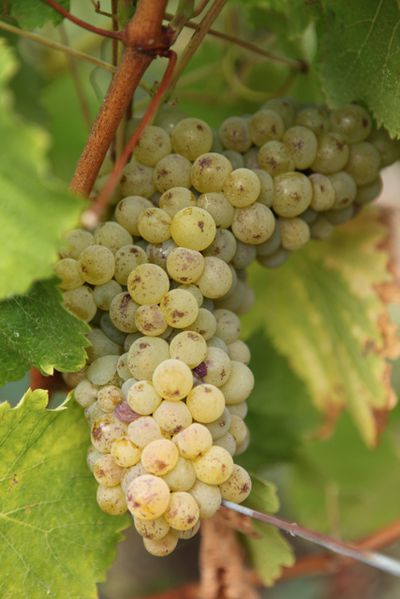
Pinot Gris
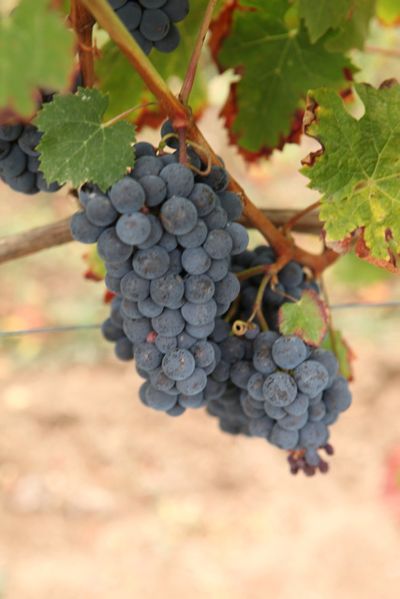
 Pinot Noir (?)
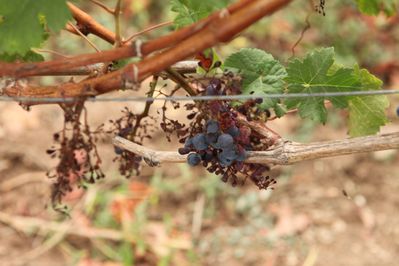
Pinot Meunier (?)

 Map of the appellation
 Detail of the Noble Joué vineyards
The growers
Street sign