Awards and citations:


1997: Le Prix du Champagne Lanson Noble Cuvée Award for investigations into Champagne for the Millennium investment scams

2001: Le Prix Champagne Lanson Ivory Award for investdrinks.org

2011: Vindic d'Or MMXI – 'Meilleur blog anti-1855'

2011: Robert M. Parker, Jnr: ‘This blogger...’:

2012: Born Digital Wine Awards: No Pay No Jay – best investigative wine story

2012: International Wine Challenge – Personality of the Year Award


Showing posts with label Sancerre. Show all posts

Thursday, 14 May 2020

Vincent Pinard: 2013 Charlouise, Sancerre Rouge


2013 is probably the most difficult recent Loire vintage – a very cold spring with flowering delayed until towards mid to late June. A hot July and August averted disaster but picking even in the Pays Nantais didn't start until late September. 

It is difficult vintages that show who are the really good producers. Almost any fool can make a decent wine in 2018, especially regarding reds. In contrast to make a very fine red in 2013 is impressive. The 2013 Charlouise Sancerre Red from Vincent Pinard is a wonderful example of a domaine being on top of its game in a testing vintage. Not forgetting, of course, that in difficult vintages coaxing good quality out of Pinot Noir is much more of a challenge than it is for Sauvignon Blanc. 

The Pinot Noir vines from Charlouise are planted on clay limestone and are on average 50 years old with yields around 30 hl/ha. The grapes are picked by hand and the wine is aged in a mix of barrels and wooden conical vats. Time in wood varies between 11 and 18 months depending on the vintage. My guess is that the 2013 spent closer to 11 months in wood than 18. The 2013 Charlouise has that seductive, silky texture that makes Pinot Noir such as sought after magical wine at its best.

Very impressive given the vintage.    

Sunday, 2 February 2020

Mathieu Fleuriet and Paul Aublet-Cuvelier's joint project in the Côtes d'Auvergne


Mathieu Fleuriet and Paul Aublet-Cuvelier

Mathieu Fleuriet of Domaine Bernard Fleuriet, a very good Sancerre producer based in Menetou-Ratel, has a joint project with Paul Aublet-Cuvelier, another Sancerre vigneron, in the Côtes d'Auvergne. They intend to plant 13 hectares of vines on abandoned terraces in the southern part of Auvergne in the Allier Valley at Belmont, a lieu-dit, in the commune of Saint-Privat-du-Dragon, which is about 10-12 kilometres to the south of Brioude which entertained Le Tour de France in 2019. 

Paul is the instigator of this project as his grandparents had bought a house in nearby Chilhac many years ago. He still loves the area and is convinced of its potential – always dreaming of finding an abandoned site and replanting vines there.    

In November 2019 Mathieu and Paul cleared scrub and bushes etc. from the terraces, which are at 700 metres and face either due south or south east, that have been abandoned for more than 50 years. In March they will plant the first parcel of vines – four hectares in total using five different grape varieties: Syrah (1.6 ha) along with 0.6 ha each of Pinot Noir, Gamay, Chenin Blanc and Roussanne.  

This is an exciting project in an area where there was a considerable area of vines in the 19th century before the arrival of phylloxera and two World Wars. I look forward to following its progress. 

Report in the local paper on their project
 

Commune of Boudes in the Côte d'Auvergne 
with the steep fields some of them abandoned 
(Boudes is some way north of Belmont 
these are for illustrative purposes)


Commune of Saint-Privat-le-Dragon
Enclave within red line on map

Belmont - lieu-dit in south-western part of
 the commune of Saint-Privat-le-Dragon close to the Allier


Thursday, 17 October 2019

2019 Loire: Sancerre, Pouilly-Fumé and Vouvray

Sancerre - evening
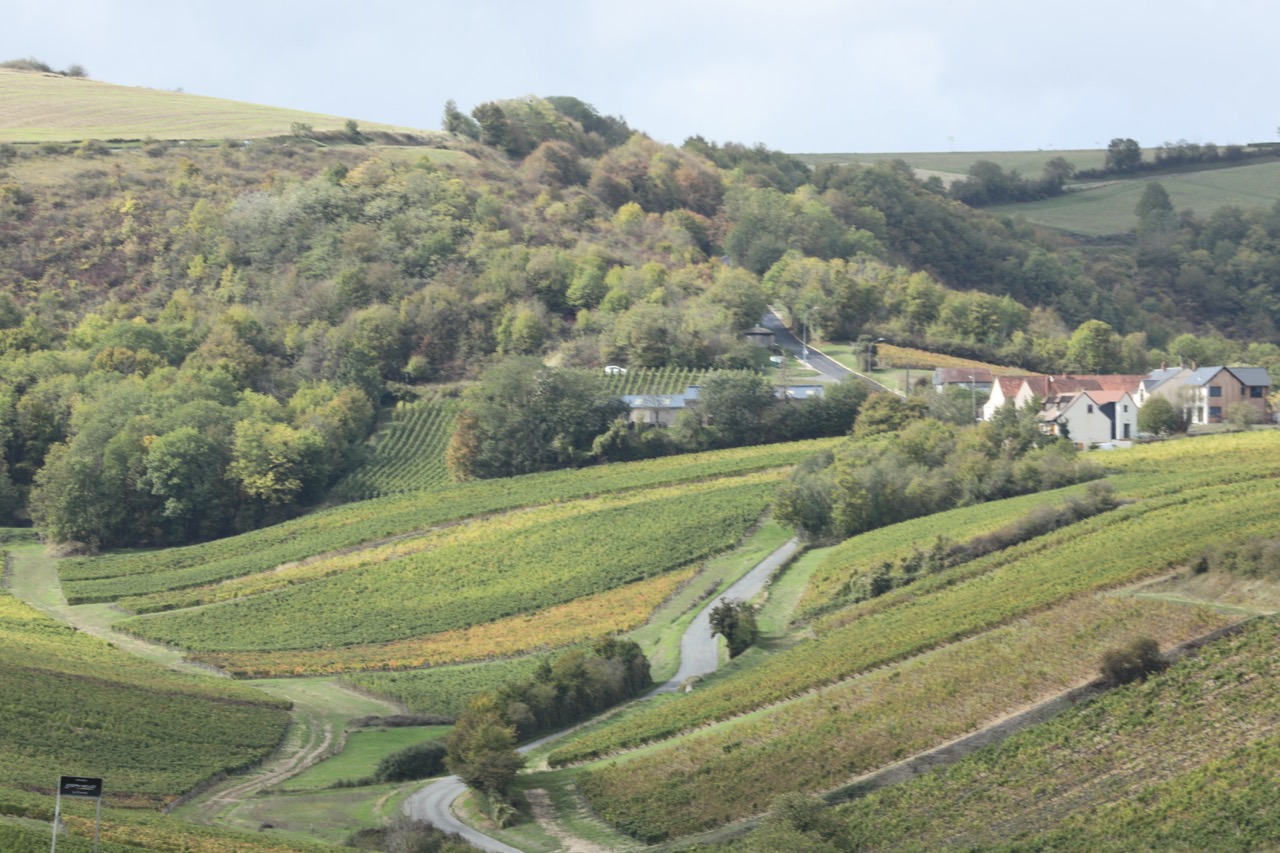
Sancerre in the evening light – taken from above Chavignol

Quick summary of reports: good to excellent vintage in Sancerre, Pouilly-Fumé and Vouvray
In the middle of last week we spent a day and half making a number of quick visits in Sancerre and Pouilly-sur-Loire to see how the 2019 vintage had gone. Unfortunately it hadn't been possible for us to get there during the harvest. Although we did spot one small team still picking, everyone else had finished.


Sancerre

François Crochet, Bué
"We have to keep our feet on the ground. Yes we do have some very good vignerons and exceptional terroir but we have had a lot of luck to have another exceptional vintage!"


This is certainly true as Sancerre has largely avoided the various frosts that have hit other parts of the Loire hard over the past few years, including neighbouring Pouilly-Fumé that has suffered.

"We started on 18th September and finished on 28th. Pinot Noir ranges from 13%-14.8% and the Sauvignon from 12.8% and 14.2% with the ph around 3.25."

Tasting a number of fermenting vats with François it was easy to see why he is pleased with 2019 as was in the case with those that I tasted with Matthieu Delaporte, Clément Pinard.

Tasting the nu- Matthieu D
Tasting the fermenting 2019 Sancerre Blanc in Matthieu Delaporte's
grandfather's cellar in Chavignol

Matthieu Delaporte, Domaine Vincent Delaporte, Chavignol
"We started on the 16th September and finished on Tuesday 1st October. I am particularly happy with the grapes that we picked in the first week before there was any rain. The grapes were very well balanced. After we had some rain from around 22nd September the acidity levels dropped a little. We picked for the Rosé on 21st and then the reds on 23rd and 24th. Potential alcohol for the whiles is around 13.5%, while for the reds it is between 13.3% and 13.5%. Compared to last year quantity is down by between 10%-15%"


Jean-Laurent Vacheron, Domaine Vacheron, Sancerre
"Despite two years of drought we have a normal vintage in white, although the quantity of red is down. We had no rain from early June to September. We started on 12th September and finished on 4th October. We started the Pinot Noir on 24th September. The harvest took a little longer than we anticipated as we lacked pickers. 140 pickers signed up to harvest for us but on 80 turned up – 43% less than expected. The peaks of sunshine did burn some of the grapes and there was some oidium near the Loire."


Benoît Fouassier, Domaine Fouassier, Sancerre
Like the other vignerons Benoît is very happy with his 2019.


"Vineyards where the soil is harrowed suffered less from the drought than those where the soil isn't turned over. We started on 16th September and finished on 30th. The Pinot Noir grapes were perfect (Benoît showed me a video on his phone of perfect bunches moving along the sorting table.) Our Sauvignon Blanc ranges from 13%-14% potential with acidity between 4 and 4.5 and a yield of between 50-55 hl/ha. 2019 is fresher than 2018 as it was less hot for most of the vendange. The reds have a little less concentration than last year but more fruit flavours."

Clément and Vincent Pinard, Domaine Vincent Pinard, Bué
Vincent: "Despite the incidence of coulure caused by wet and cold weather during the flowering we are reasonably content. We started on 16th September and finished last week on 2nd October."


Clément: "2019 has a great potential. The drought and the heat spikes concentrated both the sugars and acidity in the grapes. Our Sauvignon Blanc came in between 12.5% - 13.7% potential with the acidity varying between 4.20 and 5.10 and Pinot Noir between 13.5% and 13.7% with 4.3 acidity. Overall quantity is down on last year".

Pouilly-Fumé

Loic Cailbourdin, Domaine Alain Cailbourdin, Maltaverne
"Quality is good and are average yield is 42 hl/ha due to the drought and grapes being frazzled by the sun. Our Sauvignon came in around 13% or more with acidity between 4.4 and 4.5 and a ph of 3.26-3.30, which is a good balance. The acidities are similar to last year. The Ban des Vendanges was on 16th September but we started on the 20th September and finished on Thursday 3rd October."


Sébastien Redde, Domaine Michel Redde, Saint-Andelain
"It's a good harvest with a yield of around 45 hl/ha. The berries were small and we had a frost at the end of April. Regarding other vintages 2019 reminds me of 1997 and 2015. Our Sauvignon was at 14% potential, acidity at 4.5 and ph between 3.25 and 3.30".


Cul de Beujeu
Looking towards the steep slopes of the Cul de Beaujeu, Chavignol

Amigny
Towards the little village of Amigny
– part of the Commune of Sancerre

Chavignol
Looking down on the little village of Chavignol
home of many leading Sancerre producers

•••

Vouvray
On Friday afternoon (11th October) I rode over to Vouvray crossing the Loire at Amboise and returning by the Charles de Gaulle Bridge between Vouvray and Montlouis – an excursion of 90 kms on an e-bike. There were a good number of other cyclists about trying out the end of route of the Paris-Tours race, which was run on Sunday.


Julien Pinon, Domaine François Pinon, Vernou-sur-Brenne
I arrived the day after they had finished picking, so they were in the middle of their Berlot – the traditional party for the pickers to celebrate the end of the harvest. I managed to prise Julien away from the festivities for a few minutes to chat about the 2019 harvest.


"We started on 16th September picking our base wines for our sparkling and finished yesterday (10th October). We have a very high quality in 2019. Potential alcohols vary between 11.5% for our pétillants and 13.7% for the demi-sec. We have made any moelleux this year as the degrees didn't go high enough, the rains have started and we made a lot last year. Unfortunately it is very difficult to sell sweet wine at the moment. We had five nights of frost from 4th April to 6th May leading to 30% loss. Then the drought and between 10%-20% loss due to grapes being burnt by the sun not forgetting coulure and millerandage. Thankfully with the early frost on 4th April the second generation grapes came through and ripened. Also to our surprise there was a lot of juice in the berries".

Bernard Fouquet, Domaine des Aubuisières, Vouvray 
"We started on 23rd September and finished on 8th October. Compared to last year the sugar levels are the same but there is more acidity but as there is a lot of tartaric a lot may drop out during maturation. Potential for our grapes was between 13%-14% with the majority around 13.5% with phs from 3.15 to 3.20. Still wines we have made sec and demi-sec but no moelleux this year as we made a lot last year. Overall our yields are correct – 44 hl/ha with the still wines at 35 hl/ha. We lost 10% to frost as well as some to the drought and the heat spikes. Where we have rows running north- south we had losses due to the strength of the afternoon sun. I have a friend who told me that with the ozone level shrinking the sun's rays are now more aggressive."


Bernard was not to be drawn whether he preferred 2019 to 2018. "It's too early to say...."


Tuesday, 25 September 2018

2018 Loire – is this the birth of a legendary vintage?


 Pinot Noir awaiting sorting 
@Domaine Henri Bourgeois

On Friday Alphone Mellot snr was categorical: "This is a mythical vintage – 1947 but with quantity!" Alphonse Père was born in 1947 – obviously he will remember little of that year but says that he has never seen a vintage of this quality.

We will see but certainly overall the fruit from the vineyards we have so far visited –  Pays Nantais, Chinon, Montlouis, AC Touraine, Sancerre, Saint-Pourçain, Côte Roannaise and Côtes de Forez – has been very clean and healthy with almost no rot. For those producers equipped with sorting tables there has been little for the sorters to do apart from removing the odd leaf or grapes that have been shriveled by the sun. 

Gamay @Vincent Roussely

Alphonse Snr is not alone in never having seeing fruit like this. Vincent Roussely of Clos Roussely in Angé (AC Touraine): "This is my 19th vintage and I have never seen grapes like these." His Sauvignon Blanc is averaging 13.5% alcohol but still with good acidity plus a yield of 50 hl/ha when 30 hl/ha is his normal yield – Vincent farms organically.

In Bué (AC Sancerre) I tasted several juices – some that were just starting to ferment – with Florent Pinard. They were very clean, rich but with a freshness in the finish – surprising as for a number of days during the harvest temperatures were 30˚C and more. Fortunately many in Sancerre are equipped with liquid CO2 to cool down the grapes rapidly when they arrive at the winery. Also a number of producers, like François and Carine Crochet and Vincent and Adelaide Grall who pick by hand, started early in morning and finished at lunchtime. 

I also tasted a number of 2018 juices with Pascal Jolivet during a brief but very interesting visit. As at the Pinards the 2018 juices look very promising. It was good of Pascal to give up some of his valuable time, especially as his Italian winemaker had fallen that morning, hit her head and was in hospital. I wish her a swift recovery.  

After two difficult years due to frost producers in Pouilly-Fumé are happy both with the quality and quantity. "We had just 18 hl/ha in 2016," Loic Cailbourdin told me. 'The following year it was 28 hl/ha. This year we are averaging 60 hl/ha, although it is less in some parcels." 

Sauvignon Blanc@ Domaine Vacheron 
awaiting pressing        

There are as always exceptions and caveats:

Mildew has been a severe problem for certain producers, especially those practising organic viticulture and in certain appellations such as Montlouis. In Thursday post I mentioned that Jacky Blot had been very badly hit in some parcels but not in the 'grand terroirs'. When I saw Xavier Weisskopf on Wednesday he said his yield this year is 22 hl/ha. Xavier has had a real roller coaster over the last three years. Last year his yield was 55 hl/ha while in 2016 it was just 1 hl/ha due to the series of April frosts. He had to buy in grapes from Vouvray to make up the deficit. 

High degrees of alcohol may also prove to be a problem if only to make 2018 not a 'typical' Loire vintage – just as 1989 and 2003 produced wines that have characteristics of vineyards much further south in France. 14% alcohol levels are 'normal' this year, they head up into 15% and even in some rare cases 16% and above. 16.6% is the highest reported. Of course it will usually be possible to blend these powerful lots with those with lower alcohol. There is also the question whether juice at 15.5˚- 16˚+ will actually ferment dry. 

Philippe Gilbert (Menetou-Salon), who found the heat of the vintage particularly tiring, said: "My concern is that the 2018 wines will not be typical of the Loire rather they will have the characteristics of wines from much further south." I suggested to Philippe that this was also the case in 1989 and 2003, for instance. Philippe was relieved that his pH readings were in the right range. 

Of the producers I have seen all have been satisfied – in some cases relieved – that the pH in their juice are correct – most around 3.15-3.30. There are some unconfirmed rumours that the pH levels for some other producers are considerably higher but I didn't come across any producer worried about high pH levels. 

One of the positive weather factors this year was the wet and humid end of May and early June. This meant that there was a reserve of water available for the very dry months that followed. However, young vines on well drained soils have suffered as their root systems are not as well developed as older vines. 

Later today we are headed to Bourgueil, Chinon and Saint Nicolas-de-Bourgueil. Here I think picking started during last week, so it will be interesting to catch up on what has been happening.  

Sorting @Domaine Vincent Delaporte  
before going through their new
automatic tilted

plate press


Thursday, 20 September 2018

Loire 2018 – round up of harvest news


Since we arrived in the Loire we have seen producers from Muscadet Sèvre et Maine to the Côtes de Forez – just about from one Loire vinous extremity to the other.

In Touraine Vincent Ricard started picking on Monday 3rd September. He is happy as he has avoided any serious attack of mildew but at the cost of treating his vines 14 or 15 times. His Sauvignon is coming in at between 12.5˚ potential with the acidity averaging 5.2. Yields at 50-55 hl/ha. He expects to finish harvesting the middle of next week.

Vincent Roussely (Angé) started picking on Monday 10th September. Due to the heat they are only picking in the morning. I saw some Sauvignon Rosé that they had picked – the grapes very healthy and clean.

Luc Poullain, Domaine des Echardières – also in Angé – like Vincent Roussely also started on Monday but picking Chardonnay. He warned that vines on clay were coping well with the drought – just 10mm of rain in two months – but other on easy draining soils were suffering with maturation blocked especially if they were young vines.

In Montlouis Jacky Blot started on Thursday (6th) – earlier than he had originally thought but with the grapes ripening rapidly he didn't want the alcohol levels to shoot up and the acidity to fall away, especially as he picks by hand – three teams of pickers in action.

In certain parcels he has been badly hit by mildew with very small yields. However, the incidence is very irregular with his best parcels like the Clos Mosny and Clos Michet resisting well.

Jacky and a team started picking his top Vouvray (Vin de France) from the Clos de Venise on Thursday 13th September.


On our way to the Côte Roannaise last Thursday (13th) we dropped in quickly to see the Pinards  – Vincent, Florent and Clément – in Bué and then Domaine Fouassier in Sancerre itself. The Pinards started picking their Pinot Noir on Thursday 6th and have subsequently picked some of their Sauvignon Blanc. They are very happy with the results to date with the Pinot coming in at 12.4˚ to 13.5˚ potential with acidity averaging around 5. Florent and Clément thought that the 2018 reds will be easy to drink and easily digestible.

Sauvignon Blanc
2018 Sauvignon Blanc (Sancerre)

Pinot Noira
2018 Pinot Noir (Sancerre)


Benoît Fouassier was also very happy with their 2018s. They started on 5th and have been picking both Pinot Noir and Sauvignon Blanc. The Pinot, which they have nearly finished, coming in at up to 14˚, while the Sauvignon Blanc is between 12.5˚ and 13.5˚ and an acidity on 4-4.5.

From Sancerre we headed south to the small town of Renaison in the heart of the Côte Roannaise where we stayed at the Hotel Central, which is in town square. The hotel is very reasonably priced and is run by the very welcoming Arlette, who appears to have boundless energy as she is on the go from the early morning until late at night.

The Côte Roannaise we saw Carine, Stéphane and Robert Sérol (Domaine Robert Sérol). Their chai and some of their vineyards are up above Renaison and is one of the appellations top domaines. They started picking at the end of the previous week –  Gamay for their pétillant rosé naturel – Turbullent. Picking Gamay for their reds had started this morning.

Gamay-a
2018 Gamay, Domaine des Pothiers, Côte Roannaise

Gamays
Early on the Friday we also saw Romain Paire (Domaine des Pothiers) – another top Roannaise estate. Romain had started that morning – kicking off with his Pinot Gris (13˚ potential) before moving onto his Gamay. The juice tasted very clean and promising. Indeed everywhere the fruit in the Roannaise and the Forez looked very clean and healthy with apparently much less mildew than you can find in parts of Touraine. We also saw Simon Hawkins, an English guy who with his French wife bought the Domaine de Fontenay in 1991 and started making wine leaving the textile business behind.
We had left the car in Renaison and instead explored the Roannaise on our e-bikes. Along with the Côtes de Forez and Sancerre I think that the Côte Roannaise is one of the three most picturesque Loire appellations. The vines are planted on the lower slopes of the granite hills that quickly rise to 1000 metres or more – so an electric bike is certainly a good investment, especially if you are of pensionable age. There are plenty of quiet roads both through the charming little villages and up higher in the hills.
Sorting
Gilles and his team sorting Gamay @Domaine de la Madone
– little sorting needed this year

Friday we headed the just over 50 kilometres south to Champdieu and Gilles Bonnefoy Domaine de la Madone. Gilles was generally  happy with the way the harvest was progressing, although he had some parcels of vines that were suffering from the drought. We tasted some Gamay that he had picked the day before which had already taken on good colour even after one day but without much tannin in the skins. Gilles was happy with the potential degrees – between 11.5˚ and 12.5˚ – as his clientele appreciates wines with relatively low alcohol levels.

Max
Max @Verdier Logel, Côtes de Forez

Leaving Domaine de la Madone we stopped off briefly at the Cave Verdier-Logel and saw Odile, Max and Jacky. They were preparing to start picking yesterday  (17th September). Max was hoping that there would be no rain despite the drought because any rain was now too late to be beneficial. Instead rain was all too likely to provoke rot.

Jean with his Portuguese worker
Jean Teissèdre (left) with his Portuguese worker 

On our way back to Touraine we made a first visit to Domaine des Bérioles in Saint-Pourçain in the hamlet of Cesset, to the west of the town of Saint-Pourçain, Bérioles has been rightly building a reputation since Jean Teissèdre took over the domaine in 2011, when it had 7 hectares. He was later joined by his sister Sophie and her husband – Jérôme Roux. The domaine has now more than doubled in size with 15 hectares in production and two more planted.

On the Friday when we visited they were picking Chardonnay, which was very clean and healthy. The nearby Pinot Noir looked equally healthy with no sign of rot. During the visit it was very interesting to see a parcel of ripening Tressalier, the local grape which will be picked last.

Tressalier
Tressalier grape also known as Sacy outside Saint-Pourçain
– note pinkish tinge @Domaine des Bérioles

Due to the artificial constraints imposed by the appellation rules – 100% Tressalier and 100% Pinot Noir are banned - a very significant part of their production is sold as IGP. "This makes no difference to our sales" says Jean "as we now have established a reputation but it is a pity for the appellation."

Monday, 27 August 2018

Pascal Jolivet – Sancerre and more (Part 1)


Pascal Jolivet neck label

A couple of weeks ago I received a box of samples of his current releases kindly sent by Pascal Jolivet. I have been enjoying tasting them and this post covers the first seven. 

 2017 Attitude, IGT 
(Above and below)


2017 Attitude, IGT Val de Loire  Attitude comes from 60 hectares of vineyards managed by Pascal Jolivet with at least 30 hectares in region of Châteaux de Cheverny and Cheverny. Attitude comes in all three colours – white (Sauvignon Blanc), red (Pinot Noir) and rosé – Pinot Noir, Gamay and Cabernet (a third of each). For this Sauvignon Blanc the grapes come from two areas of Chemery (limestone) and  little further west Angé sur Cher (flint). 

The 2017 Attitude has some grassy notes as well as plenty of grapefruit flavours, attractive soft texture and some length. There is an impressive quality of cork for this cuvée.


2017 Sancerre
This is from Jolivet's Signature range and is a blend of Sancerre three different types of soil blending 50% limestone (caillottes), 30% clay limestone and 20% flint. It has weight and concentration, is quite flattering but without the complexity and finesse of the Clos du Roy. 


2017 Clos du Roy, Sancerre Blanc
The 18-hectare Clos du Roy is in the commune of Crézancy of which Jolivet has 0.8 hectares of this clay-limestone vineyard. This Clos du Roy spends four months on its fine lees. It has a citric lightly grassy nose, finesse and elegance, delicate and well balanced Sancerre.


2016 Sauvage, Sancerre Blanc 
Sauvage comes from two hectares of organic old vines between the villages of Champtin, a hamlet to the west of the village of Bué. It stays for 12 months on its lees before bottling. The 2016 Sauvage has the potential to improve further. Sauvage is very precise and clean with a mineral character. Grapefruit, citric, good length with a significant length and quality of cork. 


2016 Indigène, Pouilly-Fumé
The grapes for this cuvée comes from old vines planted on flint in the small village of Tracy sur Loire, which is just beside the Loire. Vinified in stainless steel Indigène spends 12 months on its fine lees. The 2016 Indigène is delicate, with citric flavours, especially grapefruit. Perhaps needs more time to take on more weight? 


2016 La Bondenotte, Sancerre Rouge 
The Pinot Noir for La Bondenotte from 0.86 hectares of vines owned by Pascal Jolivet in the three hectare La Bondenotte (clay-limestone) in the Bué commune. It is matured for eight months in demi-muids (600-litre barrels). La Bondenotte is a lighter style of Sancerre Rouge with raspberry fruit very much to the fore. 


 2012 Sauvage, Sancerre Rouge


2012 Sauvage, Sancerre Rouge 
The Pinot Noir for Sauvage comes from a one hectare vineyard in the centre of the commune of Bué, whose old vines were planted in 1952. It is vinified in demi-muids (600-litre barrels) where it is aged for 15 months. This is an impressive and serious red Sancerre – silky, seductive with good concentration and has the potential to age and improve further.    


Thursday, 21 June 2018

Dates for your diary: Lisbon, Sancerre, Bourgueil


For first the first time Adegga are holding a two-day wine & food festival in Lisbon on Saturday 30th June and Sunday 1st July. The Festival will be held at the recently renovated Terraços do Pavilhão Carlos Lopes in the Parque Eduardo VII. 10 chefs, 60 producers showing 500 wines. 

More event details. 

Ticket details here (Portuguese) and here (English). Prices start from 15€. 

•••

Sancerre:


•••


Bourgueil: Portes Ouvertes – Lamé Delisle Boucard – 23rd and 24th June